
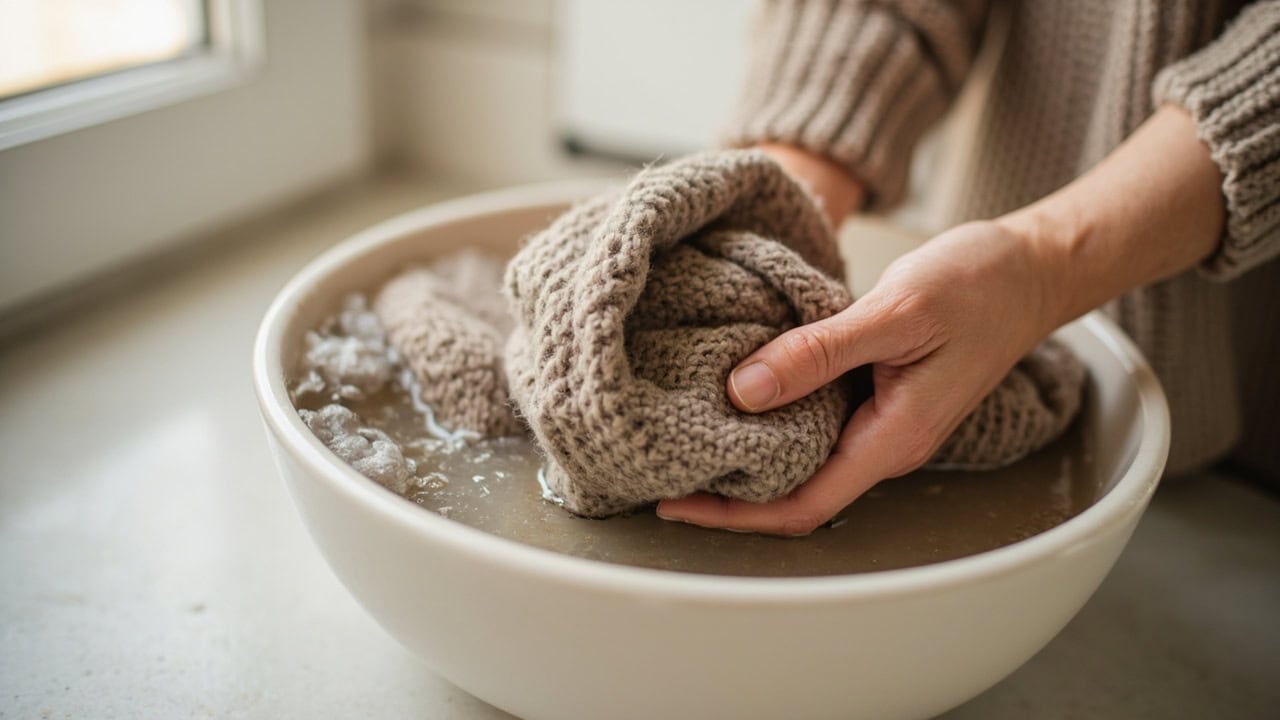
How to Wash Wool Clothes Without Shrinking

Wool clothes must be washed in cool water at 30°C (86°F) using a wool-specific detergent and a gentle agitation method — either hand washing or a machine’s wool cycle — to prevent the fiber scales from felting and causing shrinkage. Always reshape the garment while damp and dry flat to maintain its original dimensions.
What You Need Before You Start
Gathering the right supplies before you begin prevents mid-wash mistakes that ruin wool garments. Wool is a protein fiber — structurally different from cotton or polyester — and requires products formulated specifically for its delicate cuticle structure. Standard laundry products contain harsh surfactants and enzymes that degrade wool proteins on contact.
- Wool-specific detergent — a pH-neutral formula designed for protein fibers (look for labels marked “wool safe” or “delicate fabric”)
- Clean basin or sink filled with cool water at 30°C (86°F) — use a kitchen thermometer to verify temperature
- Clean white towels for blotting excess moisture during the drying stage
- Flat drying surface — a mesh drying rack allows air circulation from both sides, cutting drying time significantly
- Optional: wool wash bag for machine washing — adds a barrier between the garment and the drum
- Do NOT use: Regular laundry detergent, bleach, fabric softener, or hot water under any circumstances
Wool-specific detergents use mild, pH-neutral surfactants that lift dirt without stripping the natural lanolin that protects wool fibers. Products like Woolite or Ecover Delicate are formulated at pH 7, compared to standard detergents that run pH 9–10 and contain proteolytic enzymes — the same enzymes designed to break down protein stains, which also break down the protein structure of wool itself.
Understanding Why Wool Shrinks
Wool fibers are covered in overlapping cuticle scales — microscopic barbs that point outward from the fiber shaft like roof shingles. Under normal conditions, these scales lie flat. But when exposed to a combination of heat, moisture, and mechanical agitation, the scales lift and interlock with scales on neighboring fibers. This interlocking is called felting, and once it occurs, the bond is permanent.
Felting shrinkage is the most severe type and occurs rapidly when wool is exposed to hot water above 40°C (104°F) combined with vigorous agitation. The heat opens the cuticle scales, moisture acts as a lubricant, and mechanical motion ratchets the scales together irreversibly. A wool sweater can shrink by 20–30% in a single hot-water wash cycle.
Relaxation shrinkage is a milder, progressive form that occurs over multiple washes when wool is handled roughly even at moderate temperatures. The fibers gradually compact as minor scale interlocking accumulates. This type of shrinkage is harder to notice immediately but compounds with each wash.
Superwash wool treatments address felting by either removing the cuticle scales entirely through an acid bath process or coating the fibers with a polymer resin that smooths the surface. Superwash-treated wool can tolerate machine washing more readily, but it still requires cool water and gentle handling — the treatment reduces felting risk but does not eliminate it entirely. Temperature shock while damp or wet accentuates shrinkage even in treated wools.
For a broader understanding of fabric-specific washing techniques and how different fiber types respond to cleaning methods, visit the Laundry & Fabric Care Hub.
How to Hand Wash Wool Clothes (Step-by-Step)
Hand washing is the safest method for wool garments because you control every variable — water temperature, agitation intensity, and rinse quality. Follow these six steps precisely to clean wool without any risk of shrinkage. Before starting, check the Stain Removal Hub for pre-treatment guidance if the garment has visible stains, particularly sweat stains which are common on wool collars and underarms — see our guide on how to remove sweat stains from wool.
- Fill basin with cool water at 30°C (86°F) and add wool-specific detergent at the dilution ratio specified on the bottle — typically 5–10 mL per 4 liters of water. Swirl gently to distribute the detergent without creating excessive suds.
- Submerge the garment fully and gently agitate by squeezing the fabric through the soapy water for 30–60 seconds. Never wring, twist, or scrub the wool — squeezing mimics the gentle compression the fibers naturally tolerate.
- Soak for 15 minutes, allowing the surfactant to lift dirt, body oils, and odors from the protein fibers. Longer soaking beyond 30 minutes is unnecessary and may weaken fiber bonds.
- Rinse twice in clean, cool water at the same 30°C temperature to avoid thermal shock. Gently squeeze the garment to push out soapy water — do not twist. Temperature consistency between wash and rinse water is critical; a sudden temperature drop causes the cuticle scales to contract rapidly, triggering felting.
- Reshape immediately while the garment is still damp. Lay it flat between two clean white towels and press gently to absorb excess moisture. While the wool is pliable, stretch it gently back to its original dimensions, paying special attention to sleeves, hemlines, and collar areas.
- Dry flat on a mesh drying rack, smoothing out wrinkles and aligning seams. Turn the garment once during drying to ensure even air circulation. Thick wool sweaters may require 24–48 hours to dry completely.
Machine Washing Wool: The Proper Settings
Machine washing wool is possible with modern washing machines that include a dedicated wool or delicate cycle — but the settings must be exact. A standard “cold wash” cycle is not the same as a wool cycle. The difference lies in drum rotation speed: wool cycles use slower, gentler drum movements that reduce the mechanical stress on fiber scales.
- Select the Wool/Delicate cycle — not just a cold wash. The programmed drum rotation on wool cycles alternates between slow rotations and pauses, mimicking hand agitation.
- Set water temperature to 30°C maximum. Verify your machine’s accuracy by running a cycle with a waterproof thermometer inside. Some machines labeled “cold” actually draw water at 35–40°C from hot pipes during summer months. Use a slow spin speed of 400 RPM or less. Higher spin speeds create centrifugal force that presses wet wool against the drum wall, compressing the scales and causing localized felting.
- Add wool-specific detergent at the manufacturer’s recommended dilution — never exceed the suggested amount, as excess detergent is harder to rinse from dense wool fibers.
- Consider a mesh wash bag for additional protection. The bag limits the garment’s movement inside the drum, reducing mechanical agitation directly on the fabric.
- Remove the garment promptly at the end of the cycle. Wool left sitting in a damp drum develops creases that set into permanent wrinkles as the fabric dries.
Always check the garment care label before machine washing. Labels marked “dry clean only” should be taken to a professional cleaner — attempts to machine wash these garments often result in irreversible damage. For more on reading care labels and fabric-specific cleaning approaches, see the Laundry & Fabric Care Hub.
Drying and Finishing Wool Garments
The drying stage is where most wool shrinkage actually occurs — not during the wash itself. Wet wool fibers are in their most vulnerable state: the cuticle scales are open, the fiber structure is pliable, and any mechanical stress or heat at this stage can trigger permanent felting.
Never hang wet wool on a clothesline or hanger. A soaked wool sweater can weigh several times its dry weight, and gravity pulls that water weight straight down through the fibers. The result is a garment that stretches lengthwise while compressing widthwise — a distortion that cannot be reversed. Always dry wool flat on a clean mesh surface, reshaping seams, cuffs, and edges while the garment is still damp.
Allow 24–48 hours for thick sweaters and coats to dry completely. Thinner wool items like scarves or lightweight cardigans may dry in 12–18 hours. Turning the garment once mid-way through drying ensures even moisture evaporation from both sides and prevents musty odors from developing on the surface pressed against the rack.
If pressing is needed, use a steam iron set to the wool setting (approximately 150°C / 300°F). Hold the iron slightly above the fabric and use steam only — never press the iron directly onto wool. Direct contact heat seals the cuticle scales in their current position, which locks in any minor distortions. For stubborn wrinkles, place a clean cotton pressing cloth between the iron and the wool.
Store wool folded in drawers or on shelves rather than on hangers. Hanging causes shoulder bumps at the contact points and stretches the garment over time. For comprehensive wool storage guidance including moth prevention and seasonal storage methods, see our article on how to store wool clothes long-term.
Common Mistakes That Cause Wool to Shrink
Understanding what goes wrong — and exactly why — is the most effective way to prevent wool shrinkage. Each of these common errors triggers the same underlying mechanism: opening the cuticle scales and forcing them to interlock. The table below maps each mistake to its specific cause and the correct alternative.
| Mistake | Why It Causes Shrinkage | Correct Approach |
|---|---|---|
| Hot water wash | Heat opens fiber scales, allowing them to interlock permanently | Always use water at 30°C (86°F) or cooler |
| Standard laundry detergent | Harsh surfactants and proteolytic enzymes degrade wool protein fibers | Use wool-specific, pH-neutral detergent formulas only |
| Aggressive wringing or twisting | Mechanical stress forces scale interlocking under pressure | Gently squeeze water out — never wring, twist, or scrub |
| Hanging to dry | Water weight stretches fibers permanently out of shape | Always dry flat on a mesh rack, reshaping while damp |
| Direct iron contact | Heat seals cuticle scales in a deformed position | Use steam function at wool setting, never direct contact |
Each of these mistakes activates one or more of the three triggers for wool felting: heat, moisture, and mechanical agitation. The safest approach eliminates all three by washing in cool water, minimizing movement, and drying flat. For a full glossary of cleaning and fabric care terms referenced in this article — including pH-neutral, surfactant, protein fiber, felting, cuticle scales, dwell time, and extraction cleaning — visit the Cleaning Glossary.
Frequently Asked Questions
Q: Can you wash wool clothes in the washing machine?
A: Yes, wool can be machine washed on the wool/delicate cycle at 30°C with a wool-specific detergent and slow spin speed — but always check the garment care label first, as some wool blends may require dry cleaning.
Q: What temperature causes wool to shrink?
A: Wool begins to felt and shrink at temperatures above 40°C (104°F) — the combination of heat and agitation causes the cuticle scales to interlock permanently. Always wash at 30°C (86°F) or cooler for safe wool care.
Q: Can you use regular laundry detergent on wool?
A: No — regular laundry detergents contain harsh surfactants and proteolytic enzymes that break down wool protein fibers, causing fiber degradation and shrinkage. Only use detergents specifically formulated for wool or other protein fibers.
Q: How do you unshrink wool clothes?
A: Partially shrunk wool can sometimes be restored by soaking in lukewarm water with a hair conditioner for 30 minutes, then gently stretching the garment back to shape while damp — but severe shrinkage (full-felted wool) cannot be reversed.
References
- Wikipedia Contributors. (2024). Wool. Wikipedia, The Free Encyclopedia.
- Whirlpool Corporation. (2024). How to Wash Wool Clothes. Whirlpool Blog.
- International Wool Textile Organisation. (2023). Facts About Wool. IWTO.
- American Cleaning Institute. (2023). Laundry Tips for Delicate Fabrics. ACI.


