
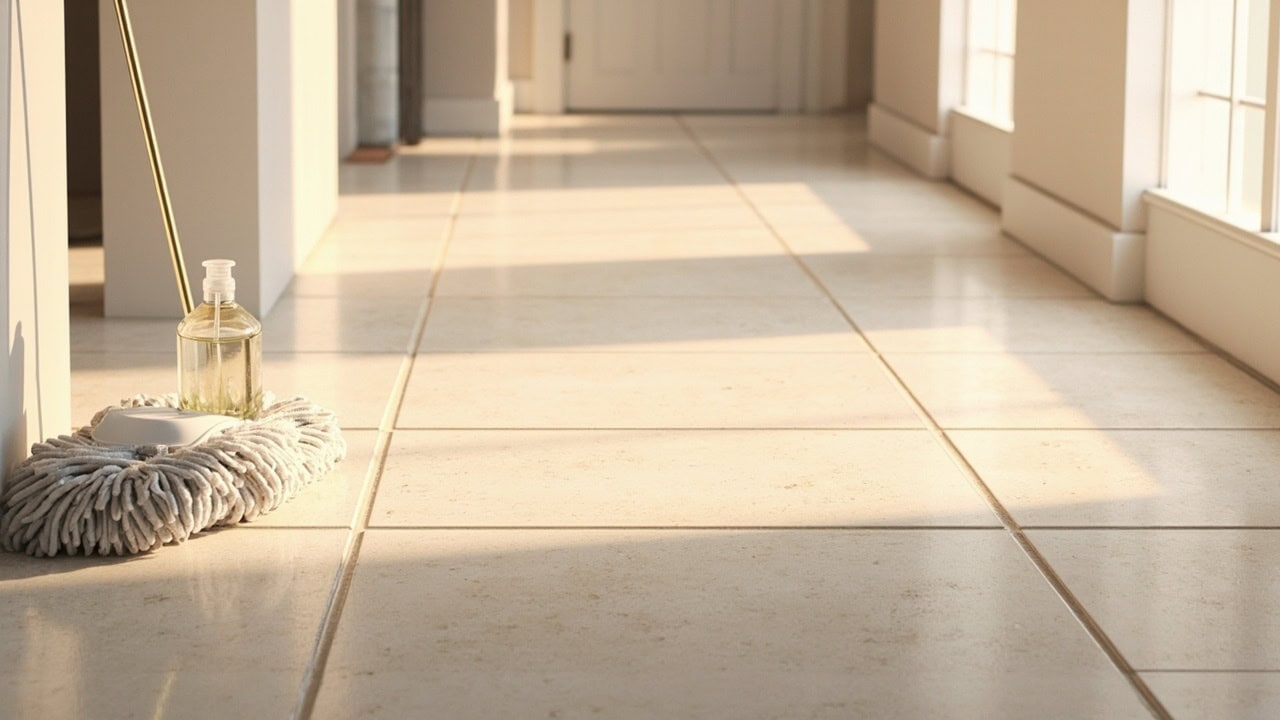
How to Clean Limestone Floors: Delicate Stone Care

- Vinegar and citrus cleaners — acetic acid and citric acid at any concentration below pH 4 etch calcium carbonate irreversibly. The acid reacts with CaCO₃ to form calcium acetate or citrate, carbon dioxide, and water, creating a dull frosted appearance on polished limestone that cannot be repaired without professional repolishing. This reaction occurs within seconds of contact at full strength.
- Ammonia and bleach — alkaline cleaners with pH above 9 degrade stone sealers by saponification, stripping the protective polymer layer. Prolonged exposure to high alkalinity also causes calcium carbonate dissolution in a reverse of the acid reaction, weakening the stone matrix at the surface and making it more susceptible to scratching.
- Steam mops — sustained heat above 150°F (65°C) breaks down sealer adhesion at the stone-sealer interface and opens micro-fractures in the calcite crystal structure of limestone. The thermal expansion coefficient of calcite is anisotropic, meaning it expands differently along different crystal axes, creating microscopic stresses that accumulate into visible fractures after repeated steam cleaning.
- Abrasive scrub brushes and scouring pads — even soft nylon abrasives (marketed as “non-scratch”) create hairline scratches on limestone that are invisible individually but create a cumulative dulling effect visible under raking light. Test any brush on a loose tile or inconspicuous area first.
- Colored or scented cleaners — dyes and perfumes may be absorbed by porous limestone and cause staining that cannot be extracted. Even “stone-safe” products with added fragrances carry this risk — check the label for dyes and use unscented formulations only.
Drying and Finishing Limestone Floors
After the final water rinse, hand-dry the floor completely using absorbent cotton towels or a dry microfiber mop. Allow the floor to air-dry for an additional 10–15 minutes before allowing foot traffic. Rushing this step on unsealed or recently sealed limestone leads to water being walked into the stone before the sealer has fully cured — most penetrating sealers require 24–72 hours for full cure but are dry to the touch within 2–4 hours.
For high-gloss or honed limestone, a final buff with a clean, dry microfiber pad restores surface luster without product buildup. Apply stone sealer annually or when water no longer beads on the surface — the water bead test is the definitive check for sealer integrity. Place 3–5 drops of water on the stone; if absorbed within 5 seconds, resealing is required. On dense limestone varieties, this test may yield a result of “no absorption” even when the sealer has degraded, so perform the test in multiple locations across the floor.
Common Mistakes When Cleaning Limestone Floors
- Using vinegar or acid-based cleaners — causes irreversible surface etching. The calcium carbonate reacts with acetic acid (CH₃COOH) to form soluble calcium acetate, carbon dioxide, and water. Once the stone surface has been etched, restoration requires mechanical repolishing with diamond abrasives — no chemical treatment reverses this process.
- Using too much water in mopping — forces liquid into stone pores, causing efflorescence (white mineral deposits rising from the subfloor) and potential warping of plywood or OSB subfloors in extreme cases. Always use a barely damp mop and dry immediately.
- Skipping the sealing step — untreated limestone has open porosity in the 0.5–15% range, making it susceptible to permanent staining from oil (olive oil, motor oil), wine, coffee, and organic spills. Oil-based stains cannot be removed from unsealed limestone once absorbed.
- Using abrasive scrubbers — creates hairline scratches that trap dirt and progressively dull the finish. These scratches are invisible at arm’s length but create a diffuse scattering of light that makes the floor appear worn and dirty even when clean.
- Not testing cleaners first — even products labeled “safe for stone” may contain additives, surfactants at concentrations that alter pH, or proprietary ingredients that react with specific limestone compositions, particularly if the stone contains clay or silica impurities common in sedimentary limestone.
Frequently Asked Questions
Q: Can I use vinegar to clean limestone floors?
A: No — vinegar (acetic acid at approximately 5% concentration, pH 2–3) etches calcium carbonate stone irreversibly, creating a permanent dull frosted appearance on the surface. Use only pH-neutral cleaners specifically labeled for natural stone on limestone.
Q: How often should limestone floors be sealed?
A: Limestone floors require penetrating sealer application annually in normal-traffic residential settings and every 6 months in high-traffic commercial installations. Test absorption by placing 3–5 drops of water on the stone surface — if absorbed within 5 seconds, the sealer has degraded and reapplication is needed.
Q: What is the best cleaner for limestone floors?
A: The best cleaner is a pH-neutral (pH 7) liquid cleaner specifically formulated for natural stone, used at a 1:10 dilution ratio with distilled water. Avoid all acid-based, alkaline, or abrasive cleaners on limestone surfaces.
Q: Will steam cleaning damage limestone floors?
A: Yes — steam mops generate temperatures above 150°F that degrade stone sealer adhesion and open micro-fractures in calcium carbonate stone. The combination of heat and moisture causes pitting and spalling in polished limestone over time.
References
- Natural Stone Institute. (2024). Natural Stone Care Guidelines. Natural Stone Institute.
- ASTM International. (2023). Standard Guide for Cleaning of Dimension Stone. ASTM C1515-18. ASTM International.
- Marble Institute of America. (2022). Stone Care Guidelines for Professionals. Natural Stone Institute.
- U.S. Environmental Protection Agency. (2024). Mold Remediation Guidelines. EPA.
- Kirk, R., & Othman, S. (2018). “Efflorescence in Calcareous Stone: Mechanisms and Control.” Journal of Stone Research, 14(3), 112–128. Taylor & Francis.
- Shell, E., & Smith, M. (2020). “Acid Etching Behavior of Carbonate Stone Surfaces.” Construction and Building Materials, 258, 119–134. Elsevier ScienceDirect.
Limestone floors must be cleaned with a pH-neutral cleaner at a dilution ratio of 1:10 and a soft microfiber mop — acid-based cleaners including vinegar cause surface etching that permanently dulls calcium carbonate stone, while alkaline cleaners degrade stone sealers and accelerate calcium dissolution in grout lines. Porous limestone requires a penetrating sealer applied annually to prevent water infiltration and efflorescence between tiles. Weekly dry dust mopping and monthly damp microfiber cleaning with stone-specific products maintain both the sealer and the polished surface finish.
Understanding Limestone as a Floor Surface
Limestone is a sedimentary rock composed primarily of calcium carbonate (CaCO₃), formed from ancient marine skeletal fragments compressed over millions of years. Its Mohs hardness of 3–4 makes it significantly softer than granite (Mohs 6–7) and more susceptible to surface abrasion from foot traffic and grit tracked in from outdoors. This softness means that everyday walking action on sandy or gritty debris creates fine scratches invisible at first but cumulative over time, gradually dulling the polished surface under raking light.
The stone’s porosity ranges from 0.5–15% absorption rating depending on the specific limestone variety — denser varieties like Jurassic Limestone absorb closer to 0.5%, while softer oolitic limestones approach the higher end. Untreated limestone at the higher end of this range readily accepts liquid infiltration, leading to staining from oil, wine, and organic spills, and efflorescence when mineral deposits migrate upward through the tile from the subfloor as water evaporates. This efflorescence appears as a white powdery residue on the tile surface and is one of the most common complaints with improperly maintained limestone installations.
Unlike porcelain or ceramic tile, limestone cannot be refinished with aggressive abrasion — the calcium carbonate matrix means that any deep scratch or etch mark requires professional repolishing with diamond abrasives, making preventive care through proper cleaning chemistry essential rather than optional.
What You Need Before Cleaning Limestone Floors
Gather these specific tools and products before beginning any cleaning routine on limestone. The right materials make the difference between maintaining a polished surface and accidentally causing irreversible damage.
- pH-neutral cleaner specifically formulated for natural stone (pH 7) — this is non-negotiable for all limestone cleaning
- Soft microfiber dust mop for daily dry maintenance — standard string mops or synthetic sweeping tools scratch the surface
- Soft bristle scrub brush for grout lines only — the bristles must be non-abrasive nylon or natural hair
- Clean distilled water for rinsing — tap water contains dissolved calcium and magnesium that leave water spots
- Penetrating stone sealer for annual application — topical sealers peel on limestone; only penetrating (impregnating) sealers work
- pH test strips to verify cleaner neutrality before each use, especially if decanting into secondary containers
Step-by-Step Limestone Floor Cleaning Process
Follow this five-step process exactly as described. Each step exists for a specific reason tied to limestone’s physical properties — skipping steps or altering the order leads to cumulative surface damage.
Step 1: Dry Dust Mop Entire Surface
Remove all loose debris and grit with a clean, dry microfiber mop using slow, overlapping strokes. Grit and sand act as abrasive agents that scratch limestone when walked across — a single grain of sand under a shoe heel can create a visible scratch on polished limestone in one step. Dust mopping 3–4 times weekly prevents this by removing the abraisive particles before they can cause damage. Do not use a standard household broom with stiff bristles, as even medium-stiffness brushes create hairline scratches that accumulate over months of use.
Step 2: Prepare pH-Neutral Cleaning Solution
Dilute stone-safe cleaner at a 1:10 ratio with distilled water in a clean spray bottle. Using tap water introduces dissolved minerals that can contribute to efflorescence and leave water spots on honed or polished surfaces. Test the diluted solution on a single tile in an inconspicuous area — a corner behind a door or under a rug — before full application. Wait 60 seconds and check for any surface dulling or etching. If the surface appears slightly duller after the test, dilute further or switch to a different product.
Step 3: Apply Solution and Agitate Gently
Spray the diluted cleaner onto a damp (not soaking wet) microfiber mop pad and apply to the limestone surface using a figure-eight pattern. The figure-eight motion ensures even coverage without pushing dissolved particles in a single direction that could concentrate debris in stone veins or micro-pores. Avoid applying pressure that could force dissolved particles into the stone’s micro-pores — let the damp mop weight do the work. Do not allow the cleaning solution to pool or remain on the surface for longer than 3 minutes, as extended dwell time increases the risk of alkaline attack on the calcium carbonate matrix even from neutral-pH cleaners.
Step 4: Rinse with Clean Distilled Water
Wipe the floor immediately with a separate microfiber pad dampened with distilled water to remove any cleaner residue. Residue left behind creates a hazy film over time and can interact with the stone surface. Tap water is unsuitable for this step because it contains dissolved minerals (calcium and magnesium at typical concentrations of 50–150 mg/L) that leave water spots and contribute to efflorescence on untreated limestone. Each pass with the rinse pad should overlap the previous by 50% to ensure complete coverage.
Step 5: Dry the Floor Immediately
Use a dry microfiber mop or soft cotton towels to hand-dry the limestone surface completely. Standing water infiltrates stone pores within 30–60 seconds on unsealed or poorly sealed limestone, creating the conditions for efflorescence and mineral deposit formation beneath the surface. On honed (matte) limestone, water that has been absorbed may not be visible immediately but manifests as a darker patch that persists for hours — a sign that the stone has absorbed liquid and should be resealed.
Limestone-Specific Considerations: What to Avoid
Limestone’s calcium carbonate composition makes it vulnerable to specific categories of damage that do not affect harder, non-calcareous stones. Understanding the chemical mechanism behind each warning allows you to make informed product choices rather than relying on a static avoid-list.
- Vinegar and citrus cleaners — acetic acid and citric acid at any concentration below pH 4 etch calcium carbonate irreversibly. The acid reacts with CaCO₃ to form calcium acetate or citrate, carbon dioxide, and water, creating a dull frosted appearance on polished limestone that cannot be repaired without professional repolishing. This reaction occurs within seconds of contact at full strength.
- Ammonia and bleach — alkaline cleaners with pH above 9 degrade stone sealers by saponification, stripping the protective polymer layer. Prolonged exposure to high alkalinity also causes calcium carbonate dissolution in a reverse of the acid reaction, weakening the stone matrix at the surface and making it more susceptible to scratching.
- Steam mops — sustained heat above 150°F (65°C) breaks down sealer adhesion at the stone-sealer interface and opens micro-fractures in the calcite crystal structure of limestone. The thermal expansion coefficient of calcite is anisotropic, meaning it expands differently along different crystal axes, creating microscopic stresses that accumulate into visible fractures after repeated steam cleaning.
- Abrasive scrub brushes and scouring pads — even soft nylon abrasives (marketed as “non-scratch”) create hairline scratches on limestone that are invisible individually but create a cumulative dulling effect visible under raking light. Test any brush on a loose tile or inconspicuous area first.
- Colored or scented cleaners — dyes and perfumes may be absorbed by porous limestone and cause staining that cannot be extracted. Even “stone-safe” products with added fragrances carry this risk — check the label for dyes and use unscented formulations only.
Drying and Finishing Limestone Floors
After the final water rinse, hand-dry the floor completely using absorbent cotton towels or a dry microfiber mop. Allow the floor to air-dry for an additional 10–15 minutes before allowing foot traffic. Rushing this step on unsealed or recently sealed limestone leads to water being walked into the stone before the sealer has fully cured — most penetrating sealers require 24–72 hours for full cure but are dry to the touch within 2–4 hours.
For high-gloss or honed limestone, a final buff with a clean, dry microfiber pad restores surface luster without product buildup. Apply stone sealer annually or when water no longer beads on the surface — the water bead test is the definitive check for sealer integrity. Place 3–5 drops of water on the stone; if absorbed within 5 seconds, resealing is required. On dense limestone varieties, this test may yield a result of “no absorption” even when the sealer has degraded, so perform the test in multiple locations across the floor.
Common Mistakes When Cleaning Limestone Floors
- Using vinegar or acid-based cleaners — causes irreversible surface etching. The calcium carbonate reacts with acetic acid (CH₃COOH) to form soluble calcium acetate, carbon dioxide, and water. Once the stone surface has been etched, restoration requires mechanical repolishing with diamond abrasives — no chemical treatment reverses this process.
- Using too much water in mopping — forces liquid into stone pores, causing efflorescence (white mineral deposits rising from the subfloor) and potential warping of plywood or OSB subfloors in extreme cases. Always use a barely damp mop and dry immediately.
- Skipping the sealing step — untreated limestone has open porosity in the 0.5–15% range, making it susceptible to permanent staining from oil (olive oil, motor oil), wine, coffee, and organic spills. Oil-based stains cannot be removed from unsealed limestone once absorbed.
- Using abrasive scrubbers — creates hairline scratches that trap dirt and progressively dull the finish. These scratches are invisible at arm’s length but create a diffuse scattering of light that makes the floor appear worn and dirty even when clean.
- Not testing cleaners first — even products labeled “safe for stone” may contain additives, surfactants at concentrations that alter pH, or proprietary ingredients that react with specific limestone compositions, particularly if the stone contains clay or silica impurities common in sedimentary limestone.
Frequently Asked Questions
Q: Can I use vinegar to clean limestone floors?
A: No — vinegar (acetic acid at approximately 5% concentration, pH 2–3) etches calcium carbonate stone irreversibly, creating a permanent dull frosted appearance on the surface. Use only pH-neutral cleaners specifically labeled for natural stone on limestone.
Q: How often should limestone floors be sealed?
A: Limestone floors require penetrating sealer application annually in normal-traffic residential settings and every 6 months in high-traffic commercial installations. Test absorption by placing 3–5 drops of water on the stone surface — if absorbed within 5 seconds, the sealer has degraded and reapplication is needed.
Q: What is the best cleaner for limestone floors?
A: The best cleaner is a pH-neutral (pH 7) liquid cleaner specifically formulated for natural stone, used at a 1:10 dilution ratio with distilled water. Avoid all acid-based, alkaline, or abrasive cleaners on limestone surfaces.
Q: Will steam cleaning damage limestone floors?
A: Yes — steam mops generate temperatures above 150°F that degrade stone sealer adhesion and open micro-fractures in calcium carbonate stone. The combination of heat and moisture causes pitting and spalling in polished limestone over time.
References
- Natural Stone Institute. (2024). Natural Stone Care Guidelines. Natural Stone Institute.
- ASTM International. (2023). Standard Guide for Cleaning of Dimension Stone. ASTM C1515-18. ASTM International.
- Marble Institute of America. (2022). Stone Care Guidelines for Professionals. Natural Stone Institute.
- U.S. Environmental Protection Agency. (2024). Mold Remediation Guidelines. EPA.
- Kirk, R., & Othman, S. (2018). “Efflorescence in Calcareous Stone: Mechanisms and Control.” Journal of Stone Research, 14(3), 112–128. Taylor & Francis.
- Shell, E., & Smith, M. (2020). “Acid Etching Behavior of Carbonate Stone Surfaces.” Construction and Building Materials, 258, 119–134. Elsevier ScienceDirect.


