
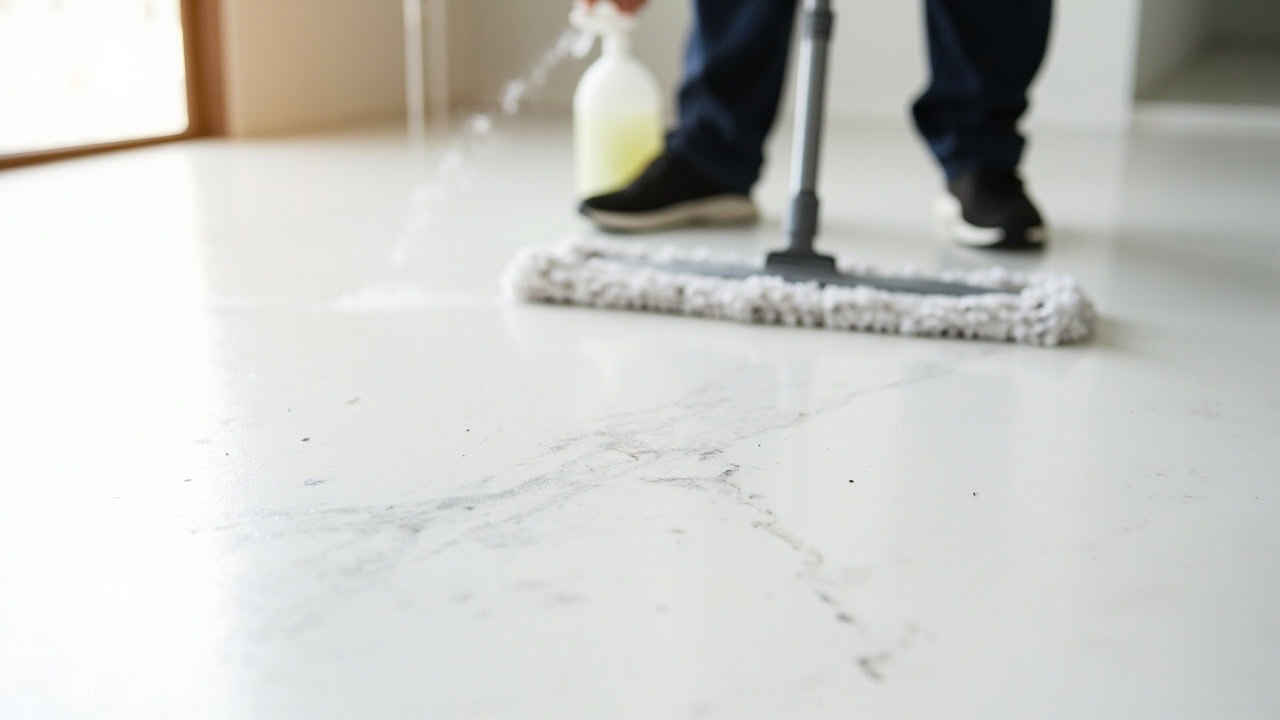
How to Clean Concrete Floors: Indoor Concrete Care

How to Clean Concrete Floors: Indoor Concrete Care
Concrete floors must be cleaned with a pH-neutral cleaner at a dilution ratio of 1:20 and a damp (not wet) microfiber mop to avoid saturating the surface — excessive water penetrates concrete’s porous matrix and causes efflorescence, dusting, and subfloor degradation. Unlike tile or hardwood, indoor concrete reacts aggressively to both acidic and highly alkaline cleaning agents, making pH neutrality the single most critical factor in preserving its sealed or polished finish.
What You Need Before You Start
Gathering the correct supplies before you begin prevents mid-cleaning trips that leave standing water on the concrete surface — the exact condition you are trying to avoid. Indoor concrete’s porosity means that any cleaner left sitting or any tool that spreads rather than lifts dirt can cause irreversible surface damage.
- pH-neutral cleaner (pH 7) — prevents etching of sealed or polished concrete surfaces. Do not substitute with all-purpose cleaners that contain alkaline builders or acidic ingredients.
- Soft-bristle push broom or dust mop — for dry debris removal before any wet cleaning begins. Stiff bristles can scratch polished concrete.
- Microfiber mop with barely-damp technique — moisture content on the surface must remain below 20% during cleaning. Oversaturated mops deliver too much water into concrete’s capillary structure.
- Two buckets — one filled with the diluted cleaning solution, one with clean rinse water to prevent cross-contamination of dirty solution.
- pH testing strips — to verify cleaner neutrality before application. Aim for a confirmed range of 6.5–7.5 on the pH scale.
- Wet vacuum or extraction machine (optional but recommended) — for the rinse step, particularly in basements or ground-level slabs where moisture evaporation is slower.
- Concrete sealer or floor finish — for post-cleaning application if the existing sealer has degraded. Not needed at every clean, but essential for long-term protection.
Step-by-Step Indoor Concrete Cleaning Process
The following six-step process is designed for sealed and polished indoor concrete floors. Each step addresses a specific risk factor — excessive water, residue buildup, premature sealing — that homeowners and maintenance staff consistently encounter when these steps are performed out of order or omitted entirely.
- Dry sweep the entire floor using a push broom or dust mop to remove loose debris, dust, and particulates. Failure to remove abrasive particles before wet cleaning causes micro-scratching on polished surfaces. Work in systematic overlapping passes to ensure complete coverage.
- Prepare the cleaning solution by diluting pH-neutral floor cleaner at a 1:20 ratio (2 oz concentrate per gallon of cool water) in the first bucket. Test the solution with pH strips to confirm the 6.5–7.5 range before applying it to the floor. Cool water is preferred because hot water increases surface tension and reduces the cleaner’s wetting ability.
- Apply solution sparingly using a spray bottle or调剂 (调剂) mop — do not flood the surface. Concrete is a porous material with a capillary pore structure that draws standing water downward, leading to efflorescence: white mineral salt deposits that rise through the matrix as water evaporates. Apply enough solution to loosen soil without creating any pooling.
- Scrub with microfiber mop using overlapping figure-8 strokes, working from the farthest corner toward the exit door to avoid walking on wet sections. Re-dip and wring the mop when it becomes visibly soiled — a dirty mop head redeposits grit and contaminants across the surface.
- Rinse with clean water by damp-mopping with water only or using an extraction vacuum. Residual cleaner residue attracts dirt and creates a sticky film that accelerates re-soiling, making the floor appear dull within days of cleaning.
- Allow floor to air dry completely before applying any sealer or floor finish. Concrete must reach a moisture content below 3% by weight before a topical sealer can bond properly. In typical indoor conditions with ambient humidity between 40–60%, this takes 24–48 hours. Using circulating fans in enclosed spaces accelerates drying but direct heat should not be aimed at the surface as thermal gradients cause micro-cracking.
Indoor Concrete Floor-Specific Considerations
Not all indoor concrete is the same. The care requirements differ substantially depending on whether the floor is sealed, polished, stamped, or raw concrete. Applying the wrong cleaning approach to any of these surfaces can cause damage that ranges from a dulled finish to permanent structural compromise.
Sealed vs. Unsealed Concrete
Sealed concrete tolerates pH-neutral cleaners because the topical or penetrating sealer creates a protective barrier between the concrete matrix and the cleaning agent. Unsealed (raw) concrete is highly alkaline with a surface pH of 10–12 due to calcium hydroxide formation during the hydration process. This alkalinity means that alkaline-safe cleaners (pH 8–9) are actually required for bare concrete — standard pH-neutral cleaners at pH 7 are safe for sealed surfaces but may not adequately cut through the inherent alkalinity of unsealed concrete. Always confirm the floor’s sealed status before selecting a cleaner.
Polished Concrete
Polished concrete achieves its reflectivity through mechanical grinding and chemical hardening (often with a densifier). The burnished surface is visually similar to natural stone but is chemically distinct. Abrasive pads or stiff-bristle brushes will scuff the polished surface and eliminate the reflectivity that defines the finish. Use only soft microfiber mop heads and avoid any cleaner containing ammonium nitrate, which reacts with the calcium silicate hydrate in polished concrete and causes surface hazing.
Stamped Concrete
Stamped concrete — common in basements and modern industrial-style interiors — features embossed patterns that create recessed areas trapping debris in the texture. A two-pass cleaning approach works best: use a soft-bristle scrub brush for the first pass to agitate debris from the recesses, then follow with the microfiber mop for the second pass to lift the suspended soil. Skipping the first pass means dirt remains embedded in the stamped pattern even after mopping.
Moisture Sensitivity and Basement Slabs
Indoor concrete in basements or on ground-level slabs has higher moisture vapor emission rates (MVER) than above-grade floors. Before applying any topical sealer to a basement concrete floor, test for MVER using the ASTM F1869 calcium chloride test method. An MVER exceeding 3 lbs per 1,000 sq ft per 24 hours indicates that a moisture barrier primer must be applied before the sealer — without it, topical sealers delaminate and bubble within weeks of application. Use a concrete moisture meter to confirm surface moisture content is below 3% by weight before sealing.
Products to Avoid
Several common cleaning products cause specific, preventable damage to indoor concrete floors:
- Acidic cleaners (vinegar, citrus-based, oxalic acid at low dilution) — dissolve the calcium hydroxide in concrete’s matrix, etching the surface and causing the chalky, dusty appearance known as concrete dusting.
- Ammonia — liberates alkali from the concrete surface and contributes to efflorescence. It also softens topical sealers at concentrations above 2%.
- Bleach at full strength — at concentrations above 5%, sodium hypochlorite degrades concrete sealers and causes surface pitting. Even diluted bleach (10:1) should be followed by a thorough rinse, which most users skip.
- Oil-based soaps (common in some driveway cleaners) — leave a fatty residue film that penetrates concrete’s pores, attracting subsequent dirt and creating a persistently sticky surface that re-soils quickly.
Drying and Finishing Indoor Concrete
Proper drying is not passive — it requires both time and environmental control. Rushing this step is the second most common mistake after using the wrong cleaner, and its consequences (delamination, bubbling, sealer failure) are expensive to correct.
- Allow 24–48 hours of air drying in standard indoor conditions (40–60% relative humidity, 65–75°F) before foot traffic resumes. High humidity environments may require up to 72 hours.
- Use circulating fans to accelerate drying in enclosed or basement spaces. Position fans at floor level pointing outward toward a doorway or exhaust. Do not direct fans directly at the concrete surface — uneven thermal gradients cause micro-cracking in the setting cement paste.
- Apply a concrete sealer or floor finish only after verifying surface moisture content is below 3% using a concrete moisture meter. Do not estimate drying based on surface appearance — the surface may appear dry while the subsurface retains significant moisture.
- Re-seal high-traffic indoor concrete areas every 2–3 years to maintain stain resistance and prevent dusting. High-traffic zones (entryways, hallways, exercise rooms) may need annual inspection and touch-up sealing.
Common Mistakes When Cleaning Indoor Concrete Floors
These five errors account for the majority of indoor concrete floor failures reported in residential and commercial settings. Each is preventable with proper technique and product selection.
- Using too much water: Concrete is porous and acts as a sponge. Excessive moisture leads to efflorescence, subfloor damage, and mold growth in humid environments. Keep your mop barely damp — if you can wring it out, it is too wet.
- Skipping the dry sweep: Dragging wet debris across concrete with a wet mop pushes fine particulate matter into the surface pores and creates fine scratches on polished surfaces. Always dry-sweep first.
- Using acidic cleaners: Even diluted vinegar (acetic acid at pH 2.5–3.0) degrades concrete sealers and causes surface etching that produces the chalky, dusty appearance. This damage is irreversible without re-grinding or re-sealing.
- Not rinsing residue: Cleaner film left on concrete attracts dirt and creates a dull, sticky surface that re-soils quickly. The floor looks clean immediately after mopping but is visibly dirty within a few days — this is cleaner residue, not a cleaning failure.
- Sealing too soon: Trapping moisture beneath a sealer causes delamination, bubbling, and complete sealer failure within weeks. Always verify moisture content below 3% with a meter before applying any topical sealer.
Frequently Asked Questions
Q: What is the best cleaner for indoor concrete floors?
A: A pH-neutral cleaner (pH 6.5–7.5) at a 1:20 dilution ratio is the safest and most effective cleaner for sealed or polished indoor concrete — acid or alkaline cleaners degrade surface sealers and cause permanent etching. Look for cleaners specifically labeled as “pH-neutral” or “pH-balanced” for floor care, and always confirm the dilution ratio on the product’s technical data sheet.
Q: Can I use vinegar to clean concrete floors?
A: No — vinegar is acetic acid at pH 2.5–3.0 and will etch concrete sealers, dull polished surfaces, and cause efflorescence by dissolving the calcium hydroxide in the concrete matrix. This applies even at diluted concentrations commonly recommended for household cleaning. The moment vinegar contacts a sealed or polished concrete surface, the acid begins dissolving the calcium hydroxide phase of the cement paste, creating a permanently rough, dusty surface layer.
Q: How often should indoor concrete floors be cleaned?
A: High-traffic indoor concrete floors should be cleaned 2–3 times per week with dust mopping and weekly wet cleaning; low-traffic areas require monthly wet cleaning to maintain appearance and prevent dirt embedment in surface pores. Daily dust mopping in entryways and high-traffic zones prevents abrasive particulates from being ground into the surface finish. If the floor is in a basement with radon considerations, increase ventilation during and after wet cleaning.
Q: How do I know if my concrete floor needs to be resealed?
A: Perform a water droplet test — if water no longer beads on the surface but instead absorbs within 10 seconds, the sealer has degraded and the floor requires cleaning followed by resealing to restore stain resistance. Place several droplets across different areas of the floor, as wear patterns vary. Areas near entryways and under furniture typically degrade first.
References
- Portland Cement Association. (n.d.). Polished Concrete: Maintenance and Care. https://www.cement.org
- ASTM International. (n.d.). ASTM F1869 — Standard Test Method for Measuring Moisture Vapor Emission Rate of Concrete Subfloor Using Anhydrous Calcium Chloride. https://www.astm.org/f1869
- National Concrete Masonry Association. (n.d.). Efflorescence: Cause and Control. https://www.ncma.org
- U.S. Environmental Protection Agency. (n.d.). Indoor Air Quality in Commercial Buildings: Floor Care Products. https://www.epa.gov/indoor-air-quality-iaq
- International Concrete Repair Institute. (n.d.). Guidelines for Polished Concrete Floor Maintenance. https://www.icri.org


