
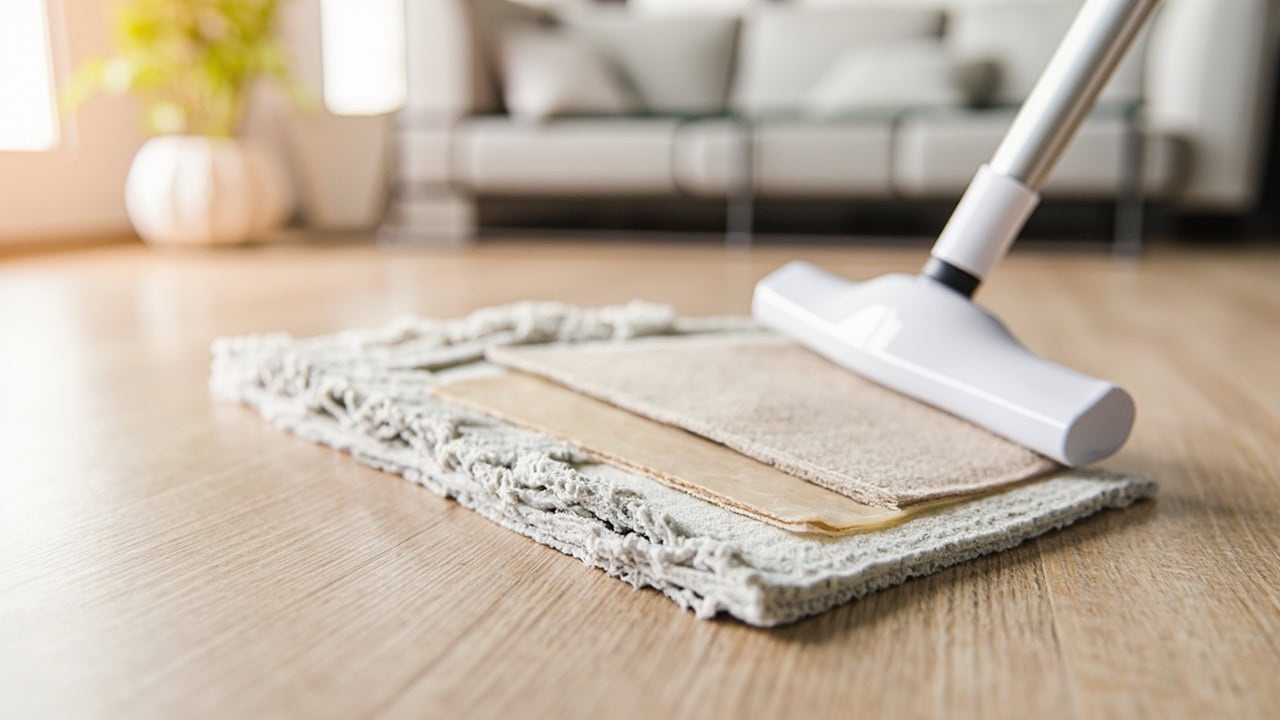
How to Clean SPC Flooring: Complete Guide

SPC flooring must be cleaned with a pH-neutral cleaner at a 1:20 dilution ratio and a barely-damp microfiber mop to protect the rigid core structure and UV-coated surface from moisture penetration. Avoid steam mops, bleach-based cleaners, and abrasive scrubbers — heat above 140°F (60°C) causes SPC delamination and chemicals below pH 5 or above pH 9 strip the wear layer. Sweep or vacuum daily to remove abrasive dirt particles before wet cleaning, and always dry floors immediately after mopping to prevent water spotting on the semi-gloss finish.
What You Need Before You Start
Gather these supplies before cleaning SPC flooring to ensure the process is efficient and safe for the material’s composite structure. Using the wrong tools can permanently damage the wear layer or cause the rigid core to swell, so precision matters.
- pH-neutral cleaner — diluted at a 1:20 ratio with water; verifies between pH 5.5 and pH 8.5 on test strips
- Microfiber mop — flat or string head only; never use a sponge mop that holds standing water
- Soft-bristle broom or vacuum — with a hardwood/floor attachment to remove loose debris without scratching
- Clean water — for rinsing the mop between passes and removing cleaner residue
- Dry microfiber cloth or towel — for hand-drying corners and edges where water pools
- pH test strips — optional but recommended for verifying cleaner neutrality before full application
Step-by-Step SPC Flooring Cleaning Process
Follow this six-step sequence for every wet cleaning session. Each step is designed to protect the SPC layer structure — the wear layer, decorative layer, rigid limestone-PVC core, and underlayment — from thermal shock, moisture intrusion, and chemical etching.
- Dry sweep first — Remove loose dirt, dust, and debris with a soft-bristle broom or vacuum to prevent scratching during wet cleaning. Dirt particles act as abrasive agents underfoot and can embed in the mop, creating micro-scratches on the UV-coated wear layer.
- Prepare cleaning solution — Dilute pH-neutral floor cleaner at 1:20 ratio with lukewarm water at approximately 80°F (27°C). Water that is too cold causes cleaner dilution failure; water that is too hot accelerates core expansion. A 1:20 ratio delivers approximately 0.05–0.1% active surfactant concentration, sufficient for breaking bond oils without leaving residue.
- Test in inconspicuous area — Apply solution to a small corner — inside a closet threshold or behind a door — and wait 2 minutes to verify no discoloration or surface damage. Some SPC products use dyed decorative layers that can bleed if exposed to unexpected pH extremes, even within the safe range.
- Mop with barely-damp technique — Dip microfiber mop in solution, wring until nearly dry (damp to the touch, not wet), and mop floor in overlapping linear passes. Never allow water to pool or stand on the surface. Overlapping passes ensure complete coverage without redundant moisture exposure in any single area.
- Rinse with clean water — Fill bucket with fresh water and damp-mop the floor again to remove residual cleaner film. Cleaner residue left behind acts as a soil attractant, causing the floor to re-dirty faster and creating streaking on the semi-gloss finish.
- Dry immediately — Use a dry microfiber cloth or allow 3–5 minutes of air drying with windows open and a fan running. SPC seams are not waterproof — standing water at seams can migrate into the rigid core by capillary action, causing edge swelling and delamination over repeated exposure.
SPC Flooring-Specific Considerations
SPC (Stone Plastic Composite) flooring differs from traditional LVT in its core composition. Understanding these material properties clarifies why certain cleaners and tools are prohibited.
Rigid Core Sensitivity
The SPC core is composed of limestone (calcium carbonate) and polyvinyl chloride (PVC) fused under high pressure. This composite expands and contracts with temperature fluctuations — the coefficient of linear thermal expansion for SPC is approximately 16–20 µm/m·°C. Excessive moisture compounds this problem because water absorbed into the core reduces internal bond strength, leading to edge swelling and layer separation at the seams.
Wear Layer Protection
The transparent UV-coated wear layer — typically 0.3mm to 0.7mm thick — is SPC flooring’s first line of defense against scratches, scuffs, and chemical exposure. This layer is cured onto the decorative film beneath it using ultraviolet light during manufacturing. While it resists abrasion from foot traffic and furniture sliding, it can be permanently etched or clouded by acidic cleaners (pH below 5.5) or alkaline cleaners (pH above 8.5). Once the wear layer is chemically etched, it cannot be restored — only replaced.
Temperature Limits
SPC flooring must not be exposed to temperatures below 50°F (10°C) or above 140°F (60°C). Temperatures above 140°F (60°C) — produced by steam mops, hot water discharges, or direct sunlight through glass doors — cause the PVC component of the rigid core to soften and the limestone binder to lose structural integrity, resulting in delamination. Cold temperatures below 50°F (10°C) make the SPC core brittle and increase the risk of cracking under impact load.
Safe Cleaner pH Range
Use only floor cleaners that test between pH 5.5 and pH 8.5 on pH test strips. Below pH 5.5, acidic cleaners begin dissolving the calcium carbonate in the core. Above pH 8.5, alkaline cleaners saponify the PVC and cause the wear layer to cloud. If you are unsure about a cleaner’s pH, test a 1:20 diluted sample before applying it to the floor. Most multi-surface spray cleaners fall in the pH 7–9 range and should be avoided unless specifically labeled safe for vinyl or SPC flooring.
Drying and Finishing SPC Floors
Proper drying is as critical as proper cleaning. SPC’s semi-gloss finish is factory-applied and cannot be enhanced by buffing or waxing — attempting to do so causes streaking and attracts future dirt. Follow these drying protocols to maintain the floor’s appearance between cleanings.
- Air dry with windows open or a fan running for 3–5 minutes after the final rinse. Adequate ventilation accelerates surface evaporation and prevents moisture from sitting at seams.
- Do not buff SPC flooring — the factory-applied semi-gloss finish cannot be improved with elbow grease or polishing machines. Buffing creates uneven heat buildup that can damage the wear layer.
- For high-traffic areas, apply an SPC-compatible floor polish every 6–12 months to restore uniform sheen. Use only products specifically formulated for SPC or rigid core vinyl — standard floor waxes cause streaking and attract dirt.
- Never use wax-based products on SPC — they create a film that bonds unevenly to the UV-cured surface, resulting in hazing and streaking that requires aggressive (and damaging) stripping to remove.
Common Mistakes When Cleaning SPC Flooring
The following table summarizes the most frequent cleaning errors that cause permanent or semi-permanent damage to SPC flooring, along with the mechanism of damage and the correct approach for each scenario.
| Mistake | Why It Damages SPC | Correct Approach |
|---|---|---|
| Steam mop | Heat above 140°F (60°C) causes core delamination, edge swelling, and permanent surface damage. The steam penetrates seams and softens the composite structure. | Use barely-damp microfiber only. Keep water temperature below 80°F (27°C). |
| Bleach or ammonia cleaners | pH extremes (bleach ~pH 11–13, ammonia ~pH 10–11) etch and cloud the UV-coated wear layer. Repeated exposure causes irreversible surface hazing. | Use pH-neutral cleaners testing between 5.5 and 8.5 only. |
| Abrasive scrubbers or pads | Scratching the UV wear layer with steel wool, stiff brushes, or magic erasers creates micro-abrasions that collect dirt and cannot be polished out. | Use only soft microfiber pads, soft-bristle brooms, or gentile nylon brushes. |
| Letting water pool | Moisture penetrates seams by capillary action and swells the limestone-PVC core, causing edge lipping and separation from the subfloor. | Wring mop thoroughly until damp. Dry corners and edges with a microfiber cloth immediately after mopping. |
| Using vinegar solution | Vinegar has a pH of approximately 2.5 — far below the safe threshold of 5.5. It corrodes the decorative layer, causes clouding, and degrades the adhesive bond between layers. | Avoid all acidic cleaners entirely. Even diluted vinegar (pH ~2.8–3.2) exceeds SPC’s safe acidity range. |
Frequently Asked Questions
Q: Can I use a steam mop on SPC flooring?
A: No — steam mops generate temperatures exceeding 140°F (60°C) which causes SPC rigid core delamination, edge swelling, and permanent surface damage. The heat melts the composite structure and separates the layers.
Q: What is the best cleaner for SPC flooring?
A: A pH-neutral floor cleaner diluted at 1:20 with water is optimal for SPC flooring. The pH should test between 5.5 and 8.5 to safely clean without etching the wear layer or degrading the limestone-PVC core.
Q: How often should SPC flooring be cleaned?
A: Sweep or dry mop daily to remove abrasive dirt, and wet clean with pH-neutral solution every 1–2 weeks for residential areas. High-traffic commercial spaces may require wet cleaning 2–3 times per week.
Q: Will vinegar damage SPC flooring?
A: Yes — vinegar has a pH of approximately 2.5, which is too acidic for SPC flooring and will etch the UV-coated wear layer, causing clouding, dulling, and reduced lifespan of the decorative surface.
References
- ASTM F3261 / F3261M-17. (2017). Standard Specification for Residential Floor Replacement Systems Using Modular Components. ASTM International.
- International Organization for Standardization. (2019). ISO 10582:2017 — resilient floor coverings — heterogeneous poly(vinyl chloride) floor covering . ISO.
- U.S. Environmental Protection Agency. (2021). Guidance for Cleaning and Disinfecting Public Spaces, Workplaces, Businesses, Schools and Homes. EPA.
- National Sanitation Foundation International. (2020). NSF/ANSI 140-2019 — Sustainability Assessment for Floor Covering Products. NSF International.
- Shaw Industries Group, Inc. (2022). SPC/Rigid Core Flooring Care and Maintenance Technical Bulletin. Shaw Industries.


