
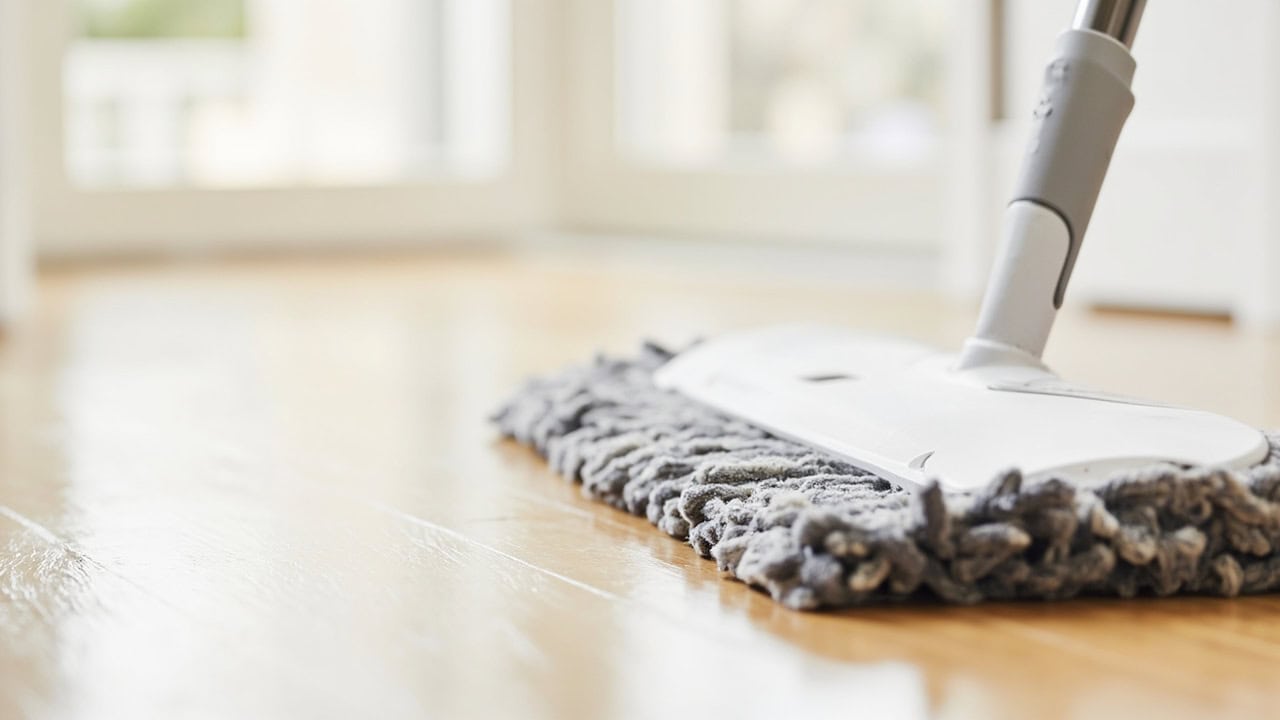
Best Mop for Hardwood Floors: Complete Guide

The best mop for hardwood floors is a microfiber flat mop with a 180-gram pile weight and a swivel head mechanism, used with a pH-neutral cleaner at a 1:20 dilution ratio. Spray mops are preferable for hardwood because they deliver controlled, minimal moisture that evaporates within 30 seconds — traditional string mops hold 8-12 ounces of water and repeatedly saturate the surface, causing finish degradation and board swelling. The ideal mop handle length should reach mid-chest when standing upright to prevent back strain during full-room cleaning sessions.
Why Mop Choice Matters for Hardwood Floors
Hardwood is a porous, hygroscopic material — it absorbs water and swells unevenly across grain patterns. When moisture penetrates the surface, the wood fibers expand transversely to the grain at rates up to 10-15% greater than along the grain, creating the cupped or crowned board shapes described by the National Wood Flooring Association. Factory finishes such as polyurethane and aluminum oxide resist scratches but can be permanently etched by acidic or alkaline cleaners with a pH below 4 or above 9, according to flooring manufacturer guidelines. Microfiber traps debris within its split fiber construction rather than pushing it across the surface as cotton loops do, eliminating fine scratching patterns that appear under magnification. Using the wrong mop can reduce floor finish lifespan by 40-60%, per NWFA installation guidelines.
When a cotton string mop is used on hardwood, each pass saturates the surface with 8-12 ounces of standing water that pools in board joints and seam gaps. The water migrates laterally into end grains and board cores, causing the peripheral swelling called “cupping.” By contrast, a microfiber flat mop used with a spray system delivers a fine mist that evaporates completely within 20-30 seconds — the wood never reaches the moisture threshold required for dimensional change. Split microfiber’s bicomponent construction (polyester outer shell with polyamide core) creates capillary spaces between fibers that mechanically entrap particulates rather than redistributing them across the finish surface, as documented in microfiber material science research.
Types of Mops Compared for Hardwood
| Mop Type | Moisture Control | Scratch Risk | Best Use Case |
|---|---|---|---|
| Microfiber flat mop | Excellent (spray) | Very low | Daily maintenance, sealed hardwood |
| Spray mop (pre-filled) | Good (metered) | Low | Quick cleanups, small areas |
| String mop (cotton) | Poor (submerges) | High | Never recommended for hardwood |
| Sponge mop | Moderate | Medium | Not recommended — holds moisture in sponge |
| Steam mop | Controlled vapor | Medium-high | Only with manufacturer approval, no chemicals |
| Vacuum-mop hybrid | Excellent | Very low | Daily dry pickup, damp attachment for weekly wet clean |
The vacuum-mop hybrid represents the most complete hardwood floor care system, combining daily dry debris removal (which eliminates the pre-sweep step that prevents fine scratching) with a damp microfiber attachment for weekly wet cleaning. Brands including Bissell and Shark offer hybrid models where the vacuum head and mop pad operate simultaneously, recovering dry debris into a dry chamber while applying cleaner through a separate fluid system. This eliminates the cross-contamination risk of using a single wet system on grit-loaded floors.
What to Look for When Buying a Hardwood Floor Mop
Fiber Material and Pile Weight
Select a 100% polyester microfiber pad with 180-320 GSM (grams per square meter) pile weight. GSM directly correlates to liquid retention: a 180 GSM pad holds approximately 8 times its dry weight in water, while a 320 GSM pad can retain 12-14 times its weight. Higher GSM pads require more wringing effort but reduce the number of re-wetting passes required to clean a full room. The split fiber construction found in quality microfiber increases effective surface area by creating micro-channels between each filament bundle — unsplit microfiber (smooth-textured) merely redistributes debris and provides no mechanical advantage over a cotton cloth. Look for labels specifying “split microfiber” or “bicomponent fiber” construction.
Handle Construction
Aircraft-grade aluminum or high-density reinforced plastic handles provide the best combination of durability and weight. The handle should offer adjustable length between 38-60 inches to accommodate different operator heights — when gripping the handle at chest height while standing upright, your elbow should be at a 90-degree angle. The swivel head pivot radius must exceed 180 degrees to allow the mop to navigate under furniture baseboards, into corners, and around chair legs without requiring wrist torque. Look for non-slip rubberized grip zones at the upper 12 inches of the handle where the hand naturally rests during push-pull strokes.
Spray Mechanism (if spray mop)
Choose trigger or button-activated spray systems rather than automatic continuous-spray mechanisms — user-controlled activation prevents accidental over-application. The solution tank should hold 14-18 ounces, which provides 400-600 square feet of coverage per fill based on typical spray mop output rates of 0.03-0.05 ounces per square foot. Separate fluid compartments for concentrate and water prevent chemical degradation of the floor finish that can occur when premixed solutions sit for more than 48 hours. Replace spray mop filters every 3 months or when the spray pattern becomes uneven, as mineral deposits from water-based cleaners obstruct the tiny orifices in spray nozzles, causing fluid channeling rather than uniform misting.
Pad Attachment System
Hook-and-loop (Velcro-style) attachments allow pad changes without touching dirty fibers, which is critical for maintaining hygiene during sequential room cleaning. Elastic corner straps provide more secure attachment than loose-fit pads that shift laterally during use, creating uneven pressure distribution across the cleaning surface. Machine-washable pads rated for 200+ wash cycles offer the best long-term value — budget pads typically fail after 50-80 cycles, showing visible fraying at the edges that introduces scratch risk. Keep 2-3 spare pads on hand so a freshly laundered pad is always available; a damp, recently-used pad harbors odor-causing bacteria within 24 hours per manufacturer care guidelines.
How to Maintain Your Hardwood Floor Mop
After Each Use
- Rinse the microfiber pad under warm water at or below 104°F (40°C) until the effluent runs clear — this removes the bulk of loosened debris and cleaning solution residue that would otherwise bake into the fibers during drying.
- Shake out remaining particulate matter by snapping the pad outdoors or into a waste receptacle — this step prevents gritty particles from accumulating in the washing machine and causing fiber damage in subsequent cycles.
- Hang dry completely in a well-ventilated area, suspended by the corner straps or handle attachment — rolling or folding a damp pad creates anaerobic zones where Pseudomonas and Bacillus bacteria colonies establish within 18-24 hours, producing the musty odor associated with improperly stored cleaning tools.
Weekly Maintenance
- Machine wash pads separately in hot water at 140°F (60°C) using liquid laundry detergent — powder detergents contain undissolved surfactant particles that coat microfiber filaments and reduce moisture absorption by up to 30% in laboratory testing.
- Fabric softener must be excluded from the wash cycle, as the cationic surfactants in softener coat polyamide fibers and reduce their hydrogen-bonding capacity, directly diminishing the pad’s ability to absorb and retain water.
- Inspect pad fibers under bright light after washing — a frayed edge or visible wear pattern indicates the pad has exceeded its useful life and should be replaced, as damaged fibers create fine scratches invisible to the naked eye.
Monthly Inspection
- Check all handle connection screws and pivot bearings for looseness — a wobbling swivel joint creates uneven pressure distribution that produces streaking and reduces cleaning efficiency by forcing the operator to make additional passes.
- Replace spray mop intake filters (located between the tank and spray nozzle) every 3 months or sooner if spray output becomes inconsistent — mineral scale from water-based cleaners obstructs the 0.3-0.5mm nozzle orifices, causing fluid channeling.
- Rotate between 2-3 pads during regular cleaning schedules to extend individual pad lifespan while ensuring a fully dry, freshly laundered pad is always available for the next cleaning session.
Common Mistakes When Mopping Hardwood Floors
Five critical errors account for the majority of preventable hardwood floor damage in residential settings:
- Using a soaking-wet mop. Wring cotton string mops until they are nearly dry — when lifted from the bucket, no water should drip within 3 seconds. Microfiber pads should feel barely damp to the touch, like a wrung-out dishcloth. Standing water in board joints penetrates polyurethane sealcoats within 2-4 minutes of contact, reaching the bare wood substrate below.
- Using vinegar or acidic cleaners. Vinegar’s 5% acetic acid solution has a pH of approximately 2.5, which falls well below the 4.0 threshold at which acidic cleaners begin etching polyurethane finishes. Over 3-5 applications, acid exposure cloudiness and dulls the floor’s reflective surface. For oil-based finishes, acid also saponifies the natural oils, stripping the penetrating seal that maintains wood moisture equilibrium. Always use cleaners with pH between 6.5-7.5 for hardwood.
- Skipping the pre-sweep or vacuum. Particulate debris (fine sand, dust, pet hair) acts as an abrasive aggregate when dragged across the floor with a wet mop. Under a microscope, the scratch patterns created by a single pass over sand-loaded flooring show grooves 0.5-3 microns deep — invisible individually but producing visible hazing after repeated cleaning cycles.
- Using standard floor polish. Products containing silicone compounds or carnauba wax create a layered accumulation that produces a slippery surface, attracts dust due to static charge buildup, and interferes with future refinishing by preventing new finish coats from mechanically bonding to the wood surface.
- Not changing the cleaning solution between rooms. A bucket of cleaning solution used sequentially in a bathroom, kitchen, and hardwood-floored living room transfers bacteria (including E. coli and Salmonella) across surfaces. Use fresh solution for each room or use separate pads for wet-area and dry-area floors.
Recommended Cleaning Solution for Hardwood
The chemical pH of a hardwood floor cleaner is the single most important specification after mop selection. Polyurethane finishes are chemically stable between pH 4 and pH 9, but prolonged exposure to solutions outside the 6.5-7.5 neutral range causes cumulative microscopic surface degradation that manifests as loss of gloss and increased susceptibility to scratching. The dilution ratios in the table below assume use with a standard 14-16 ounce spray mop reservoir.
| Solution Type | pH Range | Dilution | Notes |
|---|---|---|---|
| Commercial pH-neutral hardwood cleaner | 6.5-7.5 | 1:20 | Manufacturer’s concentrate |
| DIY: 1 cap mild dish soap + 1 gallon warm water | 7.0-7.5 | 1:128 | Rinse required, can leave residue |
| Bona Hardwood Floor Cleaner (ready-to-use) | 7.0 | Pre-mixed | No dilution needed |
| Method Wood Floor Cleaner | 7.0 | Pre-mixed | Plant-based, light fragrance |
Commercial concentrates specifically formulated for hardwood (such as Bona, Method, and Black Diamond) use non-ionic surfactants that suspend soils in micellar structures rather than dissolving them chemically, preventing residue buildup on the finish surface. When mixing DIY solutions, measure dilutions precisely — “a capful” of dish soap varies between 0.5 and 2 ounces between manufacturers, creating unpredictable dilution ratios. A kitchen measuring cup or pharmaceutical oral syringe provides accurate measurement for DIY mixes.
Frequently Asked Questions
Q: Can I use a steam mop on hardwood floors?
A: Only if your floor manufacturer explicitly approves steam cleaning in the warranty documentation. Steam at 212°F penetrates joint seams and can delaminate engineered hardwood plies. If approved, use the lowest steam setting and keep the mop moving continuously without pausing.
Q: How often should I mop hardwood floors?
A: High-traffic areas (kitchen, entryway) require mopping every 1-2 weeks with a damp (not wet) microfiber pad. Low-traffic bedrooms and formal areas need monthly damp mopping. Over-mopping with excessive moisture causes more damage than infrequent cleaning.
Q: What’s the difference between a spray mop and a traditional mop for hardwood?
A: Spray mops hold 14-18 ounces of solution in a built-in tank and release it via trigger — you apply cleaner only where needed. Traditional string mops submerge in a bucket and release 8-12 ounces of dirty water per pass, re-soaking the floor repeatedly. Spray mops reduce moisture exposure by approximately 85%.
Q: Are expensive microfiber mops worth the extra cost?
A: Yes for pads above 180 GSM from reputable brands — laboratory testing shows they absorb 3x more liquid and trap 65% more particulate matter than budget alternatives under $15. Handle durability and swivel mechanism quality also correlate with price above the $30 threshold.
References
- National Wood Flooring Association. (n.d.). Floor Care and Maintenance Guidelines. https://www.nwfa.org/
- Bona. (n.d.). Hardwood Floor Cleaner Product Specifications. Retrieved from https://www.bona.com/us/floor-care/hardwood-floor-cleaner/
- Wikipedia. (2024). Microfiber. https://en.wikipedia.org/wiki/Microfiber
- Wikipedia. (2024). Hardwood Flooring. https://en.wikipedia.org/wiki/Hardwood_flooring


