
How to Clean Inside an Oven Without Chemicals

A chemical-free oven cleaning method uses a baking soda paste combined with white vinegar and steam to dissolve baked-on grease and food residue — no commercial oven cleaners required. Baking soda (sodium bicarbonate, NaHCO₃) has a pH of approximately 8.3, giving it mild alkaline properties that break down acidic grease deposits. When white vinegar (5% acetic acid, pH ~2.5) is sprayed over the residual baking soda, the resulting acid-base reaction produces carbon dioxide gas that physically lifts stubborn grime from oven surfaces.
This method requires approximately 20–30 minutes of active cleaning plus an overnight dwell time of 8–12 hours for heavily soiled ovens. According to Marla Mock, president of Molly Maid, the baking soda paste needs a full 12-hour dwell to penetrate carbonized grease effectively. The total process from start to finish spans roughly 13–14 hours, though most of that time is passive. This approach is safe for all standard oven interiors including enamel, stainless steel, and self-cleaning oven coatings when used correctly.
What You Need Before You Start
Gathering all supplies before you begin prevents mid-process interruptions. The core ingredients — baking soda and white vinegar — are pantry staples that cost a fraction of commercial oven cleaners and contain no volatile organic compounds (VOCs) or corrosive chemicals like sodium hydroxide (lye), which is the primary active ingredient in most commercial oven cleaners.
- Baking soda — ½ cup, creates the primary cleaning paste with water; sodium bicarbonate provides mild abrasion and alkaline grease-cutting power
- White vinegar — ½ cup in a spray bottle for the activation reaction; the 5% acetic acid concentration dissolves mineral deposits and reacts with baking soda residue
- Water — approximately 3–4 tablespoons, enough to create a spreadable paste consistency
- Microfiber cloths or non-abrasive sponge — for scrubbing without scratching enamel or stainless steel surfaces; microfiber traps debris rather than pushing it around
- Rubber gloves — optional but recommended to protect hands during extended scrubbing
- Small bowl — for mixing the baking soda paste
- Spray bottle — for applying vinegar solution evenly across interior surfaces
- Soft-bristle brush or old toothbrush — for reaching corners, crevices, and the door seal area
- Putty knife or plastic scraper — for loosening particularly stubborn baked-on debris without damaging surfaces
Step-by-Step Chemical-Free Oven Cleaning Process
The following ten-step process covers the complete chemical-free oven cleaning method. Each step builds on the previous one, so follow them in order for the best results. The process draws on the same acid-base cleaning chemistry explained in the Cleaning Chemistry Hub, where baking soda’s mild alkalinity (pH 8.3) saponifies grease and the subsequent vinegar application neutralizes and lifts the residue.
- Remove oven racks — Take out all racks and place them in the bathtub or a large sink for separate cleaning. Submerge them in warm water mixed with dish soap and a generous sprinkle of baking soda. For detailed rack-cleaning techniques, see our guide on how to clean oven racks easily.
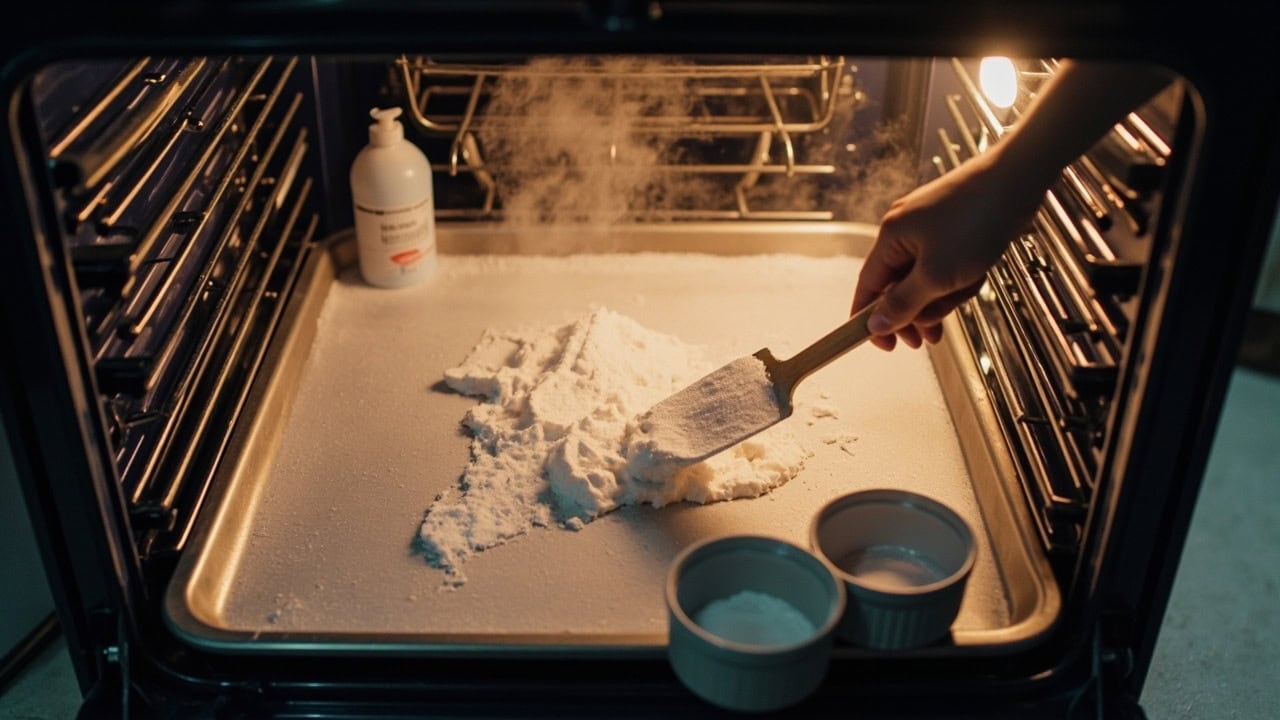
- Make the baking soda paste — Mix ½ cup baking soda with 3–4 tablespoons water in a small bowl. Add water gradually, stirring between additions, until you achieve a thick, spreadable consistency — similar to toothpaste. If the paste is too runny, it will drip off vertical oven walls and create a mess. Some cleaning professionals recommend adding ¼ cup of salt to the paste for extra scouring power on heavily carbonized surfaces.
- Apply paste to oven interior — Using a spatula or your gloved hands, spread the paste over all interior surfaces: the bottom panel, side walls, back wall, and the inside of the oven door. Apply a thick, even layer approximately ¼ inch thick. Avoid coating the heating elements (both exposed and hidden), the temperature sensor probe (a thin metal rod on the back wall), and any gas openings or pilot light assemblies.
- Let paste dwell overnight — Allow the baking soda paste to sit for a minimum of 8–12 hours, ideally overnight. This dwell time is critical — baking soda needs extended contact to penetrate and break down the carbon-oxygen bonds in baked-on grease. For ovens with heavy buildup, a longer dwell of up to 15 hours produces better results. The paste will dry and change color as it absorbs grease, typically turning from white to brown or amber.
- Remove dried paste — After the dwell period, use a damp microfiber cloth or non-abrasive sponge to wipe away the dried paste. Work in small sections, rinsing the cloth frequently in warm water. The paste should come away carrying dissolved grease and food residue. For areas where the paste has hardened significantly, lay a warm, damp cloth over the spot for 2–3 minutes to soften it before wiping.
- Spray vinegar for foam reaction — Fill your spray bottle with undiluted white vinegar (5% acetic acid) and spray all interior surfaces where baking soda residue remains. The acid reacts with residual sodium bicarbonate to produce carbon dioxide gas — visible as fizzing foam. This physical action lifts remaining grease particles from the oven surface. The reaction also neutralizes the alkaline baking soda, leaving surfaces at a near-neutral pH.
- Scrub remaining residue — Use a soft-bristle brush, old toothbrush, or plastic scraper to remove any remaining baked-on particles. Focus on corners, the oven door hinge area, the rubber door gasket, and around the convection fan if your oven has one. Avoid using any abrasive tools such as steel wool, scouring pads, or metal scrapers, which will permanently scratch enamel and stainless steel surfaces.
- Wipe clean — Wipe all surfaces thoroughly with a clean, damp microfiber cloth to remove all traces of baking soda paste and vinegar residue. Rinse the cloth in clean water between passes. Any remaining baking soda residue can leave a white powdery film that will produce smoke the next time you use the oven, so be thorough in this step.
- Clean the oven racks — While the oven interior air-dries, scrub the soaking racks with a stiff brush or steel wool pad (racks can tolerate more abrasion than oven interiors). Apply baking soda paste to any stubborn spots, let sit for 15 minutes, then scrub and rinse thoroughly under running water. Dry the racks completely with a clean towel before reinserting.
- Replace racks and finish — Once the oven interior is completely dry to the touch — typically 10–15 minutes with the door open — return the racks to their original positions. Run the oven at 200°F (93°C) for 15 minutes to burn off any invisible residue before cooking food.
Oven-Specific Considerations: What to Avoid
Not all oven surfaces respond the same way to baking soda and vinegar. Understanding which areas and oven types require caution prevents accidental damage during the cleaning process.
- Glass cooktop surfaces and ceramic elements — Never apply baking soda paste directly to glass cooktop surfaces. While baking soda is only mildly abrasive, repeated rubbing on glass can create micro-scratches that become visible over time. Use a dedicated glass cooktop cleaner instead.
- Temperature sensor — The temperature sensor is usually a thin metal probe extending from the back wall of the oven. Do not cover it with paste or scrub it aggressively, as damage to the sensor will cause inaccurate temperature readings.
- Self-cleaning ovens — The baking soda method is safe for self-cleaning ovens, but never combine it with the high-heat self-clean cycle. Self-cleaning cycles reach temperatures of 900–1,000°F (482–538°C), and residual baking soda paste can discolor or damage the oven’s porcelain coating under those conditions. For guidance on when to use each method, see our article on how to clean a self-cleaning oven properly.
- Continuous-clean (pyrolytic) oven coatings — Some ovens have a special porous ceramic coating designed to absorb and burn off grease gradually during normal use. If the manufacturer’s manual explicitly warns against using abrasives on this coating, skip the baking soda paste method and rely on steam cleaning instead.
- Steel wool, SOS pads, or harsh scrubbers — These will permanently scratch enamel, stainless steel, and pyrolytic coatings. Use only soft-bristle brushes, microfiber cloths, and plastic scrapers.
- Aluminum surfaces — Vinegar (acetic acid) can cause oxidation and discoloration of aluminum surfaces over time. If your oven has exposed aluminum components, avoid spraying vinegar directly on them.
Drying and Finishing Your Oven
Proper drying after cleaning prevents moisture-related odors and ensures no residue remains that could smoke during the next use. Allow the oven interior to air dry completely with the door open for 10–15 minutes after the final wipe-down. For faster results, wipe all surfaces with a dry microfiber cloth.
For stainless steel oven interiors, buff the surfaces with a dry cloth in the direction of the grain to prevent water spots and streaking. Replace the racks only when the interior is fully dry — trapped moisture between the rack and the oven wall can cause rust over time and produce a metallic odor during subsequent cooking. As a final step, run the empty oven at 200°F (93°C) for 15 minutes. This “burn-off” eliminates any invisible chemical residue and confirms that the oven is clean — if you notice any unusual smoking or odors, repeat the wipe-down step.
Common Mistakes When Cleaning an Oven Without Chemicals
Even with a straightforward baking soda and vinegar method, several common errors can reduce effectiveness or cause damage. The table below identifies the most frequent mistakes and how to prevent them.
| Mistake | Why It Causes Problems | How to Avoid |
|---|---|---|
| Rushing the dwell time | Baking soda needs 8–12 hours to penetrate and break down baked-on grease through slow saponification | Plan overnight cleaning or start first thing in the morning; set a timer for the minimum 8-hour mark |
| Using too much water in paste | Runny paste drips off vertical surfaces and creates messy cleanup without concentrating cleaning power where needed | Add water gradually, one tablespoon at a time, until the paste holds its shape on a spoon |
| Scrubbing too aggressively | Abrasive tools scratch enamel surfaces, damage heating element coatings, and can ruin pyrolytic self-cleaning finishes | Use soft-bristle brushes and microfiber cloths only; let the chemical reaction do the heavy lifting |
| Forgetting to clean door seals | Grease and food particles trapped in the rubber door gasket cause smoke and persistent odors during cooking | Wipe door edges and the gasket groove with a damp cloth after every deep clean |
| Using on prohibited surfaces | Some ovens have special catalytic or pyrolytic coatings that react poorly to abrasives | Check manufacturer guidelines before applying any paste; when in doubt, test on a small hidden area first |
Frequently Asked Questions
Q: Can I use lemon juice instead of vinegar for chemical-free oven cleaning?
A: Yes, lemon juice works as an alternative acidic cleaner and leaves a fresh citrus scent. However, it is less effective than white vinegar at cutting through heavy grease due to its milder acidity (citric acid at roughly 5–6% concentration vs. acetic acid at 5% with a lower pH of 2.5). Use undiluted lemon juice and expect to scrub slightly more for stubborn residue.
Q: How often should I clean my oven using this chemical-free method?
A: For light use (1–2 times per week), a monthly cleaning is sufficient. For heavy use (daily cooking, greasy meals), clean every 2–3 weeks. Avid bakers who regularly roast meats at high temperatures should deep clean every 3 months at minimum, while light users can extend to every 6 months. Regular wipe-downs after cooking spills and using the oven’s self-cleaning mode (if available) can extend time between deep cleans.
Q: Is the baking soda and vinegar method safe for self-cleaning ovens?
A: Yes, this method is safe for all self-cleaning ovens when used correctly. Never run the high-heat self-clean cycle immediately after using baking soda paste, as residue can discolor and damage the oven’s interior finish at temperatures reaching 900–1,000°F. Wait at least 24 hours after manual cleaning before using the self-clean function.
Q: Will this method remove burnt-on food and carbon deposits?
A: The baking soda paste is effective at removing light to moderate grease and food residue, but extremely baked-on carbon deposits may require repeated applications or a second overnight dwell time. For severe buildup, apply fresh paste, let it sit for another 8–12 hours, then scrub again. Carbon deposits that have been baked on for months may require two to three full treatment cycles.
References
- Mock, M. (2024). How to Clean an Oven, According to Cleaning Experts. Architectural Digest.
- PubChem. (2024). Sodium Bicarbonate Compound Summary (CID 516892). National Library of Medicine.
- Lynch, J. (2024). How to Clean an Oven with Baking Soda and Vinegar. Bob Vila.
- U.S. Environmental Protection Agency. (2024). Safer Choice Standard for Cleaning Products. EPA.


