
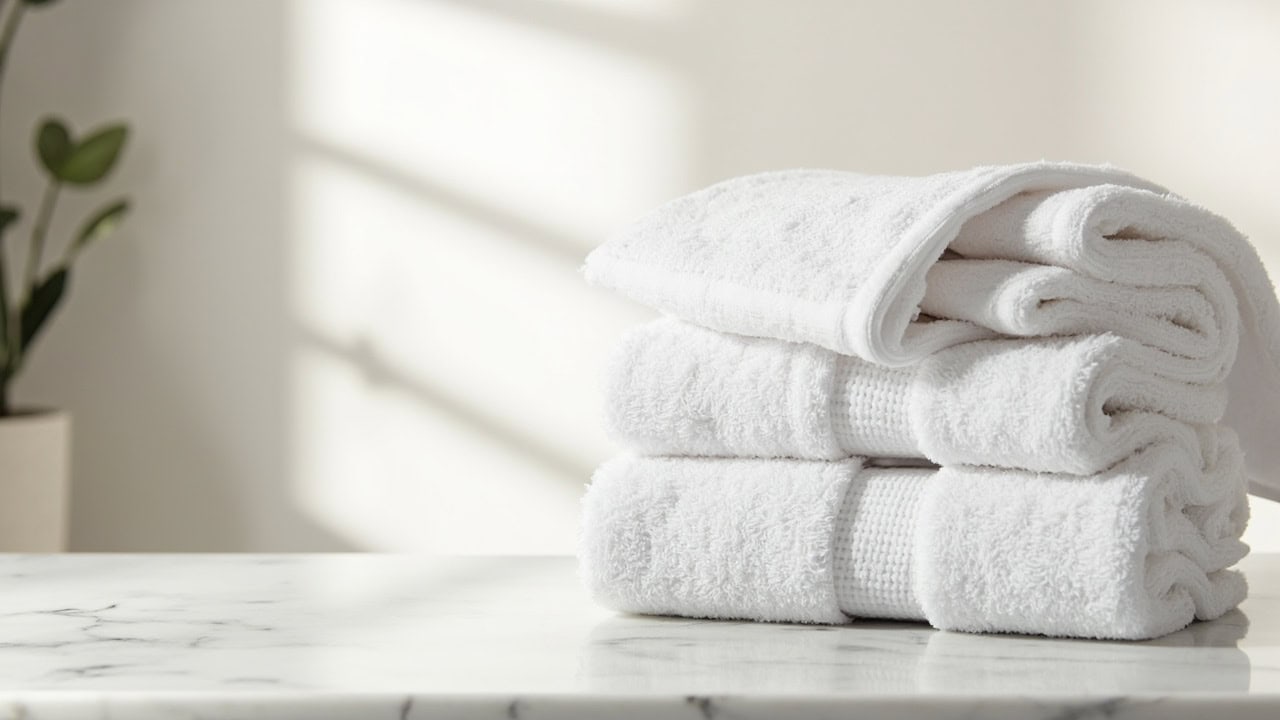
How to Keep Towels Soft: Complete Guide

Towels stay soft when washed with 1/4 cup (60 ml) white vinegar per load to neutralize hard water minerals, dried on low heat or line-dried, and shaken vigorously before drying to fluff fibers. Fabric softener should be avoided — it coats cotton fibers with hydrophobic residues that cause stiffness over 3–5 wash cycles. Hard water, which the United States Geological Survey classifies as containing more than 121 mg/L of calcium carbonate, deposits minerals on cotton fibers during every wash, making towels progressively rougher and less absorbent unless treated with an acid rinse.
What You Need Before You Start
- White distilled vinegar (5% acidity) — the primary softening agent
- Baking soda (optional, for deep-cleaning stiff towels)
- Mild liquid laundry detergent (pH 7–9)
- Dryer balls or clean tennis balls (optional, for mechanical fluffing)
- Access to a washing machine and dryer or clothesline
- Water hardness test strips (to confirm whether hard water is contributing to stiffness)
Step-by-Step Process for Keeping Towels Soft
- Measure vinegar correctly — Add 1/4 cup (60 ml) white distilled vinegar to the fabric softener dispenser or directly into the drum during the rinse cycle. Vinegar’s 5% acetic acid (pH approximately 2.5) dissolves limescale and calcium deposits by converting insoluble calcium carbonate into soluble calcium acetate, which rinses away cleanly. Unlike commercial softeners, vinegar leaves no residue on cotton fibers.
- Use minimal detergent — Use only 1–2 tablespoons (15–30 ml) of mild liquid detergent per load. Excess detergent binds to minerals in hard water, creating a stiff film on fibers that resists removal in subsequent washes. Most people use 2–3 times more detergent than necessary, and the surplus settles into towel fibers during the spin cycle.
- Wash in warm water (not hot) — Set the washer to warm (90–100 °F / 32–38 °C). Hot water (above 130 °F / 54 °C) causes cotton fibers to swell and opens the fiber cuticle, allowing dissolved calcium and magnesium ions to penetrate deeper. Warm water cleans effectively at a neutral to mildly alkaline pH while minimizing mineral absorption into the fiber structure.
- Shake towels before drying — Remove towels from the washer and give each one 3–4 vigorous shakes to separate matted fibers before transferring to the dryer. This mechanical action restores loft and prevents fibers from compacting against each other during the tumble cycle, which directly contributes to the plush feel of a soft towel.
- Dry on low heat or line dry — Set the dryer to low heat (under 135 °F / 57 °C) or air dry on a clothesline. High dryer temperatures cause cotton cellulose fibers to undergo thermal shrinkage and permanent compaction. Line drying preserves fiber structure but may leave towels feeling slightly stiff from mineral-rich water evaporation; a brief 5-minute low-heat tumble after line drying restores softness.
- Use dryer balls in the drum — Add 2–3 wool or rubber dryer balls to the cycle. They physically separate and lift towel fibers during tumbling, preventing matting and reducing drying time by up to 25%. Dryer balls also help maintain the loft that keeps towels absorbent and plush without introducing chemical coatings.
Towel-Specific Considerations
The softness and longevity of a towel depend on its raw materials and construction. Understanding how cotton type, weight, and weave affect performance helps you select towels that stay soft longer and respond better to proper washing techniques. For more guidance on fabric care fundamentals, see our complete laundry care guide.
| Factor | Impact on Softness | Recommendation |
|---|---|---|
| Cotton type | Long-staple cotton pills less and retains softness longer | Choose Egyptian or Pima cotton |
| GSM weight | Higher GSM = thicker, denser loops that feel plusher | 400–600 GSM optimal for bath towels |
| Weave | Terry cloth loops trap air and hold softness | Avoid flat-woven or jacquard-heavy sections |
| Age | Fibers break down and lose elasticity over time | Replace towels every 2–3 years |
| Color dyes | Dark dyes can stiffen fibers during manufacturing | Wash dark towels in cold water with mild detergent |
Why Fabric Softener Causes Stiffness
Fabric softener contains cationic surfactants — positively charged molecules that deposit a thin hydrophobic coating on cotton fibers. While this coating initially feels slick and smooth, it accumulates over 3–5 wash cycles, creating a waxy buildup that repels water and reduces absorbency by up to 30%. The coating also traps odor-causing bacteria inside the fiber matrix, which is why towels washed repeatedly with softener often develop a persistent sour smell despite appearing clean.
The chemistry is straightforward: cationic surfactants carry a positive charge that bonds electrostatically to the negatively charged cotton cellulose surface. Each application adds another molecular layer. After several cycles, the accumulated coating prevents water from penetrating the fiber, leaving towels feeling stiff, papery, and noticeably less effective at drying your skin. Switching to a vinegar rinse eliminates this buildup — the mild acid dissolves the surfactant bond and flushes the residue away.
A single tablespoon of fabric softener can leave enough residue on a towel to reduce its absorbency measurably after just three washes. Vinegar at the correct dilution ratio (1/4 cup per load) strips this residue without damaging fibers.
Drying and Finishing Towels
- Fold immediately when slightly damp — Over-drying makes cotton fibers brittle and causes microscopic breakage along the fiber length. Remove towels from the dryer when approximately 15–20% moisture remains for optimal softness retention. They will finish drying naturally while folded.
- Store in a dry, ventilated location — Moisture trapped in folded towels promotes bacterial growth and musty odors that directly counteract softness efforts. If towels develop an odor despite proper washing, our guide on how to remove musty smell from towels provides a targeted treatment protocol.
- Use the towel snap test — A properly soft towel will produce a crisp snapping sound when waved briskly through the air and will feel plush against your skin without any scratchiness. If it sounds dull or feels flat, the fibers have compacted and need a vinegar rinse treatment.
Common Mistakes That Make Towels Stiff
- Using too much detergent — Excess detergent (more than 2 tablespoons per load) binds to calcium and magnesium in hard water, forming soap scum that coats fibers with a stiff, chalky film. This film hardens during drying and becomes increasingly resistant to removal in subsequent washes. For hard water areas specifically, see our article on removing hard water stains from fabrics.
- Overloading the dryer — Towels need room to tumble freely. Cramming too many into a single cycle prevents the mechanical agitation that fluffs fibers, resulting in matting and compaction. Dry towels in loads that fill no more than two-thirds of the drum capacity.
- Washing with hot water only — Consistently using hot water (above 130 °F / 54 °C) opens cotton fiber cuticles and allows dissolved minerals to penetrate deeper into the fiber structure. Alternating between warm and cold water helps release detergent and mineral residues that hot water alone cannot remove.
- Skipping the vinegar rinse — Without periodic acid treatment (every 3–4 loads minimum), hard water minerals accumulate progressively on fiber surfaces and cause permanent stiffening over months. Vinegar’s short dwell time in the rinse cycle is sufficient to dissolve these deposits.
How to Restore Stiff Towels
Towels that have already become stiff from mineral or detergent buildup can be restored with a two-step stripping process. This method is more aggressive than routine maintenance and should be used only when towels feel noticeably rough or have lost absorbency.
- Run towels through a normal wash cycle with 1/2 cup baking soda instead of vinegar. Baking soda (sodium bicarbonate, pH 8.3) acts as a mild abrasive and alkaline cleaner that breaks down heavy detergent buildup and loosens trapped oils more effectively than acid-based treatments.
- Follow with a second wash cycle using 1 cup white vinegar in the rinse. The acid dissolves the mineral deposits that the baking soda loosened, flushing them from the fiber matrix entirely.
- Dry on low heat with 2–3 dryer balls to mechanically restore loft and fiber separation during the tumbling process.
- Evaluate softness after drying. For severely stiff towels, repeat the baking soda cycle once more — this double-treatment removes mineral deposits and residue buildup that single treatments miss.
This stripping protocol is also effective for bathroom rugs and other thick cotton items that accumulate detergent and mineral buildup over time. The baking-soda-first approach ensures that alkaline residues are cleared before the acid rinse dissolves the remaining mineral deposits.
Frequently Asked Questions
Q: How often should I use vinegar in my towel wash?
A: Add 1/4 cup white vinegar to every rinse cycle for optimal softness. In hard water areas (above 121 mg/L calcium carbonate, as classified by the USGS), this frequency prevents mineral accumulation that causes permanent stiffness. For standard water, every 3rd load maintains softness without over-acidifying the fibers.
Q: Can I use fabric softener sheets in the dryer instead of liquid softener?
A: Dryer sheets deposit the same hydrophobic coating as liquid softener but only on surface fibers. They provide temporary surface slickness without addressing underlying stiffness. For lasting softness, skip dryer sheets and use dryer balls instead — they mechanically separate fibers rather than coating them with chemical residues.
Q: Why do new towels feel stiff even after washing?
A: New towels often have factory chemical finishes (sizing agents) applied during manufacturing to improve shelf appearance. These finishes repel water and create a slick, stiff surface. Washing new towels 3–4 times with vinegar and low-heat drying removes these coatings and reveals the natural cotton softness underneath.
Q: Does water hardness actually affect towel softness?
A: Hard water contains calcium and magnesium ions (typically above 121 mg/L as classified by the USGS) that bind to cotton fibers during washing, creating mineral deposits called limescale. These deposits coat individual fibers and cause them to stick together, resulting in a rough, scratchy texture. Water softeners or regular vinegar treatment neutralizes these minerals before they can bind to fibers.
References
- United States Geological Survey. (2019). Water Hardness. USGS Water Science School.
- International Fabricare Institute. (2018). Guidelines for Cotton Towel Care and Maintenance. International Fabricare Institute.
- American Cleaning Institute. (2020). Laundry Detergent Dosage Recommendations. American Cleaning Institute.
- University of Minnesota Extension. (2021). Caring for Cotton and Linen Textiles. University of Minnesota Extension.
- AATCC — American Association of Textile Chemists and Colorists. (2022). Standard Test Methods for Textile Absorbency. AATCC.


