
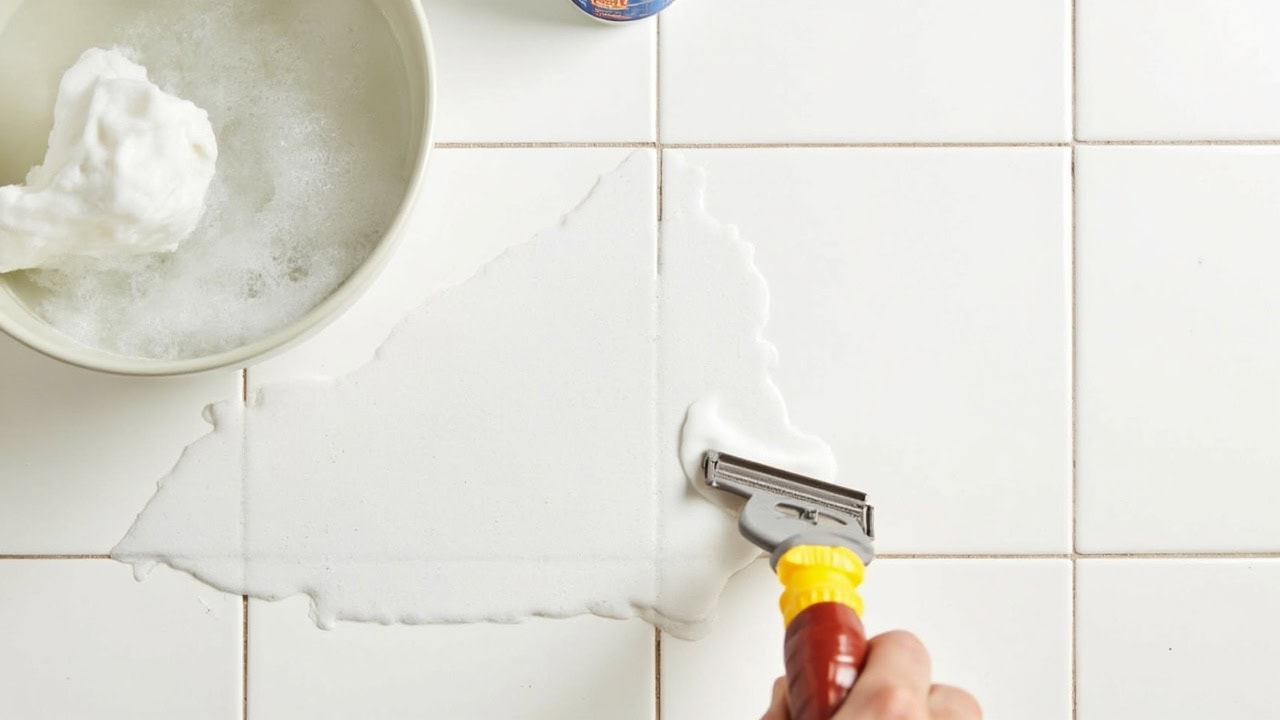
How to Remove Wax from Tile Floors

Heat and dish soap dissolve wax from tile floors at 140°F — combine boiling water, a razor scraper, and mineral spirits for complete removal without damaging grout or glazed tile. Wax accumulates on tile floors through repeated application of liquid wax products or through overspray from spray-mist waxes used on nearby hardwood surfaces, creating a cloudy translucent film that dulls the tile finish and traps dirt in grout lines. The combined thermal-chemistry method described here — heat to liquefy the wax polymer, scraping to lift the bulk, and mineral spirits to dissolve residual film — restores the original tile glaze without abrasive damage.
What You Need Before You Start
Gather these supplies before beginning — having everything within reach prevents mid-process trips that allow wax to cool and re-solidify on the tile surface. The specific tools matter more than the cleaning agents: a plastic razor scraper is non-negotiable because metal tools permanently scratch glazed tile, and microfiber cloths are superior to paper towels because they trap dissolved wax rather than spreading it.
Tools
- Plastic razor scraper (never use metal scrapers or putty knives on tile — they scratch glazed surfaces permanently)
- Microfiber cloths (6–8 clean cloths for wiping, turning frequently to avoid re-depositing wax)
- Bucket for rinse water and mop
- Cotton swabs or soft toothbrush for precision grout cleaning
Cleaning Agents
- Dish soap — a surfactant-based wax emulsifier that breaks the bond between wax and tile surface through micelle formation
- Mineral spirits (white spirit) — a petroleum-derived nonpolar solvent with boiling point 145–174°C (293–345°F) that dissolves wax hydrocarbons through polarity matching; mineral spirits below 0.1% water solubility means it does not mix with water, allowing sequential solvent then soap application
- White vinegar (5% acetic acid) — useful only for赛后 rinsing of water-based residue on grout; not a wax remover
Safety Requirements
- Ventilate the room — mineral spirits emits VOCs at up to 500 ppm (OSHA PEL for 8-hour exposure); open windows and use fans
- Wear nitrile gloves — prolonged skin contact with mineral spirits causes severe irritant dermatitis
- Avoid open flames — mineral spirits flash point is 31–54°C (87–129°F) depending on grade
Temperature Specifications
Water must reach at least 140°F (60°C) to thermally soften standard floor waxes. Beeswax melts at 62–65°C (144–149°F) and carnauba wax at approximately 66°C (150°F). Wax remains solid below 70°F, becomes pliable in the 70–140°F range, and liquefies above 150°F. Boiling water poured directly onto wax provides sufficient thermal energy to transition the wax from solid to pliable or liquid state within the 60-second dwell time specified in the removal method.
Why Wax Bonds to Tile Floors
Understanding the science of why wax adheres to tile determines which removal approach works — and why certain methods fail. Wax does not chemically bond to tile; it bonds through a combination of van der Waals forces and mechanical interlocking in grout lines and micro-pores of textured or unglazed tile surfaces.
Van der Waals forces are weak, distance-dependent intermolecular attractions between the wax molecules and the tile surface molecules. These forces become significant when surfaces are in close contact — the closer the approach, the stronger the attraction. On smooth glazed porcelain or ceramic tile, the low surface energy of the glaze means van der Waals attraction is relatively weak, which is why wax peels off more easily from glazed tile than from vinyl or linoleum. However, repeated waxing over months or years creates a layered film where each new wax layer bonds to the previous one rather than directly to the tile, producing a cumulative buildup that appears cloudy and dull.
Grout lines present a fundamentally different adhesion challenge. Grout is a porous Portland cement and sand mixture that absorbs liquid wax like a sponge. Once wax enters the grout’s micro-pore structure, it cannot be scraped free because the wax is below the surface. The grout’s porosity classification (W-grade grout indicates reduced water absorption, but no grout is fully impervious to hydrocarbon solvents) means wax that has been absorbed into grout lines requires chemical dissolution with mineral spirits, not heat and scraping alone. A 2-minute dwell time with mineral spirits applied via cotton swab allows the solvent to penetrate the grout micro-pores and dissolve the absorbed wax from within.
What NOT to Use on Tile Floors
Using the wrong tools or cleaning agents on tile floors causes damage that is often permanent. The most common failures in wax removal come from choosing aggressive methods that damage the tile surface faster than they remove the wax.
- Metal scrapers or putty knives — Scratch glazed tile surfaces permanently by cutting into the glass-like glaze layer. Even light scratching creates a permanent dull haze visible under lighting.
- Abrasive scrub pads or steel wool — Create micro-abrasions that produce a permanent dull film on glazed tile. Unlike scratches visible to the naked eye, micro-etching creates a diffuse haze that cannot be polished out.
- Bleach or ammonia-based cleaners — Do not dissolve wax and accelerate grout pigment degradation. Bleach oxidizes the iron oxide pigments in colored grout, causing permanent fading. Ammonia etches the glaze on some ceramic tiles.
- Vinegar above 10% concentration — Acetic acid at concentrations above 10% presents an acid-etching risk on marble or limestone tiles that may be installed adjacent to or in the same room as ceramic tile. Standard 5% white vinegar does not etch ceramic tile but also does not dissolve wax.
- Heat above 200°F (93°C) — Steam vapor and heat guns above 200°F can crack some ceramic tiles through thermal shock, or blister the glaze on lower-quality ceramic tiles. The boiling water pour method delivers heat at approximately 212°F (100°C) at sea level, which is safe for ceramic tile as long as it is poured rather than applied as sustained steam.
Step-by-Step Wax Removal Method
Follow each step in sequence. Skipping steps — particularly the soap wash and clean water rinse at the end — leaves mineral spirits residue that itself creates a dull film on the tile surface. Each cycle of heat and scraping removes approximately one wax layer; thick buildup requires multiple cycles.
- Heat the wax — Bring water to a full rolling boil. Pour it slowly and directly onto the waxed area, ensuring the water covers the entire wax deposit. Allow the water to dwell for 60 seconds. At 140°F minimum, the thermal energy raises the wax temperature above its plastic range (70–140°F), making it pliable enough to scrape.
- Scrape at a 45° angle — Holding the plastic razor scraper at exactly 45 degrees to the tile surface, push firmly in one direction only. Never drag the scraper back and forth — each return pass spreads liquefied wax into grout lines. Lift the scraper after each pass, return to the starting edge, and make the next pass adjacent to the first, overlapping slightly. Each pass should remove a continuous ribbon of softened wax.
- Re-heat and repeat — For wax buildup thicker than three layers, pour fresh boiling water and repeat the scraping pass. Expect 3–4 heat-scrap cycles for moderate wax buildup and 5–6 cycles for heavy buildup. Reheat before each scraping pass; wax re-cools and solidifies within 30–45 seconds of the water cooling.
- Apply mineral spirits — Dampen a microfiber cloth with mineral spirits — the cloth should be wet but not dripping. Dab the cloth onto remaining wax residue rather than scrubbing, which avoids spreading. Allow 30 seconds of dwell time for the nonpolar solvent to dissolve the hydrocarbon wax polymer. The dissolved wax appears as a translucent film on the cloth.
- Wipe clean — Using a clean section of the microfiber cloth, wipe the dissolved wax and mineral spirits residue from the tile surface. Change to a fresh cloth or fresh section when the cloth becomes saturated with wax. Fold the cloth frequently to maintain a clean wiping surface.
- Wash the floor — Prepare a cleaning solution of 1 teaspoon of dish soap per 1 gallon of warm (not hot) water. Dish soap’s surfactant molecules — with hydrophilic heads and hydrophobic tails — emulsify any remaining mineral spirits residue by forming micelles that encapsulate the solvent molecules, allowing them to be suspended in water and mopped away. Mop the entire tile surface systematically, working from the far corner toward the exit.
- Rinse with clean water — Mop a second time with clean warm water to remove any soap film residue. Soap residue left on the tile surface attracts dust and creates streaks. Allow the floor to air dry completely — typically 30–60 minutes with normal ventilation — before walking on the area.
How to Prevent Future Wax Buildup on Tile Floors
Prevention is substantially easier than remediation. Wax on glazed ceramic and porcelain tile is always a problem because these surfaces have low surface energy and do not benefit from wax coatings the way hardwood or linoleum does. A waxed tile floor requires more maintenance, not less.
- Never apply liquid wax or floor finish to glazed ceramic or porcelain tile. These surfaces are already glazed — a glass-like protective layer fired at high temperature. Wax does not penetrate the glaze and instead creates a separate film that traps dirt and becomes slippery. The only maintenance glazed tile needs is sweeping and damp mopping with a pH-neutral cleaner.
- Shield grout lines when using spray-mist wax on adjacent hardwood. Apply painter’s tape along the seam between hardwood and tile before spraying any aerosol wax product. Wax overspray travels up to 3 feet from the spray point and is nearly impossible to remove from porous grout once it has been absorbed.
- Sweep or dust-mop tile floors weekly to remove abrasive particles including sand, road salt, and silica grit that are tracked in from footwear. These particles act as microscopic cutting tools, grinding into grout lines and creating micro-scratches on tile surfaces that accelerate soiling and degrade the grout sealer.
- Clean spills immediately with a damp microfiber mop. Prolonged liquid exposure on unsealed grout degrades the grout sealer and creates conditions for mold and mildew growth between tiles. Re-seal grout annually in high-traffic areas using a water-based or solvent-based grout sealer appropriate for the grout type.
Common Mistakes When Removing Wax from Tile
| Mistake | Why It Damages Tile | Correct Approach |
|---|---|---|
| Using a metal scraper | Permanently scratches the glazed surface, creating a visible dull haze that cannot be polished out | Always use a plastic razor scraper held at a 45° angle |
| Applying bleach to grout | Bleach oxidizes iron oxide pigments in colored grout, causing permanent fading and spot bleaching | Use pH-neutral dish soap solution (pH 7–8) for all grout cleaning |
| Skipping the rinse step | Mineral spirits residue left on tile creates a persistent dull film that mimics remaining wax | Mop with dish soap solution, then mop with clean water — always complete both steps |
| Using a steam mop | Sustained steam vapor above 200°F (93°C) can crack ceramic tiles through thermal shock or delaminate stone tiles from their mortar bed; steam also pushes liquid wax deeper into grout lines | Use a boiling water pour for heat application — the brief thermal contact is safer than sustained steam |
| Scrubbing back-and-forth | Dragging the scraper backward re-deposits liquefied wax into grout lines where it is absorbed and becomes much harder to remove | Push in one direction only, lifting the scraper between each pass |
Frequently Asked Questions
Q: Can I use a heat gun to remove wax from tile floors?
A heat gun set below 150°F can soften wax, but steam cleaners and heat guns above 200°F risk cracking ceramic tiles and delaminating grout. A pot of boiling water is safer and equally effective — it delivers heat at approximately 212°F in a brief contact that raises wax temperature above its plastic range without sustained thermal stress to the tile.
Q: Does white vinegar remove wax from tile floors?
White vinegar at 5% acetic acid concentration does not dissolve wax. Wax is a hydrocarbon polymer insoluble in water and only weakly responsive to polar acids. Vinegar acts as a surfactant that helps clean water-based residues but cannot break the carbon-hydrogen bonds in wax. Mineral spirits or heat are required to dissolve and remove wax from tile surfaces.
Q: Will a steam mop remove wax from tile?
A steam mop can soften surface wax but the water temperature drops too quickly to fully liquefy thick wax buildup, and steam pressure pushes liquid wax deeper into grout lines making removal significantly harder. For complete wax removal, use the boiling water pour method for heat application followed by mineral spirits solvent treatment.
Q: How do I remove old wax from tile grout specifically?
Old wax absorbed into grout requires a 2-minute dwell time with mineral spirits applied via cotton swab or small soft-bristle brush. The solvent must physically contact the wax within the grout micro-pores. After 2 minutes, scrub gently with a soft toothbrush to work the dissolved wax out of the pores, then wipe clean with a microfiber cloth. Repeat if necessary for heavy buildup, and rinse the grout line with a damp cloth afterward.
References
- Wikipedia. (2025). Wax. https://en.wikipedia.org/wiki/Wax
- Wikipedia. (2025). Mineral spirits. https://en.wikipedia.org/wiki/Mineral_spirits
- Wikipedia. (2025). Surfactant. https://en.wikipedia.org/wiki/Surfactant
- Wikipedia. (2025). Grout. https://en.wikipedia.org/wiki/Grout
- Wikipedia. (2025). Van der Waals force. https://en.wikipedia.org/wiki/Van_der_Waals_force
- U.S. National Institute for Occupational Safety and Health (NIOSH). (2025). Mineral Spirits — NIOSH Pocket Guide to Chemical Hazards. https://www.cdc.gov/niosh/npg/
- U.S. Occupational Safety and Health Administration (OSHA). (2025). Mineral Spirits — OSHA Permissible Exposure Limits. https://www.osha.gov/


