
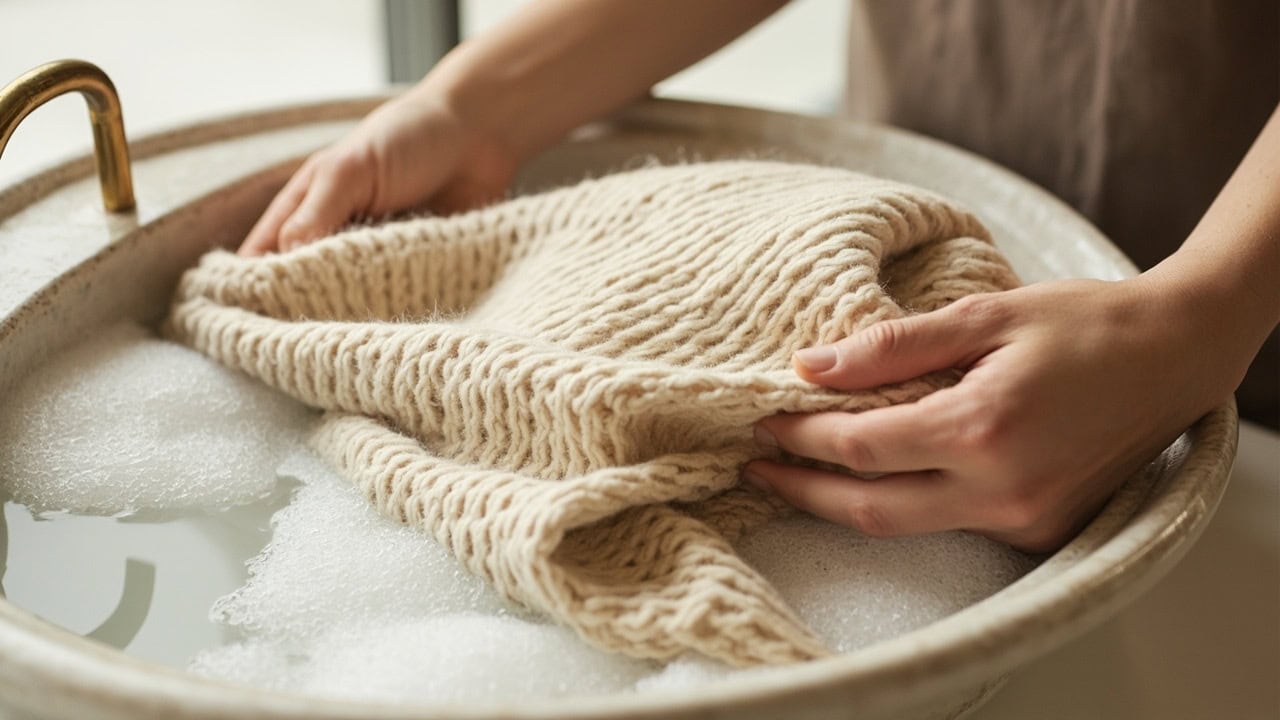
How to Wash Cashmere at Home

Cashmere must be washed by hand in cool water at 30°C (86°F) using a dedicated cashmere shampoo or mild baby shampoo, with a maximum 2-minute gentle agitation soak followed by flat drying on a clean towel to prevent stretching and preserve the fiber’s natural softness. Cashmere fibers — harvested from the undercoat of Capra hircus goats — have an average diameter of just 14–19 microns, making them roughly one-third the thickness of human hair and exceptionally vulnerable to mechanical damage, heat, and harsh chemicals. Proper hand washing at the correct temperature with the right products keeps cashmere garments soft, shaped, and pill-resistant for decades.
What You Need Before Washing Cashmere
Gathering the right supplies before you start prevents mid-wash improvisation that can damage cashmere fibers. Cashmere is a protein fiber — structurally similar to human hair — with delicate cuticle scales that can lift, break, or matte when exposed to the wrong products or temperatures. Every item in your washing kit should be selected to protect those scales and preserve the natural lanolin that gives cashmere its signature hand feel.
- Cashmere shampoo or mild baby shampoo — Must be pH-neutral (pH 5.5–7.0) and free of enzymes that break down animal fibers. Enzymatic cleaners containing protease literally digest the keratin protein in cashmere, causing irreversible fiber degradation.
- Large clean basin or sink — Filled with cool water at 30°C (86°F). Use a kitchen thermometer to verify — water that feels “cool” to the hand can easily exceed 40°C, which is hot enough to begin shrinking cashmere fibers.
- Two clean, absorbent towels — One serves as the rolling surface for moisture extraction; the second provides the flat drying base. White towels are ideal to avoid any risk of dye transfer onto damp cashmere.
- Cashmere comb or soft-bristled garment brush — For post-wash de-pilling. A dedicated cashmere comb has fine, evenly spaced teeth designed to catch pills without cutting or abrading the underlying fibers.
- Flat drying surface — A mesh drying rack allows air circulation from both sides, reducing total drying time by several hours. A clean, dry towel on a flat surface works as an alternative.
Avoid substituting regular laundry detergent for cashmere shampoo. Standard detergents contain surfactants and enzymes formulated for cotton and synthetic fibers — their alkaline pH (typically 8–10) lifts and roughens cashmere cuticle scales, producing the dull, rough texture and persistent pilling that ruins garments after just a few washes. For detailed guidance on selecting the right cleaning product for delicate fabrics, see our guide to the best detergents for delicate fabrics.
Step-by-Step Cashmere Washing Process
Follow these steps in order. Each one protects a specific aspect of cashmere fiber integrity — skipping or rearranging them increases the risk of shrinkage, stretching, pilling, or color bleeding. The entire hand-washing process takes roughly 10 minutes of active work plus 24–48 hours of drying time.
- Fill a clean basin with cool water at 30°C (86°F). Hot water is the single most common cause of cashmere damage. Temperatures above 30°C cause the protein fibers to relax and contract unevenly, resulting in permanent shrinkage — garments can lose up to two full sizes in a single hot-water wash. Cold water below 20°C is safe but less effective at dissolving body oils and trapped soils in the fiber matrix.
- Add 1–2 teaspoons of cashmere shampoo and gently swirl to distribute evenly. Do not create a heavy lather — excessive suds indicate too much product, which becomes difficult to rinse from dense cashmere knits. A light, even dispersion of shampoo in the water is sufficient. The surfactant action of the shampoo suspends oils and soils in the water without aggressive chemical action.
- Submerge the cashmere garment and gently press through the water with your palms. Do not rub, twist, or wring. Use a gentle pressing and squeezing motion to push the soapy water through the fibers. Rubbing creates localized friction that lifts cuticle scales and initiates pilling; twisting stretches the yarn unevenly and distorts the garment’s shape permanently.
- Allow the garment to soak for 2 minutes maximum. Extended soaking weakens cashmere fibers by allowing water to penetrate and swell the protein structure beyond its elastic limit. Two minutes is sufficient for the shampoo to lift trapped oils and debris without compromising fiber integrity.
- Drain the basin and rinse the garment with cool water at the same temperature (30°C) until all shampoo is removed. Temperature consistency between wash and rinse prevents thermal shock, which causes rapid fiber contraction and uneven shrinkage. Typically two to three basin changes of clean water are needed until no suds remain when you gently squeeze the garment.
- Press the garment gently against the basin edge to remove excess water — never wring or twist. Support the full weight of the wet garment in one hand while pressing with the flat of your other palm against the basin wall. Wringing concentrates stress on the shoulder and side-seam areas, causing irreversible stretching where the yarn is weakest.
- Lay the garment flat on a clean dry towel and roll the towel loosely to absorb remaining moisture. Position the cashmere item in its natural flat shape on the towel, then roll from one end like a sleeping bag. Press gently along the roll — the towel wicks moisture out of the fibers through capillary action without any mechanical stress on the yarn.
- Reshape the garment to its original dimensions and lay flat on a mesh drying rack away from direct sunlight and heat. Gently coax necklines, cuffs, and hemlines back to their intended shape while the fibers are still damp and pliable. Flat drying on a mesh rack allows air to circulate around the entire garment, producing even drying without distortion.
If your cashmere garment has visible stains, pre-treat them before the full wash cycle. Our stain removal guide covers the safe, fiber-friendly methods for lifting common stains from delicate woolens without damaging the underlying cashmere.
Cashmere-Specific Considerations: What to Avoid
Understanding what not to do is as important as the correct technique. Cashmere’s ultra-fine fiber diameter means mistakes that would be invisible on coarser wools show up immediately as permanent damage on cashmere. The following six rules apply to every cashmere garment regardless of knit weight, ply, or construction.
- Never use regular laundry detergent. Standard detergents contain enzymatic cleaners with protease and lipase enzymes designed to break down protein chains and fats — the exact compounds that form cashmere fiber. A single wash with regular detergent can strip the natural cuticle layer, producing irreversible damage, fiber weakening, and excessive pilling within one to two wash cycles.
- Never wash cashmere in a washing machine — even on the delicate cycle. The mechanical agitation of a washing machine drum, including front-loading machines on their gentlest setting, subjects cashmere to repetitive friction and torsion that causes matting, felting, and fiber breakage. Felting is irreversible — once the cuticle scales interlock and fuse, the garment cannot be restored.
- Never use fabric softener. Liquid fabric softeners deposit a silicone coating on each fiber that blocks the natural lanolin — the waxy substance secreted by cashmere goats that gives the fiber its distinctive softness, luster, and moisture-wicking properties. Stripped of its lanolin, cashmere feels flat, lifeless, and prone to static cling.
- Never hang cashmere to dry. A wet cashmere sweater can hold up to 30% of its weight in water. Suspended from a hanger, the concentrated weight at the shoulders stretches the yarn beyond its elastic recovery point, producing permanent “shoulder nipples” and a lengthened, distorted silhouette.
- Never tumble dry cashmere. The combination of heat (even on low settings) and tumbling action causes severe shrinkage — often 15–20% reduction in length — and surface damage to the cuticle scales. A tumble-dried cashmere sweater will emerge stiff, matted, and significantly smaller.
- Never use bleach on cashmere. Chlorine bleach dissolves the disulfide bonds in keratin protein, the structural backbone of cashmere fiber. Exposure to bleach literally liquefies the fiber — even brief contact produces holes, extreme weakening, and complete loss of the fabric’s structural integrity.
How Often to Wash Cashmere
Cashmere is naturally odor-resistant due to the fiber’s unique ability to wick moisture vapor away from the skin before it condenses into liquid sweat. The keratin protein in cashmere fibers contains hydrophilic amino acids that absorb up to 35% of their weight in moisture without feeling damp — this keeps the fiber surface dry and inhospitable to the odor-producing bacteria that thrive in synthetic fabrics. As a result, cashmere garments require washing only every 3–5 wears under normal conditions.
The underarm area may need more frequent attention between full washes. Spot-clean perspiration marks promptly with a damp cloth and a drop of cashmere shampoo, then press with a dry towel and lay flat. Waiting too long allows the salts and oils in perspiration to yellow the fiber and attract moths.
Always wash cashmere before long-term seasonal storage. Body oils, skin cells, and invisible food residues trapped in the fibers are the primary food source for clothes moths (Tineola bisselliella). A clean garment stored properly is far less attractive to moths than one that has been worn even once and put away without washing. For comprehensive garment care guidance beyond washing, visit the Laundry & Fabric Care Hub.
Drying and Finishing Cashmere
The drying and finishing phase determines whether your cashmere retains its shape and softness or emerges distorted and fuzzy. Always dry cashmere flat in its natural shape — any hanging or draping during the drying process introduces gravitational stress that permanently elongates the fibers. Position the garment on a mesh drying rack, gently matching its original dimensions and smoothing any wrinkles with your fingertips while the fibers are still damp.
Reshape necklines, cuffs, and hemlines while damp, before the final drying stage begins. Once the protein fibers dry and set in a position, they resist reshaping — a stretched neckline dried into place will remain stretched. Allow 24–48 hours for complete drying in a well-ventilated room at room temperature. Placing the garment near radiators, heaters, or in direct sunlight accelerates moisture removal but simultaneously causes uneven fiber contraction and surface damage.
Once completely dry, use a cashmere comb to remove any surface pilling. Draw the comb in one direction only — from top to bottom — using light, even pressure. Working in both directions tears pills from the fiber rather than cutting them cleanly, creating rough stubble that pills again faster. For a deeper dive into de-pilling techniques and the tools that work best, see our guide on how to remove pilling from cashmere.
Steam pressing from a distance of 6 inches can restore the garment’s loft and softness after drying. Hold a garment steamer or an iron on the steam setting above — never touching — the cashmere surface. The gentle steam relaxes the fibers without the crushing pressure that an iron’s soleplate would apply. After steaming, let the garment rest flat for 15 minutes so the fibers cool and set in their relaxed state.
Store cashmere folded in breathable cotton bags or acid-free tissue paper — never in plastic dry-cleaning bags or airtight containers. Plastic traps residual moisture, creating a humid microclimate that promotes mildew growth and attracts silverfish. Fold garments with acid-free tissue between layers to prevent dye transfer and creasing. Add cedar blocks or lavender sachets to the storage container as a natural moth deterrent, replacing them every season as the oils dissipate.
Common Mistakes When Washing Cashmere
Even experienced home launderers make errors with cashmere because the fiber tolerates no margin for common shortcuts. The table below maps each frequent mistake to its specific physical consequence and the correct prevention — understanding the why behind each rule makes it easier to follow consistently.
| Mistake | Consequence | Prevention |
|---|---|---|
| Using regular detergent | Rapid fiber degradation, excessive pilling | Use only cashmere-specific shampoo |
| Hot water wash | Shrinkage up to 2 sizes | Maintain 30°C (86°F) maximum |
| Wringing or twisting | Permanent stretching, distortion | Press gently, roll in towel |
| Hanging to dry | Irreversible shoulder stretching | Always flat dry on mesh rack |
| Machine washing | Felting, matting, surface damage | Hand wash only |
| Over-washing | Stripped fibers, lost softness | Wash every 3–5 wears only |
Frequently Asked Questions
Q: Can you wash cashmere that says dry clean only?
A: Yes, most cashmere can be safely hand washed at home even if labeled dry clean only — the dry clean label is often a manufacturer’s liability recommendation rather than a requirement. Always test a hidden seam first by dampening a small area with cool water and pressing with a white cloth to check for color bleeding. If the test area shows no dye transfer or texture change, proceed with a full hand wash using cool water at 30°C and cashmere shampoo. Many cashmere care experts and textile professionals consider hand washing superior to dry cleaning because the solvent-based dry cleaning process strips natural lanolin from the fibers over time, gradually reducing softness.
Q: How do you stop cashmere from pilling after washing?
A: Cashmere pills naturally during wear, not washing — the friction of everyday movement causes loose fibers to migrate to the surface and tangle into small balls. Use a dedicated cashmere comb to remove pills in one direction only after the garment is completely dry, and wash inside out to minimize friction during the cleaning process. Pilling is most concentrated in high-friction areas such as underarms, sides, and where a seatbelt or bag strap crosses the torso. For detailed techniques on restoring your garment’s smooth finish, see our guide on how to remove pilling from cashmere.
Q: Can you use white vinegar when washing cashmere?
A: White vinegar can be used as a final rinse (1 tablespoon per basin of cool water) to remove soap residue and restore fiber softness. Vinegar’s mild acidity (approximately pH 2.5) helps close the cashmere cuticle scales, leaving fibers smoother and softer to the touch. However, vinegar should never be added directly to the wash water as it may affect certain cashmere dyes — always apply it in a separate rinse step and follow with a final clear-water rinse to remove any residual vinegar scent.
Q: How long does cashmere take to dry after washing?
A: Cashmere dries in 24–48 hours when laid flat in a well-ventilated room at room temperature. Thinner knit garments such as summer-weight cashmere cardigans may dry in as few as 18–24 hours, while thick cable-knit sweaters can require the full 48 hours. Placing the garment near heat sources accelerates drying but risks fiber damage and shrinkage — the temperature gradient between the heated side and the unheated side causes uneven contraction. Flip the garment once halfway through drying to promote even moisture loss from both sides.
References
- Woolmark Company. (n.d.). The Woolmark Guide to Cashmere. Woolmark.
- Whirlpool Corporation. (n.d.). How to Wash Cashmere: Care Tips and Instructions. Whirlpool.
- Good Housekeeping Institute. (n.d.). How to Wash Cashmere the Right Way. Good Housekeeping.
- International Wool Textile Organisation. (n.d.). Cashmere Fiber Properties and Care Standards. IWTO.


