
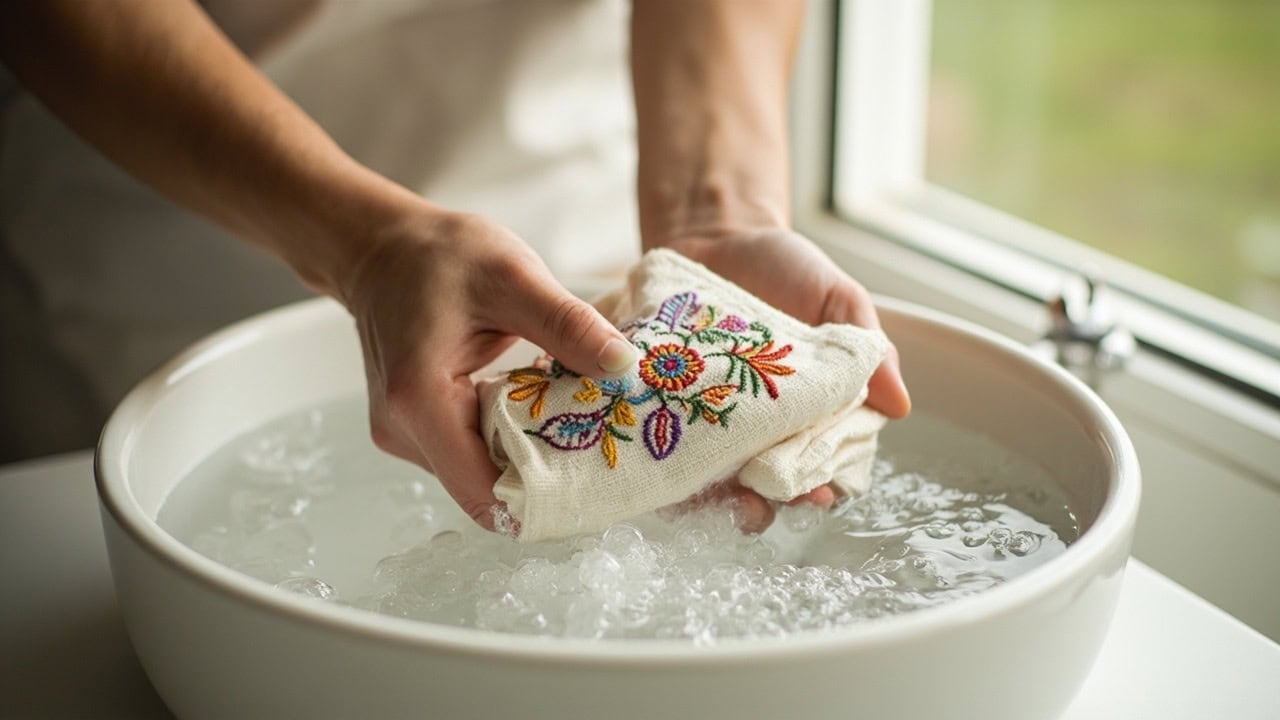
How to Wash Embroidered Clothes

Embroidered clothes must be washed by hand in cold water (below 86°F/30°C) using a mild, pH-neutral detergent at a 1:20 dilution ratio, with all embroidery faced inward to prevent snagging — machine washing causes thread loosening, color bleeding into the embroidered design, and distortion of the fabric backing. Following a structured hand-washing process preserves the thread tension, stabilizer integrity, and color vibrancy that give embroidered garments their visual appeal and structural durability.
What You Need Before Washing Embroidered Clothes
Before you begin, assembling the correct supplies ensures you will not have to improvise mid-wash with products that could damage your embroidery. The goal is to clean the surrounding fabric without degrading the threads, dyes, or stabilizer backing that hold the design together.
- Mild liquid detergent — pH-neutral (pH 6.5–7.5), free of bleach, optical brighteners, and enzymes. Enzymes break down protein-based stabilizers; bleach deteriorates thread fibers and shifts dye colors.
- Cold water — below 86°F (30°C). Use a kitchen thermometer if unsure; tap water “cold” can exceed this threshold in warm climates or during summer months.
- Clean white or light-colored towel — for pressing water out of the garment without transferring dye or lint onto the embroidery.
- Small washbasin or sink — with a smooth, non-abrasive surface. Avoid metal sinks with rough patina that can snag raised embroidery.
- Mesh laundry bag — essential if machine washing becomes unavoidable. Choose a fine-weave bag (mesh openings under 2 mm) to prevent drum holes from catching threads.
- Soft-bristled brush (optional) — only for ground-in soil on non-embroidered areas of the garment. Never brush directly over embroidery.
Step-by-Step Hand-Washing Process for Embroidered Clothes
The following seven-step process is designed to clean embroidered garments thoroughly while subjecting the stitching to minimal mechanical stress. Each step follows a specific sequence — skipping or reordering steps increases the risk of thread damage, dye migration, or stabilizer breakdown.
- Turn the garment inside out. All embroidery faces inward, protecting the design from friction against the washbasin, other garments, or any abrasive surface. This single step is the most effective precaution against snagging and thread pulls.
- Fill a clean basin with cold water and add mild detergent at a dilution ratio of 1:20 (approximately 1 tablespoon of detergent per gallon of cold water). Swirl gently to distribute — avoid creating heavy suds, which can be difficult to rinse from dense embroidery stitching.
- Submerge the garment fully and let it soak for 10–15 minutes. This allows the detergent solution to penetrate the fabric weave and loosen surface soil without agitation. Do not exceed 15 minutes; prolonged soaking can weaken water-soluble stabilizer backings.
- Gently agitate by swishing the garment through the water with slow, deliberate motions. Never scrub, rub, or wring the embroidered area — even light friction between the embroidery and the basin bottom can abrade raised stitches and distort thread tension.
- Rinse thoroughly with cold running water until all soap residue is removed. Residual detergent left in embroidery threads attracts dirt and can cause yellowing over time. Continue rinsing until the water runs completely clear and no slickness remains on the fabric.
- Press water out by laying the garment flat on a clean, absorbent towel and rolling it up like a sleeping bag. Apply even pressure along the roll — never twist or wring. Wringing distorts the fabric backing and permanently loosens thread tension in the embroidered design.
- Lay flat to dry on a fresh towel, reshaping the garment while it is still damp. Smooth out any wrinkles around the embroidery by hand, and ensure the embroidered section lies completely flat to prevent dimensional distortion as it dries. For more guidance on handling delicate fabrics through every stage of laundry care, see the Laundry Care Guide.
Embroidered Clothes-Specific Considerations
Thread Type Matters
The type of thread used in your embroidery determines how it reacts to water, detergent, and heat. Cotton embroidery thread is the most absorbent common option — it readily takes up dye but also releases it when exposed to alkaline detergents or warm water above 86°F (30°C). Rayon (viscose) thread has a silk-like luster but lower wet strength; when saturated, rayon fibers weaken by up to 40%, making them vulnerable to snagging during agitation. Polyester thread is the most durable and colorfast option — it resists shrinking, stretching, and dye bleeding at temperatures below 250°F (121°C). Metallic thread is the most delicate category; its core is typically polyester wrapped in a thin foil layer that flakes or tarnishes when exposed to harsh detergents, bleach, or excessive friction.
Fabric Backing and Stabilizer
Embroidery relies on a stabilizer backing to keep stitches aligned during production and to support the design during the garment’s life. Three main types exist, and each reacts differently to water and heat. Water-soluble stabilizers (typically polyvinyl alcohol film) dissolve completely in warm water — this is why cold water below 86°F (30°C) is critical during hand-washing. Cut-away stabilizers remain permanently fused to the fabric backing and are the most durable option, but excessive agitation can cause the stabilizer edges to fray and poke through the embroidery. Tear-away stabilizers are partially removed after embroidery but leave residual fibers in dense stitch areas; these fibers can mat and clump when exposed to heavy agitation or enzyme-based detergents.
Colorfastness Testing
Before washing the entire garment, test colorfastness on a small, inconspicuous area of the embroidery — the inside hem or collar facing works well. Press a white cotton cloth dampened with your detergent solution against the embroidery and hold for 30 seconds. If any dye transfers to the white cloth, the embroidery threads are not colorfast and require an even gentler approach: reduce soak time to 5 minutes, use the lowest possible detergent concentration, and skip agitation entirely. Red, navy, and dark-colored embroidery threads are the most prone to bleeding because their dye molecules are larger and less tightly bound to the fiber. The American Association of Textile Chemists and Colorists (AATCC) Test Method 107 evaluates colorfastness to water, and AATCC TM61 evaluates colorfastness to laundering — both are industry standards used by textile manufacturers to rate how embroidery threads will perform during washing.
Hand Embroidery vs. Machine Embroidery
Hand embroidery sits higher off the fabric surface than machine embroidery because hand stitches are typically longer and less uniformly tensioned. This raised profile makes hand-embroidered garments more susceptible to snagging on zippers, hooks, basin edges, and even coarse washbasin surfaces. Machine embroidery, by contrast, lies flatter with tighter, more uniform tension — it tolerates slightly more handling but is still vulnerable to the same risks from hot water, bleach, and wringing. If you are unsure whether your garment is hand- or machine-embroidered, examine the reverse side: hand embroidery shows irregular, slightly uneven stitches, while machine embroidery displays a precise, grid-like bobbin thread pattern.
Drying and Finishing Embroidered Clothes
Drying embroidered garments correctly is as important as the wash itself. Never hang embroidered clothes to dry — the weight of water-saturated embroidery threads pulls the design downward, stretching the fabric backing and distorting the pattern. Instead, lay the garment flat on a clean, absorbent towel in a well-ventilated area away from direct heat sources. Air drying typically takes 4–6 hours depending on ambient humidity and fabric thickness.
Direct sunlight causes UV degradation of colored threads — red, orange, and violet dyes fade fastest because they absorb higher-energy wavelengths. If outdoor drying is necessary, place the garment in full shade and bring it indoors as soon as it is dry to minimize UV exposure.
If ironing is needed after drying, always place a clean pressing cloth (a thin cotton or muslin square) over the embroidery and iron on the reverse side of the garment. Use the synthetic setting on your iron, which corresponds to approximately 275°F (135°C) — hot enough to remove wrinkles from the surrounding fabric but well below the melting point of polyester thread (approximately 480°F/250°C) and safe for most stabilizer types. Never use a steam iron directly on embroidery. Steam introduces moisture and heat simultaneously, which dissolves water-soluble stabilizer backings and can cause thread puckering as the fibers swell and contract unevenly.
Common Mistakes When Washing Embroidered Clothes
- Machine washing without protection. Top-loading washers with central agitators are the single most damaging environment for embroidered garments. The agitator’s back-and-forth motion catches raised embroidery threads on drum holes or interlocks them with other items, causing runs, loosening, and permanent thread distortion. Front-loading machines without agitators are significantly less harmful.
- Using hot water. Water temperatures above 86°F (30°C) accelerate dye migration from embroidery threads into surrounding fabric. Heat also softens synthetic threads and melts water-soluble stabilizer backings, causing the embroidery to lose structural support. AATCC TM135 measures dimensional changes after home laundering and confirms that temperature is the primary variable driving shrinkage and distortion in embroidered textiles.
- Bleach-based or enzyme-heavy detergents. Sodium hypochlorite bleach (chlorine bleach) chemically degrades both natural and synthetic thread fibers, weakening tensile strength and shifting dye colors. Enzymes in biological detergents — particularly protease and cellulase — break down protein-based stabilizers (gelatin-based cut-away) and cellulose-based tear-away backings. Use only pH-neutral, enzyme-free, bleach-free detergents rated for delicate or baby laundry.
- Wringing or twisting. Twisting a wet embroidered garment concentrates mechanical stress on the embroidered area, where stitching density is highest. This distorts the fabric backing, permanently loosens thread tension, and can shift entire sections of the design out of alignment.
- Drying in direct sunlight. UV radiation breaks down chromophores in dye molecules, causing progressive fading. Red, orange, and violet embroidery threads are most vulnerable because their dye structures absorb higher-energy visible wavelengths. Prolonged sun exposure also weakens cotton and rayon thread fibers through photo-oxidation.
When Machine Washing Is Unavoidable
Certain situations — limited time, physical constraints, or heavily soiled garments — may make hand-washing impractical. When machine washing is the only option, the following precautions dramatically reduce the risk of embroidery damage:
- Use a front-loading washer (no central agitator) on the gentlest cycle available — typically labeled “delicates,” “hand wash,” or “wool.” Front-loading machines tumble garments rather than dragging them through a central column, which eliminates the primary snagging mechanism.
- Place the garment inside a mesh laundry bag. Turn the garment inside out first (embroidery facing inward), then seal it inside a fine-mesh bag. This double barrier prevents drum holes from catching threads and limits friction against other items in the load.
- Select cold water (below 86°F/30°C) and add the minimal effective amount of mild detergent — roughly half the amount you would use for a comparable hand-washing load. Over-dosing leaves residue trapped in dense embroidery stitching.
- Remove the garment immediately after the cycle completes. Do not allow it to sit wet in the drum, where residual moisture can continue weakening stabilizer backings and promoting dye transfer. Lay flat to dry following the same protocol used for hand-washed garments.
For embroidered garments with specific stains that need treatment before washing, see How to Remove Stains from Embroidered Clothes for pre-treatment techniques that will not damage thread fibers. If your embroidered item also includes delicate lace or elastic components, the hand-washing techniques in How to Wash Delicate Lingerie apply equally. For stain pre-treatment guidance across all fabric types, the Stain Removal Guide covers techniques that connect laundry care with effective stain treatment.
Frequently Asked Questions
Q: Can you put embroidered clothes in the washing machine?
A: Embroidered clothes should only be machine washed if absolutely necessary and only in a front-loading machine on the gentle cycle with a mesh bag, cold water, and mild detergent — top-loading agitators cause the most damage to embroidery designs. When machine washing is unavoidable, always turn the garment inside out first, use a fine-mesh laundry bag, and remove the garment from the drum immediately after the cycle ends to prevent prolonged moisture exposure that weakens stabilizer backings.
Q: What temperature is safe for washing embroidered clothes?
A: Wash embroidered clothes in cold water below 86°F (30°C) — hot water causes thread dye bleeding, distorts fabric backing, and dissolves water-soluble stabilizers used in the embroidery process. In warm climates where tap water may exceed this threshold, add a handful of ice cubes to the basin or let the cold tap run for 30 seconds before filling to flush warmer standing water from the pipes.
Q: How do you protect embroidery when washing?
A: Turn the garment inside out so all embroidery faces inward, use a mesh laundry bag for machine washing, avoid bleach and enzyme-based detergents, and never wring or twist the garment — instead press water out with a towel. For additional protection, perform a colorfastness test on a hidden area of the embroidery before the first wash to identify threads that may bleed.
Q: Can you use regular laundry detergent on embroidered clothes?
A: Regular laundry detergent is too harsh for embroidered clothes — use a mild, pH-neutral detergent without bleach, optical brighteners, or enzymes, as enzymes break down protein-based embroidery stabilizers and bleach deteriorates thread fibers. Baby detergents or detergents formulated for delicates and silk are generally safe choices because they are designed to clean without aggressive surfactants or additives.
References
- AATCC. (2023). AATCC Test Methods — TM61 Colorfastness to Laundering, TM107 Colorfastness to Water, TM135 Dimensional Changes after Home Laundering. American Association of Textile Chemists and Colorists.
- ASTM International. (2023). ASTM D5489 — Standard Guide for Care Symbols for Care Instructions on Textile Products. ASTM.
- Federal Trade Commission. (2024). Care Labeling of Textile Wearing Apparel and Certain Piece Goods. FTC.
- ISO. (2020). ISO 3175-2 — Textiles — Professional Care, Drycleaning and Wetcleaning of Fabrics and Garments. International Organization for Standardization.


