
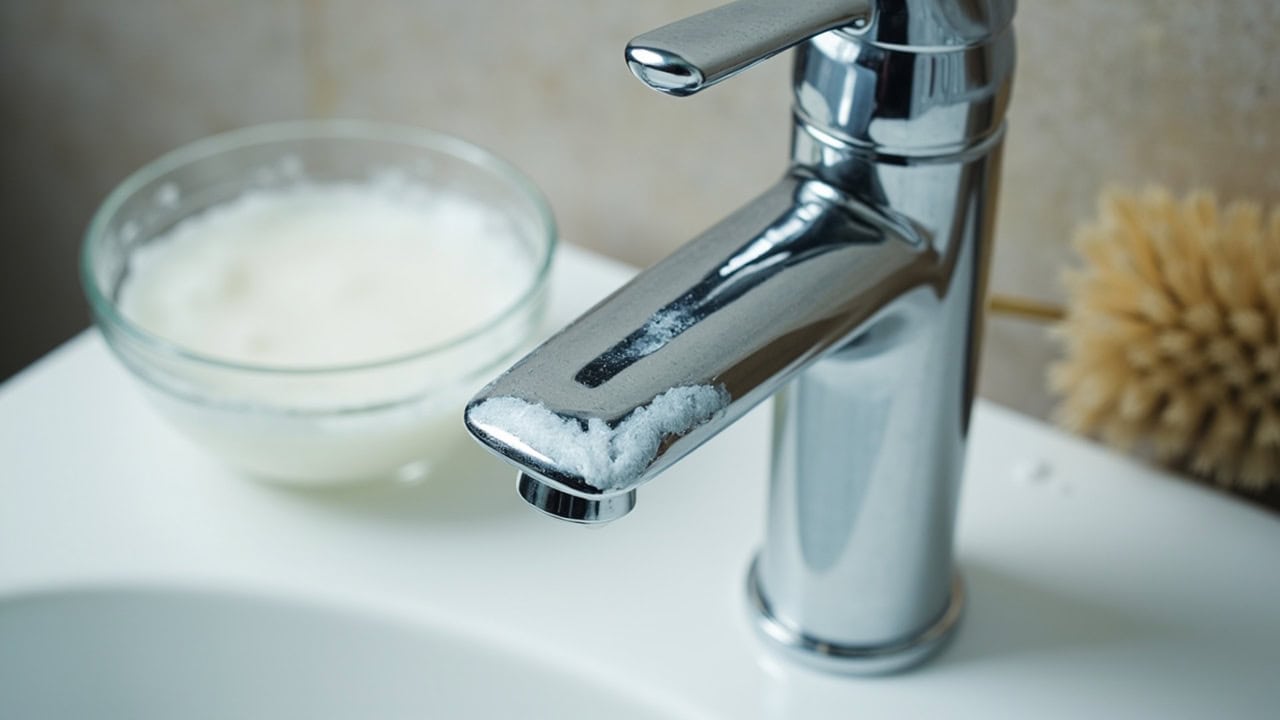
How to Remove Hard Water Deposits from Faucets

Hard water deposits on faucets are dissolved by applying distilled white vinegar (5% acetic acid, pH 2.5) directly to the affected areas and allowing 15–30 minutes of dwell time before scrubbing with a soft brush. The acetic acid chemically reacts with calcium carbonate — the primary mineral in hard water deposits — converting it into water-soluble calcium acetate that rinses away cleanly. According to the United States Geological Survey (USGS), approximately 85% of U.S. homes have hard water, classified as water containing more than 60 mg/L of dissolved calcium and magnesium measured as calcium carbonate. This makes mineral buildup on bathroom faucets one of the most common household cleaning challenges.
What Removes Hard Water Deposits from Faucets
Hard water deposits consist primarily of calcium carbonate (CaCO₃) that precipitates out of water when it evaporates on metal surfaces. Removing these deposits requires either an acid that dissolves the mineral structure or mechanical abrasion that physically breaks the bond between the deposit and the faucet finish. The most effective household solution is distilled white vinegar, which contains 5% acetic acid at pH 2.5 — strong enough to dissolve calcium carbonate but gentle enough for chrome, nickel, and stainless steel finishes when used correctly.
For light deposits under 1/8 inch thick, undiluted white vinegar applied with a soft cloth and left for 15–30 minutes dissolves the majority of visible buildup. Thicker deposits exceeding 1/4 inch require a paste made from baking soda mixed with just enough vinegar to create a spreadable consistency — this combines the chemical dissolving action of acetic acid with the gentle mechanical abrasion of baking soda particles (Mohs hardness 2.5, softer than most metal finishes). Lemon juice, which contains 5–6% citric acid at approximately pH 2.0, works as a natural alternative for light deposits but is less effective on thick, established buildup.
Commercial descaling products offer a stronger option for severe cases. Products containing citric acid or phosphoric acid dissolve mineral deposits faster than household vinegar. However, these products must be used with caution on decorative faucet finishes — always test on an inconspicuous area first and never exceed the manufacturer’s recommended contact time.
Why Hard Water Deposits Bond to Faucets
Understanding why hard water deposits form helps explain why they are so difficult to remove. Hard water contains dissolved calcium and magnesium minerals — the USGS classifies water hardness in four categories: soft (0–60 mg/L as CaCO₃), moderately hard (61–120 mg/L), hard (121–180 mg/L), and very hard (greater than 180 mg/L). Homes supplied with hard or very hard water experience significantly faster mineral accumulation on plumbing fixtures.
When water evaporates from a faucet surface, the dissolved minerals remain behind and precipitate out as solid calcium carbonate crystals. This process, called nucleation, begins at microscopic imperfections in the metal surface — tiny scratches, manufacturing residues, and existing mineral traces serve as anchor points where new crystal structures attach and grow. Once a nucleation site is established, each subsequent water evaporation event adds another layer of mineral deposit, creating the characteristic white, chalky buildup visible around faucet spouts and handles.
Several factors accelerate this accumulation. Hot water faucets develop deposits faster because elevated water temperatures increase the rate of mineral precipitation — calcium carbonate is actually less soluble in hot water than in cold. Faucet aerators with fine mesh screens (typically 18–24 mesh, or 1.0–0.7 mm openings) create spray patterns that distribute mineral-laden water droplets across a wider surface area, leaving residue on the faucet body as well as inside the aerator itself. Low-flow fixtures exacerbate the problem by increasing the ratio of evaporated water to water that drains away, concentrating minerals on exposed surfaces.
What NOT to Use on Faucet Finishes
Using the wrong cleaning tool or chemical on a faucet can cause permanent damage that makes future deposit formation worse. The protective finish on most bathroom faucets — whether chrome plating, brushed nickel, oil-rubbed bronze, or polished brass — is relatively thin (typically 0.5–2.0 microns for chrome) and susceptible to scratching, pitting, and chemical degradation.
- Steel wool or wire brushes: Cause permanent scratches in the protective finish. These scratches create additional nucleation sites where mineral crystals anchor more readily, accelerating future deposit buildup. Once the chrome or nickel plating is scratched, there is no way to repair it without replating the entire fixture.
- Bleach-based cleaners: Sodium hypochlorite degrades the rubber washers, O-rings, and gasket seals inside the faucet body. Over time, this causes internal leaks that promote mineral buildup from within the fixture — a problem far more difficult to address than surface deposits.
- Ammonia-based products: Ammonia corrodes chrome plating and damages the protective lacquer coatings applied to many decorative finishes. Repeated use dulls the surface and exposes the underlying brass or zinc alloy to oxidation.
- Citrus-based cleaners on plastic components: Concentrated citrus acid formulations may degrade ABS plastic or polycarbonate parts found on some modern faucets, particularly hand sprayers and diverter handles.
- Undiluted vinegar on natural stone: If your faucet is mounted on a marble, granite, or travertine countertop, vinegar that runs onto the stone surface will cause acid etching. Always protect surrounding stone surfaces with a towel before applying vinegar to the faucet.
Step-by-Step: Removing Hard Water Deposits from Your Faucet
The following eight-step process removes hard water deposits from bathroom faucets using household supplies. The entire procedure takes approximately 45–60 minutes, with most of that time being passive dwell time while the vinegar works. For faucets in our complete bathroom cleaning guide, this method is safe on chrome, nickel, stainless steel, and most brushed metal finishes.
- Turn off water supply valves beneath the sink to prevent accidental water flow during cleaning. The shut-off valves are typically located on the wall or floor under the sink basin. Turn both hot and cold valves clockwise until fully closed.
- Remove the aerator from the faucet spout by unscrewing it counterclockwise by hand. If the aerator is stuck, wrap a rubber jar opener around it for grip — avoid using pliers directly on the aerator body, which can crush the mesh screen. Hard water minerals frequently clog the fine mesh screens inside aerators, reducing water flow and causing sputtering.
- Soak the aerator in undiluted white vinegar for 30–60 minutes in a small bowl. The 5% acetic acid concentration dissolves the calcium carbonate trapped in the mesh screen. For aerators with heavy buildup, gently agitate the bowl every 15 minutes to circulate fresh acid around the mineral deposits.
- Apply warm white vinegar to a soft cloth and wrap the cloth around the affected faucet surfaces. Warm the vinegar in a microwave for 20–30 seconds first — warm acid reacts faster with calcium carbonate than room-temperature acid. Secure the cloth with a rubber band if needed and allow 15–30 minutes of dwell time for light deposits, or up to 60 minutes for heavy buildup.
- Scrub gently with a soft-bristled toothbrush or baby bottle brush along the base of the handle, around the spout, and in any crevices where mineral deposits have accumulated. Use small circular motions and let the dissolved vinegar do the chemical work — do not apply heavy pressure that could scratch the finish.
- For stubborn deposits that remain after the first pass, make a paste by mixing baking soda with just enough white vinegar to form a thick, spreadable consistency (approximately 2 tablespoons baking soda to 1 tablespoon vinegar). Apply the paste directly to the remaining deposits and let it sit for 10 minutes. The baking soda provides gentle mechanical abrasion while the vinegar continues dissolving the mineral structure — a dual-action approach effective against deposits exceeding 1/4 inch thickness.
- Rinse thoroughly with clean water and dry immediately with a microfiber cloth. This final drying step is critical — any water left on the surface will evaporate and leave behind new mineral residue within hours. Buff the faucet with the dry microfiber cloth to restore the original shine and remove any remaining acid film.
- Reinstall the aerator by hand-tightening clockwise until snug. Do not use tools to tighten — over-tightening strips the plastic threading found on most residential aerators and causes leaks at the spout connection. Once reinstalled, turn the water supply valves back on and run the faucet for 30 seconds to flush any loosened mineral particles from the supply line.
How to Prevent Future Hard Water Buildup on Faucets
Removing existing deposits is only half the solution — preventing new deposits from forming keeps faucets clean with minimal ongoing effort. These preventive measures address the root causes of mineral accumulation rather than just treating the symptoms.
- Install a water softener: A whole-house water softener reduces calcium and magnesium concentrations to under 50 mg/L (soft water classification), effectively eliminating new deposit formation on all plumbing fixtures. Ion-exchange softeners replace calcium and magnesium ions with sodium ions, preventing the mineral precipitation that causes scale buildup. This is the most effective long-term solution for homes with water hardness exceeding 180 mg/L.
- Wipe faucets dry after each use: The simplest preventive measure is also one of the most effective. Drying the faucet surface with a towel or microfiber cloth after each use removes the water before it can evaporate and leave mineral residue behind. This habit alone can reduce deposit accumulation by 80–90% in moderately hard water areas.
- Clean aerators monthly: Remove and soak aerators in white vinegar for 30 minutes each month to prevent gradual mineral accumulation inside the mesh screen. Regular maintenance prevents the severe clogs that reduce water pressure and cause sputtering. For detailed aerator maintenance procedures, see our guide on cleaning bathroom aerators for better water flow.
- Apply car wax or Flitz paste to chrome surfaces quarterly: These products create a hydrophobic barrier on the metal surface that repels mineral-laden water droplets. The wax layer prevents water from adhering to the faucet long enough to evaporate and deposit minerals — water beads up and rolls off instead. Reapply every three months or whenever water stops beading on the surface.
- Use a water-softening showerhead filter: For bathroom sinks connected to hard water supply lines, an inline filter installed between the shut-off valve and the faucet supply hose reduces mineral content at the point of use. These filters typically contain polyphosphate beads that sequester calcium ions, preventing them from forming scale on fixture surfaces.
Common Mistakes When Removing Faucet Deposits
Even with the right products, incorrect technique can damage faucet finishes or make the problem worse. Avoid these common errors that homeowners make when attempting to remove hard water deposits.
Using CLR undiluted on decorative finishes. Calcium-Lime-Rust remover products contain stronger acids (typically lactic acid, gluconic acid, and sulfamic acid) at concentrations far higher than household vinegar. Applied undiluted to chrome or nickel finishes, these products cause surface pitting — microscopic holes in the protective plating that expose the base metal to corrosion. Always dilute commercial descalers according to the label directions and limit contact time to the manufacturer’s recommendation.
Scrubbing with abrasive pads before allowing vinegar dwell time. Without adequate acid contact time to dissolve the calcium carbonate structure, the deposits remain hard and bonded to the surface. Scrubbing at this stage wastes effort and increases the risk of scratching the finish. Always apply vinegar first, wait at least 15 minutes, then scrub — the deposits will be partially dissolved and release from the surface with minimal mechanical force.
Neglecting the aerator. The aerator is the single most common location for hard water accumulation because its fine mesh screen traps mineral particles from every water flow event. Deposits inside the aerator reduce water pressure, create uneven spray patterns, and cause sputtering as trapped air escapes around mineral blockages. Removing and soaking the aerator during every faucet cleaning prevents these issues. For more on how mineral deposits interact with other bathroom buildup, see our guide on removing soap scum from bathroom surfaces — mineral deposits and soap scum frequently coexist and require similar acidic treatment.
Over-tightening the aerator after cleaning. Most residential aerators use plastic threading that strips easily under tool-assisted tightening. A stripped aerator thread causes water to leak around the spout connection, creating new opportunities for mineral deposit formation as the leaking water evaporates on the faucet body. Hand-tighten only — if the aerator leaks when hand-tight, replace the rubber washer inside rather than forcing the thread.
Not drying the faucet after rinsing. This is the most common and most easily avoided mistake. Any water left on the faucet surface after cleaning will evaporate and deposit a fresh layer of minerals within hours. In homes with very hard water (above 180 mg/L CaCO₃), a single neglected rinse can leave visible white spots by the next morning. Always finish by buffing the entire faucet dry with a microfiber cloth.
Frequently Asked Questions
Q: Does vinegar damage chrome faucets?
A: Distilled white vinegar at 5% concentration is safe for chrome and nickel finishes when used correctly — apply, allow 15–30 minutes dwell time, then rinse thoroughly. Never leave undiluted vinegar on any metal finish for more than one hour, as prolonged acid exposure can dull the protective lacquer coating on some faucets. For a broader look at safe cleaning chemistry, visit our cleaning glossary for definitions of acetic acid and related terms.
Q: How long does it take for vinegar to dissolve hard water deposits?
A: Light deposits (under 1/8 inch thickness) dissolve in 15–30 minutes of vinegar dwell time at room temperature. Thick deposits exceeding 1/4 inch may require overnight soaking or a second application. Warm vinegar (microwaved for 30 seconds) accelerates the reaction but should not be used on plastic components. The USGS notes that calcium carbonate solubility increases with decreasing temperature, but the chemical reaction rate with acetic acid increases with temperature — warm vinegar strikes the right balance for household cleaning.
Q: Can I use lemon juice instead of vinegar to remove hard water from faucets?
A: Yes, lemon juice works on light hard water deposits because it contains 5–6% citric acid at approximately pH 2.0, but it is less effective than white vinegar on thick buildup. Lemon juice is preferable for routine maintenance on chrome finishes since it leaves a fresh scent and contains no strong odor. Apply with a soft cloth, let sit 10–15 minutes, then rinse.
Q: Why do some faucets get hard water deposits faster than others?
A: Faucet deposit accumulation depends on three factors: water hardness level (measured in grains per gallon or mg/L of calcium carbonate), water temperature (hot water accelerates mineral precipitation), and faucet design features like aerators, omega-loop bends, and swivel spouts that create spray patterns and low-flow areas where minerals settle out more readily. Kitchen faucets experience similar issues — see our kitchen cleaning guide for cross-cluster advice on hard water in kitchen fixtures.
References
- United States Geological Survey (USGS). (2019). Water Hardness. U.S. Department of the Interior.
- United States Geological Survey (USGS). (2016). Water Quality Properties and Characteristics. U.S. Department of the Interior.


