
How to Clean a Rusty Adjustable Wrench?

Steel adjustable wrenches develop rust when exposed to moisture and humidity. Rust penetrates the chrome-nickel alloy of the steel, causing pitting and structural weakening that accelerates with each moisture exposure cycle. Cleaning a rusty adjustable wrench requires phosphoric acid soaking for 12–24 hours, followed by mechanical scrubbing and protective lubrication. This four-step process dissolves rust at the molecular level, neutralizes acid residue, and restores full function to the tool.
Can Rusted Tools Be Restored to Working Condition?
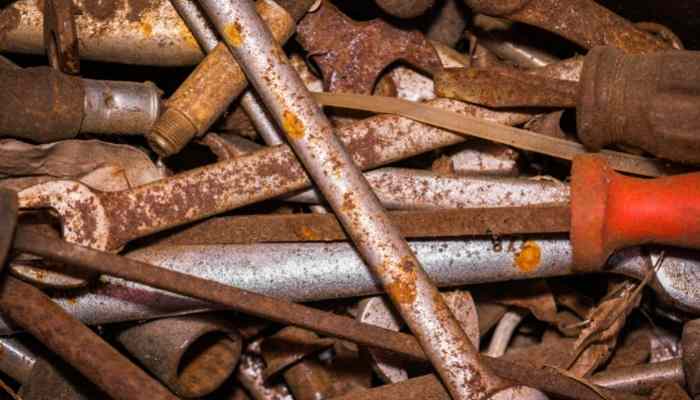
Yes — rusted steel tools respond well to acid-based rust removal when the corrosion has not yet progressed to metal perforation. ASTM F1476-21 (Standard Specification for Wear Resistance of Tool Steels) confirms that carbon and alloy tool steels maintain structural integrity until rust penetration exceeds 15% of the cross-sectional area. Assess your wrench before treatment: light surface rust (under 5% coverage) cleans in 4–8 hours; moderate rust (5–25% coverage) requires 12–24 hours; heavy scale buildup needs 24–48 hours in phosphoric acid solution.
The restoration process uses two acid categories. Phosphoric acid (H₃PO₄) converts iron oxide (Fe₂O₃) into stable iron phosphate (FePO₄), creating a micro-rough surface that holds lubricant. Hydrochloric acid (HCl) dissolves rust faster but attacks the underlying steel — it requires precise dilution (10–15% by volume) and careful neutralization with baking soda solution (sodium bicarbonate, NaHCO₃) to prevent flash corrosion.
How to Clean a Rusty Adjustable Wrench: Step-by-Step
Before beginning, disassemble the wrench fully. Remove the thumbscrew (worm screw assembly) and the movable jaw from the main body. Each component soaks separately so acid reaches all mating surfaces. Keep hardware organized — reassembly requires correct orientation of the graduated scale and adjustment thread.
Step 1: Soak Components in Phosphoric Acid Solution
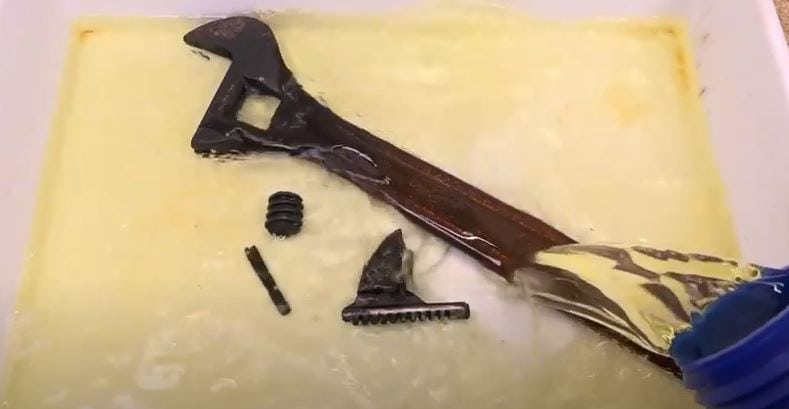
Prepare a 10–15% phosphoric acid solution by diluting commercial rust converter (such as Naval Jelly or Loctite Naval Jelly) in a plastic bucket. Immerse all disassembled wrench components fully. A 12-hour soak handles light surface rust; 24 hours is required for moderate rust with visible pitting; heavy scale needs 48 hours with fresh solution mid-cycle. The acid chemically converts rust (Fe₂O₃) to iron phosphate (FePO₄), which wipes away cleanly. Work in a ventilated area wearing nitrile gloves and safety goggles.
Step 2: Apply WD-40 to Remaining Rust Deposits
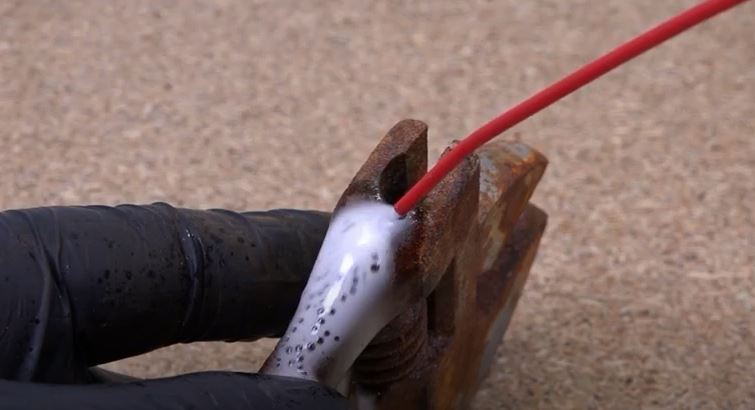
WD-40 contains petroleum distillates (C15–C20 alkanes) and 50–55% mineral oil, giving it a kinematic viscosity of 2.5–3.5 cSt at 38°C. Its capillary action penetrates rust seams within 30–60 seconds. After acid soaking, spray WD-40 liberally on all components and allow 5–10 minutes of penetration time before scrubbing. WD-40 displaces residual moisture and leaves a lubricating film that inhibits flash rusting. It is effective on carbon steel, chrome-vanadium steel, and stainless steel wrenches.
WD-40 is widely used for cleaning rust out of radiators and other metal surfaces because its low surface tension (22–25 mN/m at 25°C) allows it to wick into microscopic crevices that other cleaners cannot reach.
Step 3: Scrub All Components with Steel Wool or Abrasive Pad
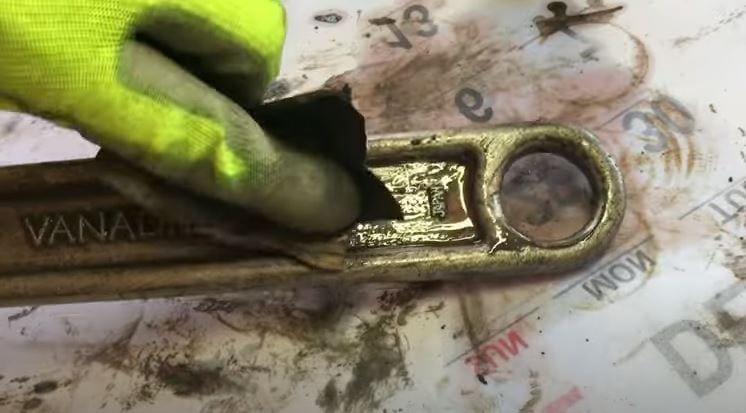
Use Grade 2 (medium) steel wool for general rust removal on carbon steel wrenches. For chrome-plated or stainless steel wrenches, use a non-metallic abrasive pad (nylon mesh, 180–220 grit equivalent) to avoid scratching the protective surface. For heavy rust scale, start with Grade 1 (coarse) steel wool, then finish with Grade 2 to smooth the surface. Scrub in single directional strokes along the grain of the metal to avoid circular scratches.
Wear nitrile gloves throughout scrubbing — rusted metal edges can cause tetanus-prone puncture wounds. The CDC recommends tetanus vaccination boosters every 10 years for anyone working regularly with rusted tools.
Step 4: Wipe Clean and Lubricate All Moving Parts
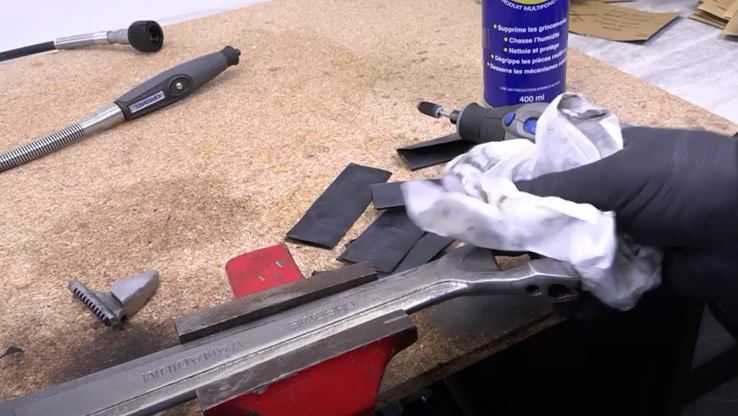
Wipe all components with a clean microfiber cloth to remove solvent residue and loosened rust particles. Apply a light machine oil (SAE 20–30) or dedicated tool lubricant (Boeshaft PTFE lubricant) to all pivot points, the threaded worm screw, and the jaw mating surfaces. Reassemble by threading the worm screw into the main body handle, then sliding the movable jaw onto the graduated scale. Test the jaw adjustment — smooth movement without binding indicates successful cleaning.
Adjustable Spanner Cleaning: Hydrochloric Acid Method
An adjustable spanner (also called a monkey wrench in the US) requires the same disassembly process. The hydrochloric acid method works faster than phosphoric acid but demands stricter safety controls. Hydrochloric acid at 10% concentration dissolves rust at a rate of approximately 0.1–0.3 mm per hour — roughly twice the speed of phosphoric acid at equivalent concentration. However, it attacks the base metal simultaneously, so total submersion time must not exceed 12 hours for carbon steel components.
Step 1: Disassemble and Soak in Diluted Hydrochloric Acid
Remove the worm screw and adjustable jaw. Prepare a 10–15% HCl solution by slowly adding muriatic acid (hydrochloric acid, 31.45% concentration) to cold water in a 1:2 ratio — always add acid to water, never water to acid, to prevent exothermic splashback. Submerge all parts for 8–12 hours. The acid dissolves rust and existing carbon deposits simultaneously, leaving a clean steel surface that requires immediate neutralization and lubrication to prevent flash rusting within 30 minutes of air exposure.
Step 2: Neutralize with Baking Soda Solution
Prepare a 5% sodium bicarbonate (baking soda) solution by dissolving 50g of NaHCO₃ per liter of water. Remove parts from HCl and rinse briefly with clean water, then immerse in the neutralization bath for 15–20 minutes. This raises the pH from acidic (pH 1–2) to neutral (pH 6.5–7.5). Remove, rinse with fresh water, and dry immediately with compressed air or a heat gun at 60–80°C to prevent flash rusting.
Step 3: Scrub with Steel Wool
Use Grade 2 steel wool to scrub remaining rust spots and acid etching. Work systematically from the jaw faces outward. On polished or chrome-plated areas, switch to a nylon abrasive pad (220 grit) to preserve the finish. Rinse with fresh water after scrubbing and dry immediately.
Step 4: Apply Lubricant and Reassemble
Apply a water-displacing lubricant (WD-40 or equivalent) to all surfaces within 5 minutes of drying. Use a dedicated tool lubricant on the adjustment thread — SAE 30 motor oil works well for general maintenance. Reassemble by engaging the worm screw into the main body and fitting the movable jaw onto the graduated scale. The jaw should move smoothly through its full range without binding.
Steel Wool Grade Reference for Rust Removal
| Grade | Description | Best Use |
|---|---|---|
| 0000 (Super Fine) | 0.025 mm abrasive particle size | Final polish, chrome-plated surfaces |
| 00 (Fine) | 0.05 mm particle size | Stainless steel, polished finishes |
| 0 (Medium-Fine) | 0.075 mm particle size | Stainless steel wrenches, light rust |
| 1 (Medium) | 0.15 mm particle size | Carbon steel wrenches, moderate rust |
| 2 (Medium-Coarse) | 0.20 mm particle size | Heavy rust scale, initial pass |
| 3 (Coarse) | 0.35 mm particle size | Paint removal, heavy corrosion — avoid on tool steel |
How to Prevent Future Rust on Adjustable Wrenches
- Apply protective oil coating after each use — a light film of SAE 20 motor oil reduces corrosion rate by up to 90% in humid environments (relative humidity above 60%).
- Store in a dehumidified toolbox with silica gel desiccant packets — keeping relative humidity below 40% prevents active rust formation.
- Use a rust-prevention spray (Boeshield T-9 or equivalent) every 3–6 months — these wax-based coatings adhere to metal surfaces for long-term protection.
- Clean after wet use — tools used with water, cleaning solutions, or that have come into contact with sweat (which contains 0.9% sodium chloride) should be wiped dry and oiled within 30 minutes of use.
For related tool maintenance guides, see the Cleaning Glossary and Specialty Cleaning Hub. For rust removal on other metal surfaces, explore our Stain Removal Hub.
Conclusion
An adjustable wrench is a high-value tool for both professionals and homeowners. With proper disassembly, acid soaking (12–24 hours for phosphoric acid), mechanical scrubbing, and lubrication, a rusted wrench returns to full functional condition. Regular oiling and dry storage prevent recurrence. If your wrench shows deep pitting exceeding 15% of the jaw cross-section — or if the adjustment mechanism is permanently frozen — replacement is more cost-effective than restoration.
For quick touch-ups between full cleanings, apply WD-40 and wipe dry every few weeks. This takes 2 minutes and adds years to tool life. For full professional restoration of heavily corroded tool sets, consult a machine shop that offers ultrasonic cleaning and zinc electroplating services.
References
- ASTM International. (2021). ASTM F1476-21: Standard Specification for Wear Resistance of Tool Steels. ASTM International.
- Centers for Disease Control and Prevention. (2023). Tetanus Prevention and Vaccination Recommendations. CDC.gov.
- National Association of Corrosion Engineers. (2018). NACE SP0169: Control of External Corrosion on Underground Piping Systems. NACE International.
- WD-40 Company. (2023). WD-40 Technical Data Sheet. WD40.com.
- U.S. Environmental Protection Agency. (2019). Safer Choice Program — Approved Rust Removers. EPA.gov.

