
Why Does My Bissell Carpet Cleaner Start Smoking?

Your Bissell carpet cleaner starts smoking when the belt slips, the brush roll is clogged, or the motor overheats. In most cases, a worn belt causes the roller brush to spin irregularly, generating friction heat that produces smoke or a burning rubber smell. Overheating typically starts at motor temperatures above 140°F (60°C), which occurs when the belt slips continuously or debris wraps around the brush roll shaft. Regular maintenance—cleaning the filter, checking the belt every 50 hours of use, and clearing tangled threads—prevents smoking in Bissell carpet cleaners rated between 6–12 amps at 120V.
Reason #1: Belt Slipping Causes Smoke and Burning Smell
A slipping belt is the primary cause of smoking in Bissell carpet cleaners. The drive belt connects the motor to the brush roll, and when it wears, cracks, or stretches, it slips under load. This slippage generates friction heat—typically 140–180°F (60–82°C) at the belt surface—that melts rubber and produces visible smoke.
Solution: Replace the belt every 50–100 hours of use, or sooner if you notice a burning rubber smell. Bissell replacement belts (part numbers vary by model) are available at hardware stores and online. A correctly tensioned belt should deflect approximately 1/4 inch (6mm) when pressed firmly.
Reason #2: Clogged or Debris-Wrapped Brush Roll
String, thread, carpet fibers, and pet hair wrap around the brush roll shaft and create resistance that forces the motor to work harder. This extra load raises motor temperature and causes the machine to smoke, particularly during extended use on high-pile carpet.
Solution: Unplug the unit, flip it over, and cut away tangled debris with scissors. Remove the brush roll per your model’s instructions and clear the bearing ends. Check the belt area for accumulated fiber as well—clean it monthly to prevent buildup.
Reason #3: Worn or Damaged Brush Roll Bearings
The brush roll bearings wear out over time, causing wobble and uneven rotation. A wobbling brush roll places asymmetric load on the motor, generating excess heat that leads to smoking. Most brush rolls are rated for 200–300 hours of typical home use before bearing wear becomes problematic.
Solution: Replace the entire brush roll assembly if the bearings are seized, noisy, or the roll wobbles more than 1/16 inch (1.5mm) when spinning. Bissell brush roll replacement parts are model-specific—consult your owner’s manual or the Bissell support site for your exact part number.
Reason #4: Motor Overheating
Bissell carpet cleaner motors typically draw 6–12 amps at 120V, producing 720–1,440 watts. When blocked airflow, extended runtime, or belt slippage forces the motor beyond its thermal limits, internal temperatures exceed safe thresholds and the motor smokes or shuts off thermally. Bissell motors are protected by a thermal cutoff switch that trips around 265°F (130°C).
Solution: Allow the machine to cool for 30–45 minutes to reset the thermal cutoff. Clean all air intake filters monthly—clogged filters restrict cooling airflow and cause rapid overheating. If the motor smokes repeatedly, it has suffered thermal damage and requires professional service or replacement.
Reason #5: Dirty or Clogged Filter
Bissell carpet cleaners have one or more filters that trap fine particulate. When filters become saturated with cleaning solution residue and debris, airflow drops, suction weakens, and the motor overheats. Bissell recommends rinsing the filter after each use and replacing it every 1–3 months depending on usage frequency.
Solution: Remove the filter, rinse thoroughly under warm water, and allow it to dry completely (24 hours) before reinstalling. Replace with a genuine Bissell replacement filter—third-party filters may have lower filtration efficiency and different airflow characteristics.
Reason #6: Wrong Cleaning Setting for Carpet Type
Running a Bissell carpet cleaner on the wrong setting for your carpet type causes the brush roll to work too aggressively on delicate fibers or inadequately on high-pile carpet, both scenarios that strain the motor and generate heat.
Solution: Use the “high pile” setting for thick or plush carpets and “low pile” for synthetic or Berber carpets. Running on the correct setting reduces motor strain by up to 30% and extends belt and brush roll life significantly.
Troubleshooting Checklist: Diagnose Your Smoking Bissell Carpet Cleaner
- Unplug the carpet cleaner and allow the motor to cool for 30–45 minutes to reset the thermal cutoff switch.
- Remove and rinse the filter under warm water. Allow 24 hours to dry completely before reinstalling.
- Empty and rinse both the clean water tank and the dirty water tank. Refill the clean tank with cold water only.
- Flip the unit and inspect the brush roll for tangled string, thread, or carpet fibers. Cut away debris carefully.
- Remove the bottom plate and inspect the belt for cracks, glazing, or stretching. A worn belt appears shiny and feels hard rather than flexible.
- Spin the brush roll by hand—it should rotate smoothly without wobble or grinding noise. Replace if bearing play exceeds 1/16 inch.
- Check the motor air intake vents for dust and debris buildup. Clear with a dry brush to restore airflow.
- Verify you are using the correct setting for your carpet type (high pile vs. low pile/Berber).
- Reassemble and test on a small carpet area. If smoking recurs, discontinue use and contact Bissell customer support.
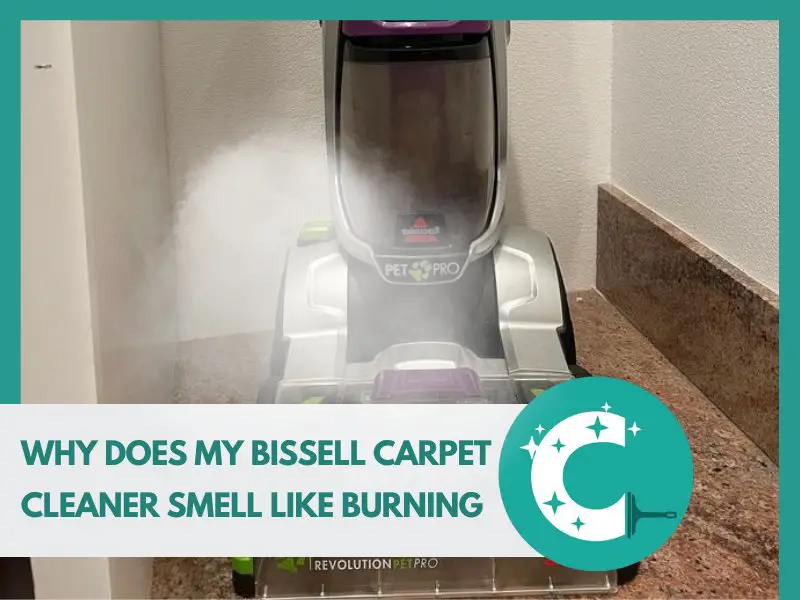
Why Does My Bissell Carpet Cleaner Smell Like Burning Rubber?
The burning rubber smell in a Bissell carpet cleaner is almost always caused by a slipping belt. As the rubber belt slips under load against the drive pulley, surface temperatures reach 140–180°F (60–82°C), which softens and partially melts the belt material. This produces a distinct acrid rubber odor that precedes visible smoke if the issue is not addressed.
Secondary causes include debris wrapped around the brush roll shaft creating friction against the belt, or a seized brush roll bearing that forces the belt to drag instead of rotating freely.
Quick-Reference Specs for Bissell Carpet Cleaner Motors
| Specification | Typical Value | Notes |
|---|---|---|
| Voltage | 120V (North America) | Verify label on your specific model |
| Amperage | 6–12 amps | Higher amps = more powerful suction |
| Wattage | 720–1,440W | At 120V × amperage draw |
| Suction (water lift) | Up to 80 inches (20 kPa) | Measured at floor nozzle |
| Thermal cutoff temp | 265°F (130°C) | Auto-shutoff protects motor |
| Belt replacement | Every 50–100 hours | Or when burning smell appears |
| Filter rinse interval | After each use | Replace every 1–3 months |
Safety Warning: Stop Use If Your Carpet Cleaner Smokes
If your Bissell carpet cleaner produces visible smoke, turn it off immediately and unplug it from the wall outlet. Continued operation while smoking can lead to thermal damage to the motor windings, belt melt-through, or, in rare cases, a fire hazard. Bissell recommends contacting their customer support team or an authorized service center if the unit smokes during normal operation after troubleshooting the belt, filter, and brush roll.
For spare parts, owner’s manuals, and model-specific troubleshooting, visit Bissell.com or call their consumer support line.
Frequently Asked Questions
Why does my Bissell carpet cleaner start smoking?
Your Bissell carpet cleaner starts smoking primarily because the drive belt is slipping. A worn or stretched belt causes the brush roll to drag, which forces the motor to overheat and produce smoke. Other causes include debris wrapped around the brush roll, a clogged filter restricting airflow, or an incorrectly set carpet-height adjustment.
How do I stop my Bissell carpet cleaner from smoking?
To stop smoking: (1) Unplug and cool for 30–45 minutes, (2) clean or replace the filter, (3) remove tangled debris from the brush roll, (4) inspect and replace the belt if cracked or glazed, and (5) verify the carpet-height setting matches your floor type. If smoking continues after these steps, discontinue use and contact Bissell support.
Is a smoking carpet cleaner a fire hazard?
Yes—visible smoke from a carpet cleaner indicates serious overheating, typically from belt slippage or motor strain. While Bissell units have a thermal cutoff that shuts off the motor at approximately 265°F (130°C), repeated thermal stress degrades motor windings over time. If your unit smokes, stop immediately and troubleshoot before further use.
How often should I replace the belt on my Bissell carpet cleaner?
Replace your Bissell carpet cleaner belt every 50–100 hours of use, or immediately if you hear a squealing sound or smell burning rubber. Belt wear is accelerated by heavy use, pet hair, and long carpet fibers that load the brush roll.
What are the signs of a failing motor in a carpet cleaner?
Signs of motor failure include: a burning electrical smell before smoke appears, the unit shutting off on its own and not restarting immediately, a grinding or bearing noise from the brush roll area, and progressively worsening performance even after filter and belt replacement.
References
- Bissell. (2024). Bissell Customer Support — Replacement Parts & Owner Manuals. Bissell Consumer Care.
- European Commission. (2017). Ecological Design Directive: Vacuum Cleaner Energy Limits. European Union.
- U.S. Consumer Product Safety Commission. (2024). Carpet Cleaner Safety Standards and Recalls. CPSC.


