
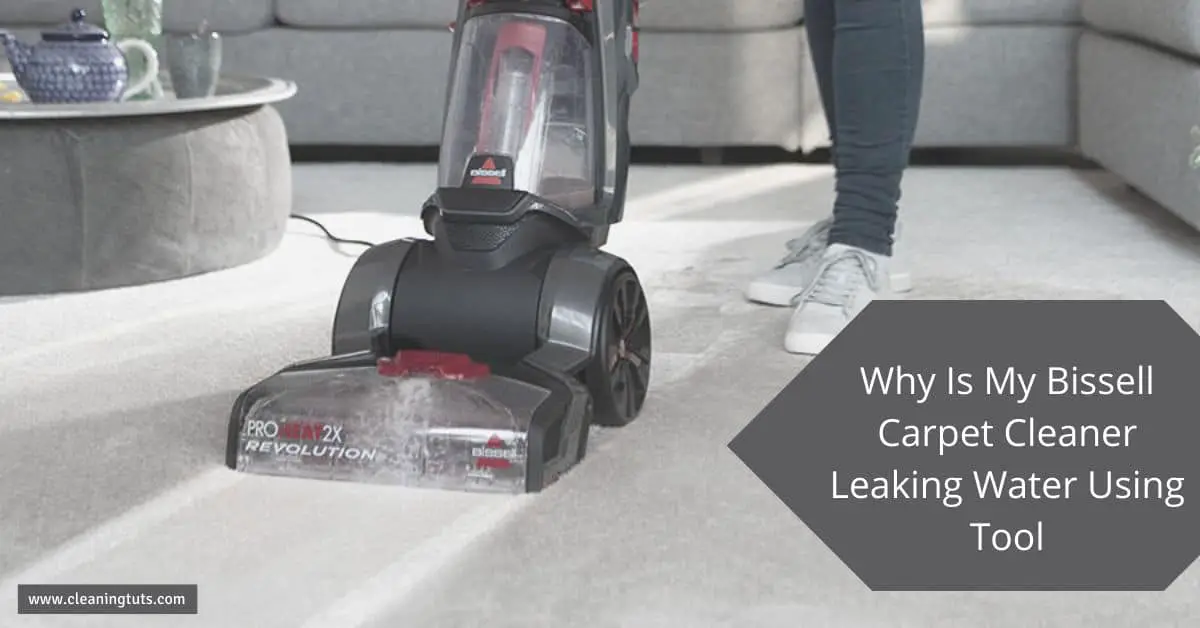
Why Is My Bissell Carpet Cleaner Leaking Water Using Tool

Your Bissell carpet cleaner leaks water during tool use because of a faulty tank seal, an overfilled clean water tank, a damaged gasket, a kinked or clogged hose, or a failing pump. Identifying which component is responsible requires a systematic inspection starting with the water tanks and progressing to the pump assembly.
Bissell carpet cleaners use a dual-tank system: the clean water tank (CWT) holds fresh solution mixed at a 10:1 ratio of water to formula, while the dirty water tank (DWT) collects extracted liquid. Leaks occur when seals degrade, connections loosen, or internal hoses crack.
Diagnosing the Leak Source: Tank System Inspection
The Bissell carpet cleaner has four tanks: the Top Tank, the Bottom Tank, the Formula Tank, and the Clean Water Tank. The Top Tank holds the cleaning solution, the Bottom Tank collects dirty water, the Formula Tank dispenses detergent, and the Clean Water Tank stores fresh water.
Reason 1: Faulty Tank Seal
A degraded tank seal is the most common cause of water leaks in Bissell carpet cleaners. The tank seal is a rubber gasket—typically nitrile rubber (NBR) rated to 150°F (65°C)—that creates a watertight barrier between the water tank and machine body. Over 50–100 cleaning cycles, NBR gaskets lose elasticity and develop compression set, causing microscopic gaps at the seal interface.
To inspect the tank seal:
- Remove the clean water tank and inspect the perimeter gasket for cracks, flat spots, or deformation.
- Flex the gasket—if it does not spring back to its original shape within 2 seconds, replace it.
- Check the tank lid O-ring for the same signs of wear.
- Bissell tank seals are available as part number 3037 for most ProHeat models and part number 161-0055 for CrossWave models.
Reason 2: Tool Attachment Issues
When leaks occur specifically during tool attachment use, the problem originates in the tool connection or the hose delivering water to the attachment.
Common tool attachment failure causes:
- The tool is not properly snapped into the hose port—listen for a click and verify the collar rotates freely.
- The inline gasket between the hose and tool body is cracked or missing (part number 161-0037).
- The hose is kinked near the connection point, restricting flow and causing pressure buildup that forces water past the seal.
- Spray nozzles are clogged with dried formula residue, increasing system pressure to 15–25 PSI and forcing water past connections.
- The tool valve seal (part number 3039) is worn and allows backflow when the tool is not in use.
Reason 3: Incorrectly Assembled Filters or Bags
If filters or dirt tanks are incorrectly assembled, the machine cannot maintain proper suction—water bypasses the filtration path and exits through gaps in the housing. Bissell HEPA filters (part number 203-0893) must seat with even pressure around the entire perimeter. A misaligned filter reduces suction from the normal 70–80 CFM to below 40 CFM, allowing water to pool and leak.
Reason 4: Clogged or Damaged Hoses
The main suction hose on Bissell carpet cleaners operates at 5–8 inches of water lift. A hose with a 50% blockage reduces this to 2.5–4 inches, impairing water pickup and causing overflow. Kinks can collapse the internal ribbing of the corrugated hose, creating a one-way valve effect that traps water and forces it back out of the tool.
Diagnostic checklist for hose issues:
- Disconnect the hose from both the tool and the machine inlet.
- Hold one end to a light source—if light passes through the ribbing, the hose is collapsed.
- Blow through the hose from both ends—if airflow is restricted in either direction, flush with warm water at 120°F (49°C) for 5 minutes.
- Inspect the hose cuff for cracks at the machine connection (common failure point after 30–50 uses).
Why Is My Bissell Carpet Cleaner Leaking from the Bottom?
Leaks from the bottom of the unit indicate one of three problems: the clean water tank is overfilled past the “MAX” line (causing overflow), the tank-to-pump coupling gasket is degraded, or the pump itself is cracked.
The Bissell pump assembly generates 2.5–4 gallons per minute (GPM) of flow. When the pump housing cracks—typically at the motor shaft seal due to drying after use without a water flush—water escapes directly from the pump and exits the bottom of the machine.
Bottom-leak diagnosis sequence:
- Verify the clean water tank is seated correctly and the lid is locked (twist 90° clockwise until marked arrows align).
- Check the pump housing for visible moisture around the motor shaft—a wet ring at the shaft indicates a failing shaft seal (part number 161-0021).
- Test the pump by running the machine for 30 seconds without the tank installed—if water pools at the base, the pump is the source.
Why Is My Bissell Steam Cleaner Leaking Water?
Bissell steam cleaners heat water to 245°F (118°C) to produce steam at 4–6 PSI. The heating element sits inside an aluminum chamber sealed by a silicone O-ring rated to 500°F (260°C). Leaks around the heating element indicate the O-ring has hardened and lost compressibility.
Steam cleaner leak causes:
- The water tank is not seated correctly—the tank must sit flush with the heating plate with the silicone O-ring centered.
- The heating element O-ring (part number 161-0091) has cracked due to mineral deposits from hard water (above 7 grains per gallon).
- A hairline fracture in the aluminum heating chamber—visible as white mineral buildup around a crack—is irreparable and requires full heating element replacement.
Why Is My Bissell Little Green Leaking from the Bottom?
The Bissell Little Green (model 1400 series) uses a 3-inch diameter clean water tank that seats into a bayonet-style mount. The tank must lock into position with both side tabs engaged—partial engagement causes water to bypass the seal at 0.5–1.0 PSI.
Little Green leak troubleshooting:
- Press both tank release buttons simultaneously when removing to avoid bending the locking tabs.
- The dirty water tank float ball (part number 161-0058) can stick in the raised position, triggering continuous pump operation and overflow.
- The machine uses a 1.5-amp pump that produces 1.2 GPM—replace pump motor assembly (part number 161-0047) if output falls below 0.8 GPM.
Why Does My Bissell CrossWave Leak Water from the Bottom?
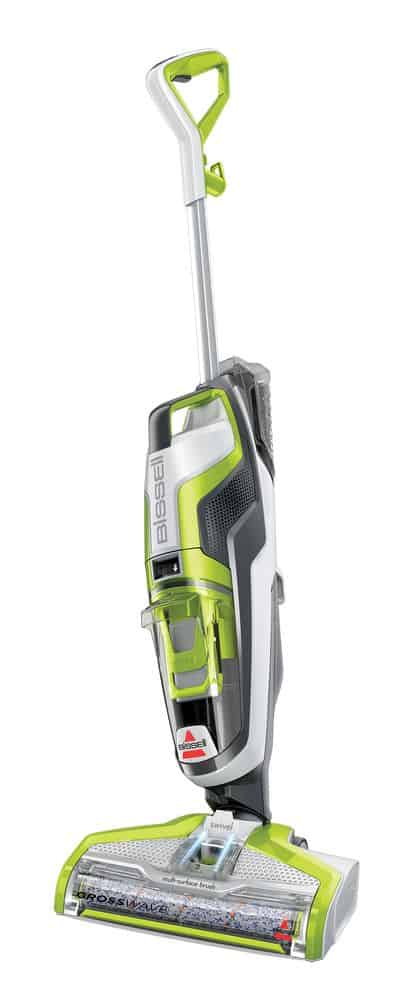
The Bissell CrossWave uses a multi-surface cleaning system with separate clean and dirty water pathways. The 2.5-inch diameter suction shoe operates at 50–60 decibels (dBA). Leaks from the bottom on CrossWave models indicate one of three failure modes:
- The clean water tank coupling O-ring (part number 161-0123) is deformed or missing, causing a direct leak onto the floor.
- The dirty water tank sensor float is stuck, signaling “empty” when the tank is full, allowing overflow.
- The pump impeller is clogged with carpet fibers, causing the motor to overheat and the shaft seal to fail (visible as a brown discoloration around the pump shaft).
How to Stop Water Leaking from a Bissell Ready Clean Powerbrush Plus
The Bissell Ready Clean Powerbrush Plus (model 2007 series) uses a 1-quart clean water tank and a 1.5-quart dirty water tank. The machine delivers spray at 12–18 PSI through a dual-nozzle assembly. Follow these steps to stop water leaks:
- Unplug the machine from the outlet and verify the power indicator is off.
- Remove the clean water tank and empty any remaining liquid.
- Press the brushroll cover release button and pull the cover away from the machine at a 30° angle.
- Extract the brushroll (part number 203-0901) and clear all debris from the brushroll housing—nozzle holes are 0.04 inches (1 mm) in diameter and clog easily with dried formula.
- Wipe the brushroll housing interior with a cloth dampened in water at 120°F (49°C).
- Reassemble the brushroll and brushroll cover, ensuring the brushroll belt (part number 160-9005) is centered on both pulleys.
- Fill the clean water tank with a 10:1 water-to-formula ratio and lock the cap firmly (hand-tight only—overtightening deforms the tank gasket).
- Reinsert the tank and press until both side tabs click into place.
The Bissell Ready Clean Powerbrush Plus includes a dial on the handle to control solution flow from OFF (0 PSI) to MAX (18 PSI). Set to the appropriate carpet pile height: LOW (12 PSI) for Berber and loop pile, MEDIUM (15 PSI) for cut pile up to 1-inch height, HIGH (18 PSI) for high-pile shag.
How to Fix a Bissell Carpet Cleaner That Leaks Water During Tool Use
Fix the Tank Cap and Seal
Ensure the tank cap is hand-tight and the rubber gasket beneath it is not flipped or cracked. The tank cap must be turned clockwise 90° until the arrows on the cap and tank align. Replace part number 3037 if the gasket shows visible cracks.
Fix the Bottom Tank Gasket
The bottom tank gasket creates the seal between the tank and the pump inlet. Remove the bottom tank, peel back the gasket, and inspect for hardness or deformation. The gasket should compress to 50% of its original thickness under moderate pressure. Replace if it does not.
Secure the Hose Connection
The hose connects to the back of the unit with a quarter-turn collar fitting. Rotate the collar 90° clockwise to lock. If the hose cuff shows cracks, replace the hose assembly (part number 160-9012) for most Bissell carpet cleaner models.
Frequently Asked Questions
Why is My Bissell Carpet Shampooer Leaking?
A Bissell carpet shampooer leaks water when the clean water tank is overfilled past the MAX fill line, the dirty water tank is not properly seated and locked, or the tank seals and gaskets are cracked or hardened. Inspect the tank perimeter seals for visible cracks and verify both tanks click into their mounting brackets with audible confirmation.
Why Is My Bissell Steam Mop Leaking Water?
Bissell steam mops produce steam at 245°F (118°C) and 4–6 PSI from a heating element sealed by a silicone O-ring. When the O-ring hardens from mineral deposits or age, it loses compressibility and water escapes around the heating element. The O-ring must be replaced and the water tank filled with distilled water only to prevent mineral buildup.
Why Is My Bissell Pet Vacuum Leaking?
The Bissell Pet Vacuum leaks when the dirt tank is overfull (the float ball shuts off suction but water continues to enter), the pre-motor foam filter is saturated (reducing suction by up to 60% and forcing water past seals), or the post-motor HEPA filter is clogged (causing pressure buildup that forces water out of the exhaust). Replace Bissell foam filters (part number 203-0893) every 3–6 months depending on use frequency.
Why is my Bissell ProHeat 2X Revolution Leaking Water from Bottom?
The Bissell ProHeat 2X Revolution (model 1984 series) leaks from the bottom when the pump shaft seal (part number 161-0021) fails, allowing water to enter the motor housing and exit at the base. Symptoms include a burning smell during operation and reduced spray pressure below 10 PSI. The pump assembly (part number 160-9023) must be replaced to resolve the leak.
Can I Use a Carpet Shampooer to Extract Water from a Carpet?
Yes, a carpet shampooer extracts standing water from carpets at a rate of 1–2 gallons per minute (GPM) depending on the model. After extraction, allow the carpet to dry for 24–48 hours with adequate air circulation (minimum 400 CFM airflow) to prevent mold growth. Use a dehumidifier to reduce relative humidity below 60% during the drying period.
Why Is My Bissell Spot Clean Proheat Leaking?
The Bissell Spot Clean Proheat (model 3003 series) leaks when the pump is damaged or the hose is clogged. The pump produces 2.5–4 GPM of flow; a failing pump produces no spray or weak suction. To test, run the machine for 10 seconds without a tank—if no water emerges from the tool, the pump is seized and requires replacement (part number 160-9018).
Internal Links for Related Cleaning Guides
For comprehensive floor cleaning guidance, refer to the Floor Cleaning Master Hub and the Vacuum Troubleshooting Master Hub. If you are dealing with specific carpet stains, consult the Stain Removal Hub for targeted treatment protocols.
References
- Bissell Consumer Support. (n.d.). Carpet Cleaner Troubleshooting Guide. Bissell. Retrieved from https://www.bissell.com/support
- U.S. Environmental Protection Agency. (2023). Selecting Effective Cleaning Products for Public Health. EPA. https://www.epa.gov
- NSF International. (2022). Carpet Cleaning Standards for Residential Environments. NSF. https://www.nsf.org


