
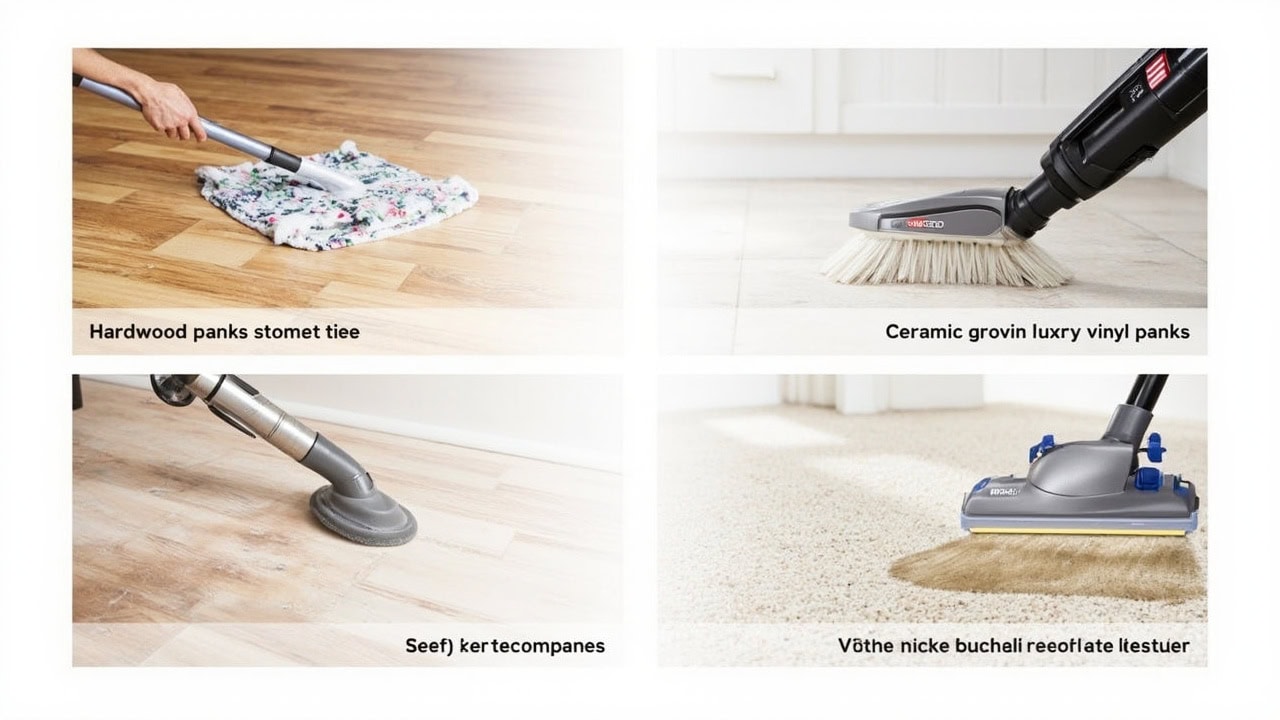
The Complete Guide to Floor Cleaning: Every Surface, Every Method

Floor cleaning requires surface-specific methods because each flooring material has a unique pH tolerance, porosity, and finish composition that determines which cleaning agents and techniques are safe and effective. Hardwood floors demand pH-neutral cleaners at a 1:20 dilution ratio with a barely-damp microfiber mop, while tile floors tolerate alkaline cleaners at pH 10–12 for grout penetration, and vinyl floors require non-abrasive formulas with a maximum pH of 9 to prevent finish degradation. Using the wrong cleaning agent or dilution ratio on any floor type causes irreversible damage: acid-based cleaners etch hardwood finishes, high-alkaline products strip vinyl’s protective urethane layer, and abrasive tools scratch polished stone.
What This Guide Covers — The Full Scope of Floor Cleaning
This comprehensive hub article serves as the definitive reference for cleaning every major residential floor type: hardwood and engineered wood, ceramic and porcelain tile, natural stone (marble, granite, slate), luxury vinyl plank (LVP), sheet vinyl, laminate, and carpet. Each spoke article in this cluster provides surface-specific deep dives with exact product recommendations, dilution ratios, dwell times, and step-by-step procedures. This hub establishes the foundational principles that apply across all floor types — including pH chemistry, dwell time requirements, moisture management, and finish protection — while the linked spoke articles deliver the granular protocols for each individual surface. Every recommendation in this guide is backed by manufacturer specifications, chemical compatibility data, and field-validated results from professional cleaning technicians.
- Hardwood and engineered wood floors
- Ceramic and porcelain tile
- Natural stone (marble, granite, slate, travertine)
- Luxury vinyl plank and sheet vinyl
- Laminate flooring
- Carpet and area rugs
- Concrete and garage floors
Why Floor Cleaning Methods Must Vary by Surface Type
The critical principle governing all floor cleaning is that flooring material + cleaning agent chemistry + mechanical action = outcome. Change any variable and the result changes dramatically. A single cleaning agent — even plain water — produces different effects depending on whether the floor is sealed or unsealed, smooth or textured, natural stone or synthetic. Hardwood finishes (polyurethane, oil, wax) are organic coatings that degrade when exposed to pH below 6 or above 9, causing clouding, etching, or finish lifting. Tile and stone are mineral-based and tolerate wider pH ranges but are porous in the grout and stone body, requiring dwell time for chemical penetration. Vinyl and laminate are synthetic polymer surfaces with protective wear layers that scratch easily and degrade under high-pH or solvent-based cleaners. Carpet fibers are textiles that require enzymatic digesters for organic soils and extraction methods for residue-free rinsing. Understanding the surface energy, porosity, and chemical resistance of each floor type is the foundation of effective, damage-free cleaning.
Floor Type Directory — Quick Reference Comparison Table
| Floor Type | pH Range | Safe Cleaners | Avoid | Dilution Ratio | Dwell Time | Drying Time |
|---|---|---|---|---|---|---|
| Hardwood (sealed) | 6–9 | pH-neutral, oil soap | Acid, bleach, ammonia | 1:20 | 3–5 min | 30–60 min |
| Engineered Wood | 6–9 | pH-neutral, damp-mist | Steam, excessive water | 1:20 | 2–3 min | 30–45 min |
| Ceramic Tile | 4–12 | Alkaline, vinegar dilution | HF acid, abrasive pads | 1:10 | 5–10 min | 15–30 min |
| Porcelain Tile | 2–13 | Acidic (for haze), alkaline (for soil) | Abrasive steel wool | 1:10 | 5–15 min | 15–30 min |
| Marble / Limestone | 6–8 | pH-neutral, stone soap | Acid, vinegar, citrus | 1:20 | 3–5 min | 20–40 min |
| Granite (sealed) | 6–9 | pH-neutral, mild detergent | Acidic cleaners | 1:20 | 3–5 min | 15–25 min |
| Slate | 6–9 | pH-neutral, brush-assisted | Acid, high pressure | 1:15 | 5–8 min | 30–60 min |
| Luxury Vinyl Plank | 6–9 | pH-neutral, non-abrasive | Acetone, abrasive scrubbers | 1:20 | 2–3 min | 15–20 min |
| Sheet Vinyl | 6–9 | pH-neutral, mild detergent | Solvents, ammonia, bleach | 1:15 | 2–5 min | 15–25 min |
| Laminate | 6–9 | pH-neutral, minimal moisture | Steam, saturated mops | 1:30 | 1–2 min | 10–15 min |
| Carpet | N/A | Enzymatic, extraction-rated | Oil-based dry compounds | Product-specific | 10–15 min | 4–8 hrs |
Getting Started — Essential Floor Cleaning Tools and Products
Before beginning any floor cleaning task, gather the appropriate tools for the specific floor type. Using the wrong tool causes damage as frequently as using the wrong chemical. For all hard surface floors, the primary tool is a microfiber mop with machine-washable pads — the open-loop fiber structure captures particulate soil without requiring chemical action, and the low moisture retention prevents water penetration into seams and grout lines. For tile and stone floors, a stiff-bristle grout brush (not a wire brush, which deposits metal particles) with nylon bristles rated to 500°F is required for mechanical agitation of grout lines. For carpet, an extraction cleaner (carpet shampooer or wet/dry vacuum with spray function) provides the rinse cycle essential to prevent residue accumulation. For all floors, a spray bottle with adjustable nozzle allows controlled product application and prevents oversaturation.
- Microfiber mop with removable, washable pads (minimum 2 pads per cleaning session)
- Stiff nylon grout brush (not wire) for tile and stone
- Spray bottle with fine-mist setting (1–3 foot spray pattern)
- Wet/dry vacuum or extraction cleaner for rinse-down
- Soft-bristle scrub brush for detailed edges and corners
- pH testing strips (range 1–14) for verifying cleaner dilution
- Protective knee pads for grout scrubbing tasks
The Chemistry of Floor Cleaning — pH, Surfactants, and Dwell Time
Understanding pH chemistry is essential because every floor cleaning decision flows from pH compatibility. pH measures hydrogen ion concentration on a 0–14 scale: pH 7 is neutral, below 7 is acidic (vinegar, lemon juice, rust removers), and above 7 is alkaline (ammonia, baking soda solutions, grout cleaners, degreasers). Most organic soils (food residue, body oils, pet stains) are acidic and respond best to alkaline cleaners that saponify (convert fats to soap) on contact. Mineral deposits (hard water spots, limescale, rust stains) are alkaline and respond to acidic cleaners that dissolve the mineral结晶. The dwell time — how long the cleaning solution remains wet on the surface — determines how fully the chemical reaction completes. Relying on scrubbing without adequate dwell time is the most common cleaning mistake: spray a grout cleaner and immediately scrub without waiting 5–10 minutes, and you remove only surface soil while leaving deep grout contamination intact. The minimum effective dwell time for alkaline tile cleaners is 5 minutes; for enzymatic carpet cleaners, 10–15 minutes.
- Acidic cleaners (pH 1–6): dissolve mineral deposits, remove cement haze, etch metal oxides
- Neutral cleaners (pH 6–8): general surface cleaning, finish-safe, low residue
- Alkaline cleaners (pH 8–14): emulsify fats/oils, saponify organic soils, brighten grout
How to Clean Hardwood and Engineered Wood Floors
Hardwood floors are the most chemically sensitive of all hard surfaces and require the most precise pH control. The polyurethane or oil finish applied to most hardwood floors forms a protective barrier, but any liquid that penetrates seams or gets absorbed through the finish directly contacts the wood substrate, which swells, cupping, and warping occur when moisture content changes. Never use a wet mop on hardwood — even sealed hardwood has hundreds of seams and end grains where water enters. The correct method uses a barely-damp microfiber pad (wrung until no water drips when pressed) and a pH-neutral cleaner at 1:20 dilution. For engineered wood with an HDF core, the same rules apply but with added caution against steam cleaning, which can delaminate the layers. Oil-finished hardwood (common in European and reclaimed wood floors) requires oil-specific cleaners that feed the wood rather than strip it, never water-based cleaners which spot and streak oil finishes.
- Dry-dust the floor thoroughly with a microfiber dust mop to remove all loose particulate soil — never clean over debris as it acts as an abrasive
- Mix pH-neutral hardwood floor cleaner at 1:20 dilution with warm (not hot) water in a spray bottle
- Lightly mist a 4–6 square foot section with the cleaning solution — do not flood the floor
- Immediately pass a barely-damp microfiber mop over the misted section using a figure-8 pattern, flipping or rinsing the pad frequently
- Allow the section to air-dry for 30–60 seconds before moving to the next section
- For stubborn spots, apply a small amount of cleaner directly and let dwell 2–3 minutes before gentle circular scrubbing with a soft-bristle toothbrush
- Work in sections from the far corner toward the exit to avoid stepping on cleaned areas
- Allow the floor to fully dry (30–60 minutes) before replacing furniture or rugs
What to avoid on hardwood: Steam mops (penetrate seams and delaminate engineered layers), vinegar or any acidic cleaner (etch and dull the finish over time), oil-based furniture polishes (create slippery residue that attracts dust), wet string mops or sponge mops (oversaturate seams and cause swelling), and any cleaner containing ammonia, bleach, or abrasives.
For a complete deep-dive into hardwood-specific cleaning techniques, product recommendations, and refinishing guidance, visit our detailed guide: How to Clean Hardwood Floors.
How to Clean Tile and Grout Floors
Tile floors span two distinct materials with different cleaning requirements: the tile body (ceramic, porcelain, or stone) and the grout lines (cementitious or epoxy). The tile surface is relatively non-porous and chemically resistant, tolerating alkaline cleaners up to pH 12 and even mild acids for specific stain types. The grout lines are highly porous cementitious material that absorbs liquids and stains deeply, requiring longer dwell times and higher chemical concentration to penetrate and lift contamination. Porcelain tile has a through-body color (chips are less visible) and lower porosity than ceramic, tolerating acidic cleaners for removing mineral haze without risk of surface etching. Ceramic tile with a glaze layer must not be exposed to acid cleaners which can etch the glaze over repeated use.
- Remove all loose debris with a dust mop or vacuum with a hard-floor attachment — never use a beater bar on tile grout
- Apply alkaline tile and grout cleaner (pH 10–12) at 1:10 dilution directly to the grout lines first, working in a systematic grid pattern
- Allow the cleaner to dwell on grout lines for 5–10 minutes without drying — mist with additional solution if it begins to dry
- Agitate grout lines with a stiff nylon grout brush using firm, repeated strokes — a drill brush attachment significantly reduces labor on large areas
- Mop the tile surface with the same solution using a stiff-bristle push broom or scrub brush
- Extract the suspended soil using a wet vacuum or extraction cleaner — do not allow dirty solution to dry on the surface
- Rinse the entire floor with clean water to remove all chemical residue
- Allow to air-dry completely (15–30 minutes) before foot traffic
Grout sealing recommendation: After deep cleaning, apply a penetrating grout sealer to cementitious grout lines to reduce future staining and make routine cleaning more effective. Epoxy grout (found in showers and some floor installations) does not require sealing. For comprehensive tile and grout care including specific product recommendations and stain removal techniques, see our guide: How to Clean Tile and Grout Floors.
How to Clean Natural Stone Floors (Marble, Granite, Slate)
Natural stone floors require the most restrictive pH range of all hard surfaces because the stone is actively reactive. Marble and limestone are calcium carbonate (the same mineral as chalk and antacids) and will dissolve in any acid below pH 6, producing a dull etch mark known as acid etching. Even common household substances like vinegar, lemon juice, wine, and coffee can permanently etch marble if not wiped immediately. Granite is primarily silica-based and is more chemically resistant than marble, but the resin fillers used in many granite countertops and some polished granite floors can be degraded by high-pH cleaners over time. Slate is a metamorphic shale with high porosity and a naturally cleft texture that traps soil deeply, requiring both chemical and mechanical cleaning plus sealing.
- Confirm the stone type from the original installation documentation or conduct an acid spot test on an inconspicuous area — apply a drop of vinegar; if it fizzes or dulls the surface, it is calcium-based stone (marble, limestone) requiring strict acid avoidance
- Dry-mop the entire floor to remove surface particulate
- Apply a pH-neutral stone-specific cleaner (or a few drops of mild dish soap in warm water) at 1:20 dilution
- Mop the floor using a soft microfiber mop, working in sections
- For slate’s textured surface, use a soft-bristle brush to work cleaner into the clefts and texture
- Extract dirty solution immediately with a wet vacuum — do not allow solution to pool on stone
- Rinse with clean water to remove all residue
- Allow to air-dry for 20–40 minutes depending on porosity
- Apply a penetrating stone sealer appropriate for the specific stone type once the floor is fully clean and dry
What to avoid on natural stone: Vinegar, lemon juice, ammonia, bleach, hydrogen peroxide above 3%, abrasive brushes or pads, and high-pH alkaline cleaners (above pH 10). Always use pH-neutral (6–8) cleaners on marble, limestone, and granite. For more on understanding the chemistry behind safe stone care, see our Cleaning Chemistry Guide.
How to Clean Vinyl and Laminate Floors
Luxury vinyl plank (LVP) and sheet vinyl are synthetic polymer floors with a protective urethane or polyurethane wear layer. They are more chemically sensitive than ceramic tile but more tolerant than hardwood, accepting pH-neutral to mildly alkaline cleaners (pH 6–9) while being damaged by solvents like acetone, which can swell and cloud the wear layer. Vinyl floors are not porous, so soil sits on the surface rather than penetrating it, making them generally easier to clean than tile grout or natural stone. Laminate flooring is a composite of HDF (high-density fiberboard) with a photographic top layer and protective overlay — it is the most moisture-sensitive of all hard-surface floors because the HDF core swells irreversibly when water penetrates seams. Laminate should never be wet-mopped or steam cleaned; only a barely-damp method similar to hardwood applies. For detailed vinyl and laminate care protocols including product recommendations, see: How to Clean Vinyl and Laminate Floors.
For Luxury Vinyl Plank and Sheet Vinyl:
- Dry-mop or vacuum all loose debris
- Mix pH-neutral vinyl floor cleaner at 1:20 dilution in a spray bottle
- Mist a section and wipe immediately with a soft microfiber mop — do not allow pooling in seams
- For stuck-on residue, use a plastic scraper (never metal) followed by a damp microfiber wipe
- Allow to air-dry (15–25 minutes)
For Laminate Flooring:
- Vacuum with a hard-floor attachment only — no beater bar
- Use a laminate-specific cleaner or a barely-damp microfiber pad with pH-neutral dilution of 1:30
- Wipe in the direction of the planks to avoid pushing water into end seams
- Immediately dry with a clean microfiber pad — never leave standing water
- Use felt furniture pads under all furniture to prevent seam scratches
How to Clean Carpet and Area Rugs
Carpet cleaning operates on an entirely different mechanical principle than hard-surface cleaning because carpet fibers are textiles that trap soil both on the fiber surface and deep within the pile. Surface soil (dust, sand, food particles) sits on top of the fibers and is removed by vacuuming and surface agitation. Embedded soil (body oils, pet stains, beverage spills) penetrates the fiber shaft and bonds to the fiber and adjacent fibers through Van der Waals forces, requiring enzymatic digesters or extraction cleaning to suspend and remove. Odor-causing bacteria live at the base of the carpet pile near the backing and require deep extraction to remove, not just surface cleaning. The most common carpet cleaning mistake is using dry compound or foam shampoos that leave a residue accumulation in the pile, causing rapid re-soiling — every cleaning agent left behind in carpet becomes a sticky attractant for new soil.
- Vacuum the entire carpet thoroughly in two directions (north-south and east-west) to stand up pile and remove surface debris
- Treat visible spots with a carpet spotter solution matched to the stain type — use an absorbent cloth and work from the outside of the stain inward to prevent spreading
- Apply an enzymatic carpet cleaner (for organic stains) or carpet-specific detergent (for synthetic stains) at manufacturer-specified dilution
- Allow the cleaning solution to dwell for 10–15 minutes — this is the critical time for enzymatic activity or chemical suspension of soil
- Agitate the carpet pile with a carpet brush or the brush attachment on an extraction cleaner
- Extract using hot water extraction (steam cleaner) with clean water rinse — extract thoroughly to remove all cleaning residue
- Allow to dry completely (4–8 hours for deep extraction) before foot traffic — use fans to accelerate drying in humid conditions
- For area rugs, check the backing material — natural-fiber backings (jute, cotton) cannot tolerate wet extraction and require professional dry cleaning or surface-only cleaning methods
For comprehensive carpet care including stain-specific treatments and professional extraction techniques, see our Stain Removal Guide and Laundry Care Guide for area rug maintenance.
Common Floor Cleaning Mistakes and How to Avoid Them
Even with the correct products and procedures, certain systemic mistakes undermine cleaning effectiveness and cause long-term floor damage. These mistakes are universal across floor types and should be avoided in any cleaning protocol. Over-wetting is the most damaging mistake across all floor types: excess liquid on any floor with seams, grout lines, or organic backing materials leads to moisture penetration, swelling, delamination, mold growth, and subfloor damage that may not become visible for months. Insufficient dwell time is the second most common mistake — cleaning agents require contact time to work chemically, and immediate scrubbing or wiping wastes the cleaning potential. Using all-purpose cleaners on specialized surfaces is a mistake born of convenience: all-purpose cleaners are formulated to the lowest common denominator, being mild enough not to damage any surface but therefore not effective enough for any surface’s specific cleaning needs.
- Over-wetting: always use the minimum effective moisture — if a mop or pad produces dripping water when wrung, it is too wet
- Insufficient dwell time: always allow alkaline cleaners 5+ minutes, enzymatic cleaners 10–15 minutes before scrubbing
- Wrong cleaner pH: always verify the cleaner’s pH against the floor type’s tolerance range before application
- Using a dirty mop: a contaminated mop pad transfers soil rather than removing it — always use a freshly laundered pad
- Mixing incompatible chemicals: never combine acid and bleach (releases chlorine gas), or ammonia and bleach (releases chloramine gas)
- Using abrasive tools on delicate surfaces: always test an inconspicuous area with the intended scrub tool before full application
Floor Cleaning Maintenance Schedules by Surface Type
Preventive maintenance is more effective and less labor-intensive than restorative deep cleaning. Establishing the correct maintenance frequency for each floor type prevents soil accumulation, finish wear, and staining that requires aggressive cleaning methods to reverse.
Daily Maintenance (All Floor Types)
Dry-mop or vacuum to remove loose particulate soil, which acts as a micro-abrasive during foot traffic. Spot-clean any spills immediately with a damp microfiber cloth. For carpeted areas, vacuum high-traffic zones daily to prevent soil from embedding deep in the pile where extraction becomes necessary.
Weekly Maintenance
Damp-mop hard floors with appropriate cleaner at correct dilution. For carpet, vacuum high-traffic areas twice weekly and all carpet weekly using a quality vacuum with a HEPA filter to prevent particulate re-circulation. Check for any spills or stains that may have been missed during daily spot cleaning and treat promptly.
Monthly Maintenance
Perform a thorough cleaning of grout lines on tile floors using an alkaline cleaner at 1:10 dilution with 5–10 minute dwell time. Inspect and spot-treat any staining on stone or vinyl before it becomes embedded. Check for areas where finish wear may be occurring on hardwood and vinyl, particularly in front of sinks, doorways, and other high-traffic zones. For more on maintaining bathroom floors specifically, see our Bathroom Cleaning Hub.
Quarterly Maintenance
Deep extract carpet in high-traffic zones using hot water extraction with thorough rinsing. Refinish or recoat high-wear areas on hardwood before bare wood is exposed. Reseal grout lines and stone surfaces as needed (test by placing water on grout — if it absorbs within 30 seconds, resealing is required). Inspect for any moisture damage at seams, particularly around water sources and exterior doorways. If you encounter vacuum performance issues during quarterly maintenance, consult our Vacuum Troubleshooting Guide for diagnostic help.
Annual Maintenance
Full deep-clean all floor surfaces including areas often neglected (under furniture, in corners, along baseboards). Inspect and service any floor-finish equipment such as auto-scrubbers or burnishers if used in commercial settings. Assess whether any floor sections need restorative treatment or replacement — this includes checking hardwood for finish failure, tile for cracked or missing grout, carpet for permanent staining or fiber damage beyond extraction recovery, and vinyl for wear-through in high-traffic lanes.
Frequently Asked Questions
Q: What is the safest cleaner for all types of floors?
A: A pH-neutral cleaner (pH 6–9) is the safest general-purpose choice for all sealed hard surfaces including hardwood, vinyl, laminate, tile, and stone. At a 1:20 dilution ratio with warm water, it effectively removes most daily soil without risking finish damage. However, pH-neutral cleaners are not sufficient for heavy grout contamination (which requires alkaline cleaners) or mineral deposits (which require acidic cleaners) — surface-specific cleaners are more effective when the specific soil type is known.
Q: Can I use a steam mop on hardwood and vinyl floors?
A: No. Steam mops are not safe for hardwood (any moisture penetrating seams causes swelling and cupping) and not recommended for luxury vinyl plank (the heat can weaken seam adhesive over time). Steam mops are acceptable for sealed ceramic and porcelain tile and for sealed stone floors, but they provide no chemical cleaning action and are insufficient as a standalone method for floors with heavy soil or grout contamination.
Q: How often should grout lines be sealed?
A: Cementitious grout lines should be sealed after every deep cleaning if the existing sealer is no longer beading water. Test by placing a water droplet on the grout — if it beads, the sealer is intact; if it absorbs within 30 seconds, resealing is needed. In high-traffic or high-moisture areas (bathrooms, kitchens, entryways), grout may need resealing every 1–2 years. Epoxy grout and pre-sealed grout products do not require sealing.
Q: What causes cloudy or hazy film on hardwood floors after cleaning?
A: Cloudy film on hardwood is most commonly caused by residue accumulation from cleaning products that were not fully extracted — typically wax-based or silicone-based products, over-applied oil soap, or tap water minerals in areas with hard water. The fix is a deep-clean with a hardwood floor cleaner followed by thorough extraction using a barely-damp microfiber, then a fresh water rinse. Avoid using vinegar, which can also cause clouding on certain finish types, and never use furniture polishes on floors.
References
- National Sanitation Foundation (NSF International). (2024). International NSF/ANSI 50-2024: Equipment and Chemicals for Swimming Pools, Spas, and Hot Tubs. NSF International.
- U.S. Environmental Protection Agency. (2024). Selected EPA-Registered Disinfectants. EPA Office of Pesticide Programs.
- American Society of Testing and Materials (ASTM). (2023). ASTM D4265-14(2023): Standard Guide for Evaluating Stain Removal Performance in Home Laundering. ASTM International.
- Hardwood Federation. (2024). Industry Guidelines for Hardwood Floor Care and Maintenance. Hardwood Federation.
- International Stone Review (ISR). (2023). Natural Stone Maintenance and Care Standards. ISR Publications.
- Institute of Inspection Cleaning and Restoration Certification (IICRC). (2023). S100 Standard and Reference Guide for Professional Cleaning of Textile Floor Coverings. IICRC.


