
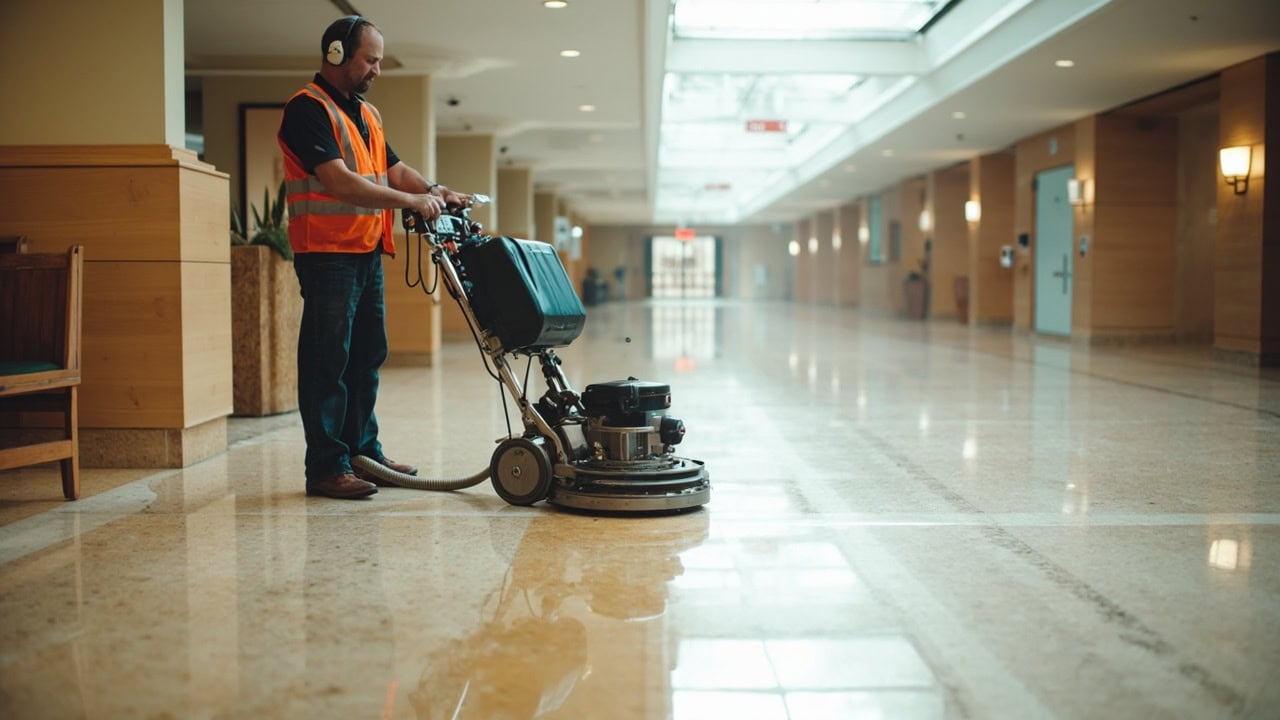
How to Clean and Maintain Floor Finish (Screens, Burnishing)

Floor finish must be maintained through a three-stage process: routine dust mopping, periodic screen cleaning (using a 220-400 grit screen under a standard floor buffer at 150-175 RPM), and high-speed burnishing (1500-1800 RPM) to heat-fuse the finish back to a high gloss — skipping any stage leads to finish oxidation, black heel marks, and premature re-coating costs. Regular screening removes the top 1-2 mils of oxidized finish while burnishing re-melts the remaining finish to restore clarity and reflectivity.
What Is Floor Finish and Why It Needs Maintenance
Floor finish (also called floor wax or floor coating) is an acrylic polymer emulsion applied to VCT (vinyl composition tile), terrazzo, and concrete floors to provide gloss, slip resistance, and protection against black heel marks and moisture. This polymer-based coating forms a sacrificial layer that absorbs daily wear, protecting the underlying substrate from damage, staining, and moisture penetration that would otherwise require costly floor replacement.
Floor finish oxidizes over time from foot traffic, UV light exposure, and air pollutants — oxidation causes yellowing, dullness, and reduced scuff resistance as the acrylic polymer chains break down and the surface becomes micro-rough. In commercial settings with heavy foot traffic (500+ crossings per day), visible oxidation can appear within 60-90 days of application. UV-sensitive fluorescent lighting accelerates this process, causing uneven yellowing in areas exposed to prolonged artificial light.
Screen cleaning and burnishing are the primary maintenance methods for preserving and restoring finish appearance without stripping and re-coating, extending floor life by 2-4 times compared to a schedule of stripping only when damage becomes severe. Understanding the difference: screens abrade the oxidized surface layer (removing 1-2 mils of finish per pass), while burnishing uses heat and friction at 1500-1800 RPM to re-melt and fuse the remaining acrylic polymer to a high gloss without removing additional material.
Tools and Products Needed
Successful floor finish maintenance requires specific equipment calibrated to exact specifications. Using the wrong tools or incorrect settings will damage the finish rather than restore it, resulting in costly re-coating requirements.
| Tool | Purpose | Specification |
|---|---|---|
| Microfiber dust mop (24-36 inch) | Daily debris removal | Microfiber, 24-36 inch width |
| Floor buffer | Screen cleaning | 150-175 RPM swing machine |
| Screen discs | Abrade oxidized finish | 180-220 grit (heavy oxidation), 220-400 grit (maintenance) |
| High-speed burnisher | Re-fuse finish to gloss | 1500-1800 RPM propane or electric |
| Neutral floor cleaner | Between maintenance cleaning | pH 7-9, 1-2 oz per gallon dilution |
| Wet vacuum or auto-scrubber | Slurry extraction | Wet recovery system |
Additional Equipment
- Spray buff solution: Ready-to-use acrylic polymer spray for touch-up burnishing on high-traffic areas
- Red or blue scrubbing pads: For pre-screen cleaning of heavy scuffs and black heel marks before screening
- Wet floor signs and caution markers: Required for OSHA compliance during wet cleaning procedures
- Microfiber damp mop: For rinsing after screen cleaning, 24-36 inch width recommended
Step-by-Step Floor Finish Maintenance Process
Follow this eight-step process for complete floor finish maintenance. Each step is critical — skipping steps or performing them out of order compromises the final result and may cause finish damage requiring stripping and re-coating.
- Remove loose debris — Dust mop the entire floor with a clean microfiber dust mop, starting from the far corner and working toward the exit to avoid re-walking cleaned areas. Vacuum corners and edges with a crevice tool. Abrasive dirt particles embedded under foot traffic cause micro-scratches that accelerate finish wear and create entry points for moisture damage.
- Pre-treat high-traffic areas — Apply neutral floor cleaner (pH 7-9, 1-2 oz per gallon) to black heel marks and scuff areas using a spray bottle or mop-on application. Allow 3-5 minutes dwell time without letting the solution dry. Shorter dwell times are ineffective; longer dwell times risk drying and leaving residue.
- Attach appropriate screen — Select 220-400 grit screen based on finish condition: 180-220 grit for heavy oxidation where multiple layers have yellowed, 220-320 grit for moderate oxidation, 400 grit for light maintenance on recently burnished floors. Secure to floor machine drive plate and verify concentric attachment before operation.
- Screen clean the floor — Operate buffer in overlapping passes at 150-175 RPM, keeping the machine moving continuously at a pace of approximately 4 feet per second. Focus 2-3 passes on heavily soiled areas. Let machine do the work — excessive downward pressure reduces screen life by up to 50% and creates uneven abrasion patterns. A properly operating buffer should feel nearly weightless when moving correctly.
- Extract slurry immediately — Use a wet vacuum or auto-scrubber to remove the screen slurry (a milky white liquid containing abraded acrylic polymer and soil) immediately after screening each section. Do not allow slurry to dry on the floor — dried slurry re-deposits as a white powder or haze that requires additional cleaning to remove and can embed in the finish.
- Rinse with neutral cleaner — Damp mop with fresh neutral cleaner solution (pH 7-9, 1-2 oz per gallon) to remove any remaining residue from the screen cleaning process. Allow floor to dry completely for 20-30 minutes with adequate ventilation (air changes per hour of 4-6 minimum) before proceeding to burnishing. Trapped moisture under the burnisher causes finish blistering and peeling.
- Burnish to restore gloss — Once floor is confirmed dry, operate high-speed burnisher at 1500-1800 RPM in overlapping passes, overlapping each pass by 2-3 inches. The friction heat (surface temperature reaches 200-225°F / 93-107°C) re-melts the acrylic polymer finish to a high gloss. Two to three complete floor passes are typically required for optimal clarity and reflectivity on VCT flooring.
- Apply finish refresh (optional) — For severely worn areas where the finish has thinned to below 2 mils, apply a thin coat of spray buff or liquid floor finish (1-2 mils wet thickness) before the final burnish pass. This adds a fresh polymer layer only where needed, avoiding the cost and labor of a full re-coat.
Floor Finish Maintenance Schedule
Consistent scheduling prevents the accumulation of oxidation and embedded soil that accelerates finish degradation. The following schedule applies to medium-to-high traffic commercial facilities (offices, retail, healthcare, education).
| Frequency | Task | Method |
|---|---|---|
| Daily | Dust mop | Microfiber dust mop, 24-36 inch |
| Daily | Spot clean spills immediately | Damp microfiber, neutral cleaner |
| Weekly | Damp mop high-traffic zones | Neutral cleaner (pH 7-9), 1-2 oz/gal |
| Weekly | Spot treat scuffs | Spray buff with low-speed red pad |
| Monthly | Full damp mop all floors | Neutral cleaner, proper dilution |
| Quarterly (3-6 months) | Full screen clean | 220-400 grit screen + buffer at 150-175 RPM |
| After each screen cleaning | Burnish entire floor | High-speed burnisher, 1500-1800 RPM, 2-3 passes |
High-traffic facilities (hospitals, schools, airports, grocery stores) may require monthly screen cleaning and burnishing to maintain appearance, while low-traffic office environments can extend the screen cleaning interval to every 6-12 months. Track floor appearance and finish thickness (using a finish thickness gauge) to adjust the schedule based on actual wear patterns rather than fixed calendar intervals.
Common Mistakes to Avoid
These errors cause finish damage that requires expensive stripping and re-coating to correct. Each is preventable with proper training and procedure adherence.
- Using too much water: Excessive moisture penetrates finish edges and causes lifting, particularly at seams, corners, and control joints where the substrate is exposed. Always use damp mopping technique rather than saturated mops, and extract standing water immediately with a wet vacuum.
- Skipping the rinse step: Screen slurry left on floor re-deposits as a white powder or haze after drying — this is acrylic polymer residue mixed with soil, and it creates a hazy film that burnishing will seal in rather than remove. Always rinse with neutral cleaner after slurry extraction.
- Using acid or bleach-based cleaners: These soften and cloud acrylic polymer finishes by breaking down the polymer chain bonds, requiring premature stripping. Acidic cleaners (pH below 6) cause immediate dulling; bleach (pH 11+) causes clouding and embrittlement within 24-48 hours of application.
- Burnishing wet or damp finish: Trapped moisture turns to steam under burnisher heat (200-225°F surface temperature), causing finish to blister, peel, and delaminate from the substrate. Always confirm floor is completely dry with a moisture meter reading below 3% relative humidity before burnishing.
- Using wrong grit screen: Too coarse (below 180 grit) removes too much finish per pass (3-5 mils instead of 1-2 mils), significantly shortening floor life before re-coating is required. Too fine (above 400 grit) does not effectively abrade oxidized layers, wasting labor without meaningful results.
- Neglecting daily dust mopping: Abrasive dirt particles (silica, calcium carbonate, sand) tracked in by foot traffic act as microscopic sandpaper under each subsequent foot step, creating thousands of micro-scratches that accelerate finish wear by 40-60% compared to properly maintained floors.
- Using standard buffers for burnishing: A 175 RPM floor buffer cannot generate sufficient heat to re-melt acrylic polymer — it will only smear and spread the finish, creating an uneven appearance that requires stripping to correct. Only 1500-1800 RPM burnishers produce the thermal fusion required.
How to Know When Floor Finish Needs Re-Coating vs. Burnishing
Choosing the correct maintenance intervention saves labor and materials while preventing unnecessary finish removal. Each maintenance method has specific triggers that indicate when it is the appropriate response.
Re-Coat When:
- Finish is worn through to bare substrate in high-traffic lanes — visible VCT tile color or concrete indicates the protective polymer layer is completely removed
- Widespread pitting is present across more than 30% of the floor surface — pitting occurs when oxidation has progressed beyond the point where surface abrasion can restore a smooth appearance
- More than 2-3 screen passes are required to restore acceptable appearance — excessive screening thins the finish below the minimum protective thickness of 2-3 mils
- Finish has yellowed unevenly due to UV exposure or rubber embedment that screening cannot address — this indicates oxidation has penetrated deeper than the screen abrasion depth
Burnish When:
- Finish is oxidized but intact — the acrylic polymer matrix is still coherent but has lost surface gloss due to micro-scratches and surface oxidation (typically 6-12 mils thickness remaining)
- Finish has lost gloss due to surface scratches only — burnishing re-melts the top 0.5-1 mil without removing additional material
- Moderate scuff marks are present but no finish penetration is visible — scuffs are surface deformation, not damage, and respond to thermal re-flow
Strip and Re-Coat When:
- Multiple burnishing sessions (2-3 consecutive) fail to restore gloss — this indicates the polymer itself has degraded beyond thermal repair
- Finish has yellowed unevenly across the floor — differential UV exposure creates appearance inconsistencies that burnishing cannot correct
- Multiple layers have built up (more than 8-10 coats) causing uneven appearance — accumulated layers create an uneven base that prevents uniform gloss development
- Black heel marks have penetrated through to the substrate — rubber compounds have chemically bonded with the finish and cannot be extracted by surface cleaning alone
Regular screen cleaning every 3-6 months prevents situations where stripping becomes necessary. Budget for quarterly screen cleaning and burnishing to extend floor life to 3-5 years before requiring a full strip and re-coat cycle, compared to 12-18 months without regular maintenance.
Frequently Asked Questions
Q: How often should you screen clean floor finish?
A: Screen cleaning should be performed every 3-6 months for medium-traffic commercial spaces (offices, retail) and every 1-3 months for high-traffic facilities (hospitals, schools, airports). Over-screening accelerates finish wear by removing excessive polymer thickness per year — if your floor needs screen cleaning more than monthly, consider increasing the number of finish coats (from 4 to 6-8 coats) or switching to a more scuff-resistant finish formula with metallic or zinc cross-linkers.
Q: Can you burnish floor finish without screen cleaning first?
A: Burnishing alone only re-melts the existing surface and provides temporary gloss improvement that fades within 48-72 hours on heavily traveled floors. For heavily oxidized finishes with surface contamination, burnishing without screening seals the oxidation layer in place — the heat fusion process locks in the yellowed, contaminated surface rather than restoring clarity, and the gloss will fade within days. Always screen clean before burnishing when the finish has dulled significantly (gloss reading below 40 on a 60-degree gloss meter).
Q: What RPM is required for burnishing floor finish?
A: Effective burnishing requires 1500-1800 RPM, which generates surface temperatures of 200-225°F (93-107°C) — the glass transition temperature range where acrylic polymers re-flow and fuse. Standard floor buffers (175 RPM) and low-speed swing machines (300-400 RPM) produce insufficient friction heat (surface temperature stays below 90°F / 32°C) and will only smear and spread the finish rather than fusing it to a high gloss. Using a standard buffer for burnishing instead of a high-speed burnisher is one of the most common and costly mistakes in floor maintenance.
Q: What causes floor finish to turn yellow or darken?
A: Floor finish yellowing is caused by three interconnected factors: oxidation of the acrylic polymer (polymer chain scission from UV and air pollutants), UV light exposure from sunlight or fluorescent lighting (which initiates free radical degradation), and soil embedment in the top layers (especially rubber from shoe soles). Black heel marks and dark traffic patterns are specifically caused by rubber contamination — polyurethane sole materials from athletic shoes and furniture leg tips — which chemically bond with acrylic polymer and require screening or stripping to remove. Regular screening removes the contaminated surface layer and accumulated oxidation before re-coating or burnishing.
References
- ASTM International. (2024). ASTM F1066 – Standard Specification for Vinyl Composition Floor Tile. ASTM International.
- U.S. Environmental Protection Agency. (2023). Safer Choice Standard for Cleaning Products. EPA.
- ISSA. (2022). Commercial Cleaning Industry Standards and Best Practices. International Sanitary Supply Association.
- Armstrong Flooring. (2024). VCT Floor Care and Maintenance Technical Guide. Armstrong World Industries.
- Tarkett. (2023). Commercial Floor Maintenance Best Practices Guide. Tarkett S.A.


