
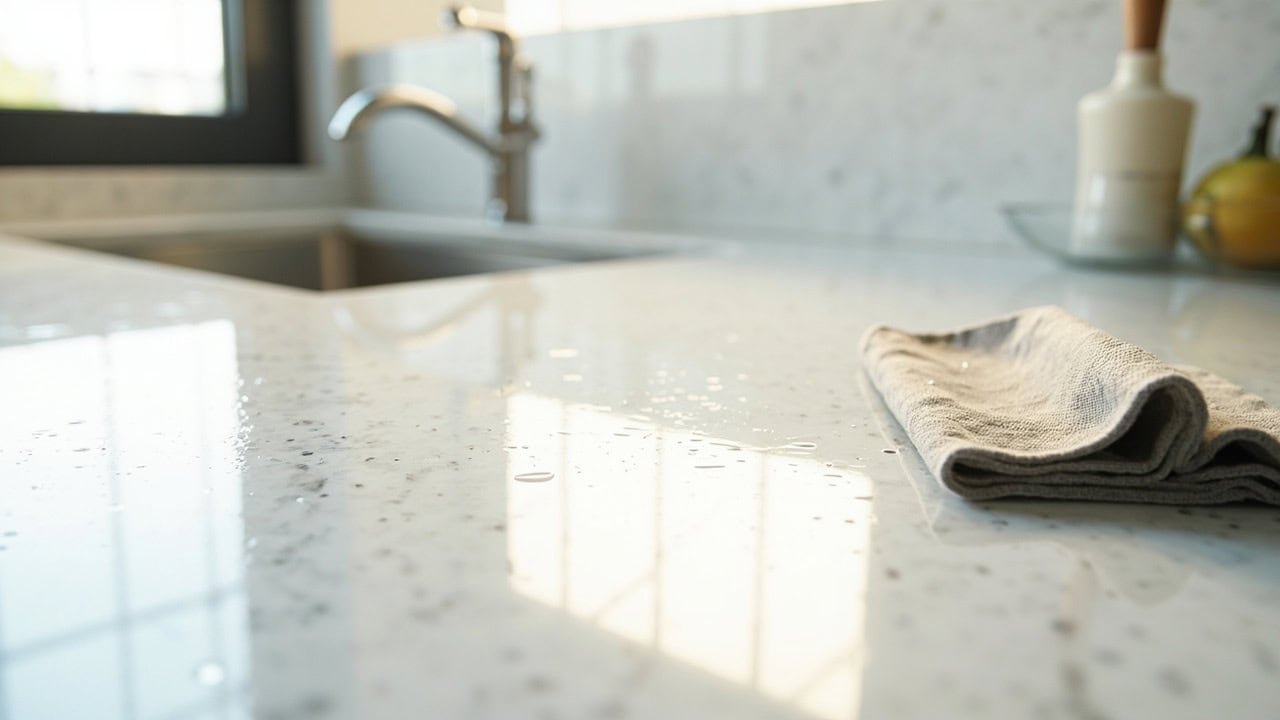
How to Clean Quartz Countertops

Quartz countertops must be cleaned with a pH-neutral cleaner diluted at a ratio of 1:10 with warm water and a non-abrasive microfiber cloth using circular motions — acid-based cleaners with a pH below 6 cause irreversible etching on the polymer resin surface. Engineered quartz consists of 90–95% crushed natural quartz aggregate bound together with 5–10% polymer resin, typically a polyester or epoxy-based binder. This resin component is vulnerable to strong acids, solvents, and caustic chemicals that break down the polymer network. For daily maintenance, a mild dish soap solution at approximately 1 teaspoon per quart of warm water cleans effectively without degrading the resin binder.
What You Need Before You Start
Gathering the correct supplies before you begin prevents the most common cause of quartz surface damage: reaching for the wrong cleaner mid-task. Quartz countertops have a factory-polished finish maintained by the polymer resin binder that holds the stone aggregate together, and the wrong product can compromise that finish in a single application.
- pH-neutral cleaner formulated for quartz — Products with a pH between 6 and 8 are safe for daily use. Avoid vinegar, bleach, ammonia-based cleaners, and any product containing citrus or solvent ingredients.
- Soft microfiber cloth or non-scratch sponge — Never use steel wool, scouring pads, or abrasive scrubbers that scratch the polished resin surface.
- Warm water — Used for diluting the cleaner and rinsing the surface. Room-temperature to warm (approximately 70–100 °F / 21–38 °C) is ideal.
- Soft-bristled toothbrush or detail brush — Essential for cleaning seams, edges, and corners where grime accumulates in the caulk lines.
- Paper towels or a dry microfiber cloth — For the final buffing step that prevents water spots and leaves a streak-free finish.
Dilution ratio: Mix the pH-neutral cleaner at a 1:10 ratio with warm water unless the product label specifies otherwise. Using a concentrated solution does not clean better — it leaves residue that attracts soil more quickly and may cloud the polished surface over repeated applications.
Step-by-Step Cleaning Process
Follow this sequence for effective, damage-free cleaning. The entire process takes approximately 5–10 minutes for an average kitchen countertop. Caesarstone, one of the leading quartz manufacturers, recommends warm soapy water as the primary daily cleaning method, supplemented by a dedicated quartz surface cleaner for heavier soilage. The key is consistent gentle maintenance rather than aggressive periodic deep cleaning.
- Clear the surface — Remove all small appliances, cutting boards, food items, and loose debris. Crumbs and grit trapped under a cloth act as abrasives during wiping, causing micro-scratches in the resin surface.
- Rinse with warm water — Wet the entire surface with warm water using a cloth or spray bottle. This pre-rinse loosens dust, dried food particles, and water-soluble residues so the cleaner can focus on bonded soilage.
- Apply pH-neutral cleaner — Spray or wipe the diluted cleaner across the entire surface in an even layer. Work in sections of roughly 2 × 2 feet to prevent the cleaner from drying before you agitate it.
- Agitate gently — Use a soft microfiber cloth in circular motions to lift soilage from the surface. Allow the cleaner a dwell time of 30–60 seconds before wiping — this gives the surfactant molecules time to break the bond between the soil and the resin surface.
- Focus on seams and edges — Use a soft-bristled toothbrush for corners, seams, and caulk lines where grease and food residue accumulate. Apply gentle pressure — the goal is to lift debris from the crevice, not scrub the surrounding surface.
- Rinse thoroughly — Wipe the entire surface with a clean, damp microfiber cloth to remove all cleaner residue. Any remaining surfactant film attracts dust and makes the surface feel sticky rather than smooth.
- Buff dry — Use a dry microfiber cloth to wipe the surface in one direction, preventing water spots and achieving a streak-free shine. This final step is what separates a properly cleaned quartz countertop from one that looks smeared.
Quartz Countertop Considerations: What to Avoid
Quartz is engineered stone — the polymer resin binder that holds the quartz aggregate together makes the surface non-porous and resistant to bacteria, but it also creates chemical vulnerabilities that natural stone does not share. Understanding what damages the resin layer is more important than knowing what cleans it, because a single exposure to the wrong chemical can cause permanent damage that no polishing can reverse.
Never Use Acidic Cleaners
Vinegar (pH 2.5–3.0), lemon juice (pH ~2.0), and citrus-based cleaners all fall below the safe pH threshold of 6. The acid attacks the polyester or epoxy resin binder, causing irreversible etching that appears as dull, cloudy spots on the polished surface. Unlike natural stone where etching can sometimes be polished out, the resin layer in engineered quartz cannot be restored once chemically degraded.
Avoid Bleach and Ammonia
Sodium hypochlorite (bleach) and ammonia-based products degrade the polymer binder over time, causing yellowing, loss of gloss, and eventual surface breakdown. Caustic alkaline cleaners with a pH above 10 — including oven cleaners, paint removers, and floor strippers — have the same destructive effect from the opposite end of the pH scale. Caesarstone’s official care guidelines explicitly list these products as prohibited for use on quartz surfaces.
Never Use Abrasive Tools
Steel wool, scouring pads, and stiff-bristled brushes create visible scratches in the factory-polished resin surface. Even “non-scratch” sponges with a textured scrubbing side should be used with caution — test on an inconspicuous area first. The safest approach is to rely on chemical action (proper dwell time with a suitable cleaner) rather than mechanical abrasion to remove stubborn soil.
Protect from Extreme Heat
Although quartz is heat-resistant to approximately 300 °F (150 °C) for brief contact, sustained or extreme heat causes thermal shock that can crack the slab. Always use trivets or hot pads under pots, pans, and electric cooking appliances. The polymer resin begins to discolor and soften at temperatures above 300 °F, and thermal expansion differentials between the quartz aggregate and the resin can cause internal cracking that is invisible until the slab fails under pressure.
Wipe Up Spills Immediately
While quartz is non-porous and resists staining better than natural stone, prolonged contact with strongly pigmented substances — red wine, coffee, tea, curry, beet juice, and oil-based products — can cause discoloration that requires a specialized quartz stain remover to address. The non-porous surface means spills do not penetrate deeply, but surface-level staining still occurs if pigments bond with the resin over extended contact periods.
Drying and Finishing Quartz Countertops
Proper drying is the step most homeowners skip, and it is the reason their countertops show water spots despite using the correct cleaner. Hard water contains dissolved minerals — primarily calcium carbonate and magnesium — that deposit on the surface as the water evaporates. These mineral deposits bond to the resin over time and become progressively harder to remove with each cycle of wetting and air-drying.
- Use a dry, clean microfiber cloth for final buffing — paper towels leave lint fibers that cling to the slightly tacky resin surface.
- Work in sections of approximately 2 × 2 feet to ensure no moisture is left behind to air-dry and form spots.
- Buff in one direction (not circular) for a uniform sheen — circular buffing creates overlapping patterns visible under overhead lighting.
- For stubborn water spots that have already formed, apply a quartz-specific polish or a single drop of mineral oil or baby oil on a microfiber cloth, then buff in one direction. Do not use paste waxes or automotive polishes designed for natural stone — these contain solvents incompatible with quartz resin.
Common Mistakes When Cleaning Quartz Countertops
Even homeowners who know the basics of quartz care frequently make these errors. Each one causes cumulative damage that shortens the lifespan of the factory finish.
Using Vinegar or Lemon Juice as a “Natural” Cleaner
The most common mistake is treating quartz like natural stone. Vinegar is frequently recommended for granite and marble cleaning in DIY circles, and homeowners assume the same approach works on quartz. It does not — the acid in vinegar (5% acetic acid at pH 2.5) and lemon juice (citric acid at pH 2.0) directly attacks the polyester or epoxy resin binder, producing permanent dull spots that cannot be repaired without replacing the affected section. For safe cleaning chemistry principles, see our Cleaning Chemistry Hub.
Applying Abrasive Powdered Cleaners
Scouring powders and soft-scrub products containing micro-beads or diatomaceous earth particles create fine scratches across the polished surface. These scratches appear as a hazy film under direct light and provide microscopic crevices where dirt and bacteria accumulate, undermining the non-porous quality that makes quartz hygienic. If you need to compare engineered quartz care with natural stone care methods, see our guide on how to clean granite countertops.
Leaving Acidic Foods on the Surface
Tomato sauce, citrus fruits, wine, and coffee are all acidic enough to etch the resin if left in contact for extended periods. While brief contact during meal preparation is generally harmless, leaving a spill overnight — or using the countertop as a permanent coffee bar without a coaster — causes localized etching that appears as a permanently dulled ring or spot.
Cross-Contaminating Cleaning Cloths
Using the same cloth that was just used to wipe the stovetop, sink, or bathroom surfaces transfers chemical residue and abrasive particles to the quartz surface. A cloth that was used with a bleach-based bathroom cleaner will deposit sodium hypochlorite onto the quartz resin. Dedicate a specific set of microfiber cloths for quartz countertop cleaning only.
Over-Wetting the Surface
Allowing large volumes of water to pool on the countertop — especially near seams, edges, and where the countertop meets the backsplash — risks water penetrating into the seam adhesive and the substrate beneath. While quartz itself is non-porous, the joint adhesive and the cabinetry below are not. Pooled water at seams is a leading cause of adhesive degradation and eventual seam separation.
For stubborn stains that resist normal cleaning, see our guide on how to remove stains from stone countertops for advanced techniques that are safe for engineered quartz surfaces.
Frequently Asked Questions
Q: Can I use vinegar to clean quartz countertops?
A: No. Vinegar should never be used on quartz countertops. Its acetic acid content (5% concentration, pH 2–3) etches the polymer resin binder that holds the quartz aggregate together, causing permanent dull spots and surface damage that cannot be polished out. The resin layer cannot be restored once chemically degraded — unlike natural stone where etching may be repairable through re-polishing. Always use a pH-neutral cleaner formulated specifically for quartz surfaces.
Q: What is the best daily cleaner for quartz countertops?
A: A pH-neutral, quartz-specific cleaner diluted at a 1:10 ratio with warm water is the best choice for daily cleaning. For routine everyday maintenance, a mild dish soap solution (approximately 1 teaspoon per quart of warm water) cleans effectively without degrading the polymer resin binder. Avoid generic all-purpose cleaners — many contain solvents, ammonia, or citrus additives that are incompatible with quartz resin. Products carrying the NSF International certification for food-contact surfaces provide an additional safety assurance.
Q: How do I remove dried-on food or stains from quartz?
A: For dried food or stubborn stains, apply a quartz-safe stain remover and allow it to dwell for 5–10 minutes to break the bond between the residue and the resin surface. Then gently scrape with a plastic putty knife held at a 45-degree angle — never use metal tools, razor blades, or steel wool, all of which scratch the polished resin surface. After removing the bulk of the residue, clean the area with a pH-neutral quartz cleaner and buff dry with a microfiber cloth. For persistent staining, consult the kitchen cleaning guide for additional techniques.
Q: Can I use rubbing alcohol or hydrogen peroxide on quartz?
A: Diluted hydrogen peroxide at 3% concentration can be used sparingly on light-colored quartz for spot treatment of tough stains, but prolonged or repeated exposure may gradually lighten the resin binder and affect the uniformity of the surface color. Rubbing alcohol (isopropyl alcohol) at concentrations of 70% or lower is generally safe for occasional spot cleaning, but avoid prolonged contact with seams and joints where the adhesive may be affected by the solvent action. For routine cleaning, stick with pH-neutral products — alcohol and peroxide should be reserved for targeted stain treatment only.
References
- Caesarstone. (2024). Care & Maintenance Guide. Caesarstone Australia.
- NSF International. (2024). NSF/ANSI Standard 51: Food Equipment Materials. NSF International.
- ASTM International. (2023). ASTM C1526 — Standard Specification for Agglomerated Stone Products. ASTM International.
- Cosentino Group. (2024). Silestone Care & Maintenance. Cosentino Group.
- U.S. Environmental Protection Agency. (2023). Safer Choice Standard for Cleaning Products. EPA.gov.


