
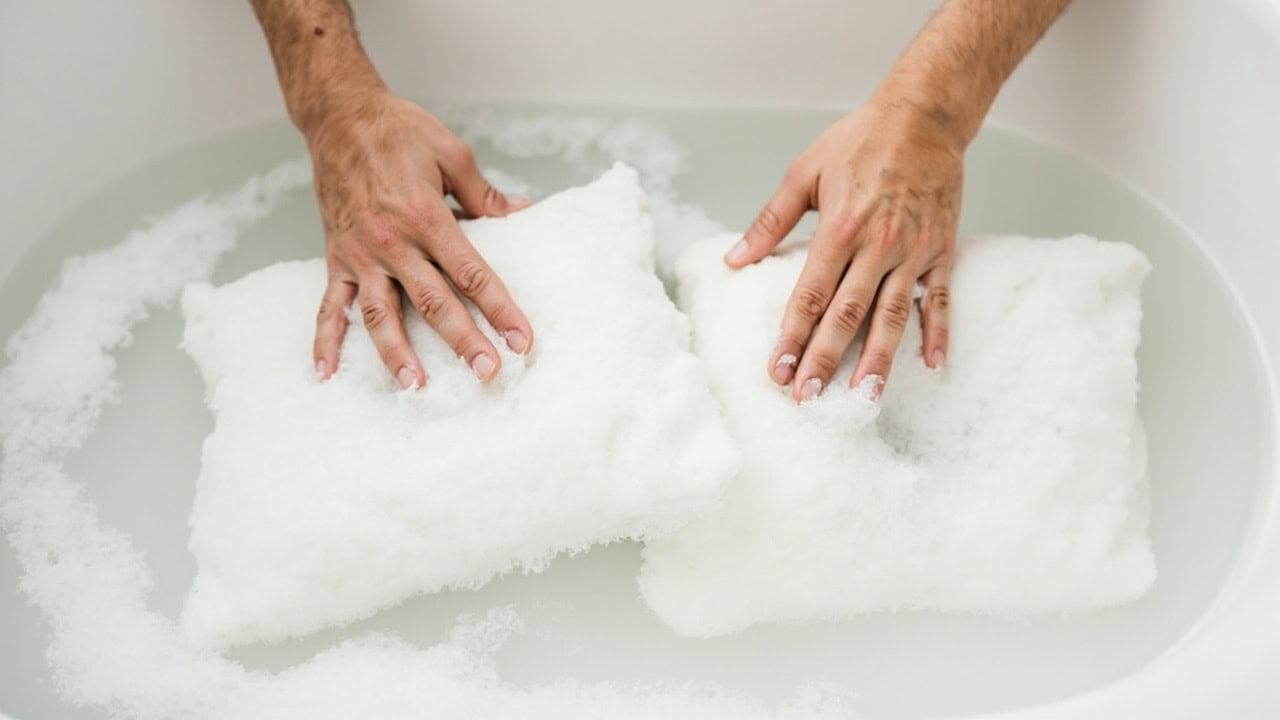
How to Wash Memory Foam Pillows

Memory foam pillows must be hand-washed in lukewarm water (under 90°F/32°C) with a mild, pH-neutral detergent using a gentle squeezing motion — never wring, twist, or machine wash as this causes the foam to tear, clump irreversibly, and lose Loft. The pillow should be air-dried completely flat in a well-ventilated area for 24–48 hours before use, as residual moisture trapped in the dense foam creates mold risk and deteriorates the polyurethane material. Memory foam — a temperature-sensitive viscoelastic polyurethane foam — softens under body heat and pressure, which is exactly why hot water and mechanical agitation destroy its open-cell structure.
What You Need Before You Start
Gathering the right supplies before you begin prevents mid-process mistakes that can permanently damage your pillow. Memory foam reacts adversely to heat, harsh chemicals, and mechanical force, so every item you use must meet specific criteria.
- Mild, pH-neutral liquid detergent — free of bleach, fabric softeners, and enzymes that degrade foam. Look for detergents labeled “gentle” or “free and clear” with a pH between 6.5 and 7.5, which is safe for polyurethane foam cell walls.
- Clean, cool to lukewarm water — below 90°F/32°C. Use a kitchen thermometer to verify. Water above 95°F/35°C begins to soften and permanently deform the viscoelastic structure of memory foam.
- Two clean, dry towels — for absorbing excess water after rinsing. White, lint-free towels are ideal.
- A flat drying surface with unrestricted airflow — a clean drying rack or a towel-lined table near a fan works well.
- Optional: baking soda — for deodorizing between washes. Sprinkle on the surface, let sit 30 minutes, then vacuum with an upholstery attachment.
Never substitute dish soap, laundry pods, or powdered detergent — these contain surfactants and enzymes formulated for fabric, not foam, and can leave residues that irritate skin and degrade the memory foam over time.
Step-by-Step Hand-Washing Process
Follow each step in order. Rushing or skipping a step — especially the rinsing or drying stages — is the most common cause of post-wash odor, mold growth, and foam degradation.
- Fill a clean basin or sink with lukewarm water (under 90°F/32°C) and add 1–2 teaspoons of pH-neutral liquid detergent. Swirl the water gently to distribute the detergent without creating excessive suds.
- Submerge the pillow partially and apply detergent directly to any visible stains or body oil spots. For spot-cleaning specific areas, use your fingertips to work the detergent into the stain using small circular motions. For a full wash, let the pillow absorb water gradually — do not force it underwater.
- Gently squeeze the pillow with both hands working from outside toward the center — never wring, twist, or scrub as this tears the foam cell structure. Use a slow, rhythmic compression that mimics pressing a sponge, allowing the soapy water to circulate through the foam.
- Drain the soapy water and rinse thoroughly with clean lukewarm water, continuing to squeeze gently until all detergent is removed. Any residual soap left inside the foam will attract dirt and cause skin irritation. Repeat the rinse cycle 2–3 times until the water runs completely clear.
- Press firmly between clean, dry towels to extract as much water as possible without wringing. Fold a towel over the pillow and press down with your full body weight. Replace with a dry towel and repeat until minimal moisture transfers.
- Reshape the pillow to its original form and place on a flat, well-ventilated drying surface. Gently pat and mold the foam back into its original contour — memory foam can hold a deformed shape if left misshapen while damp.
- Flip and rotate the pillow every 2–3 hours during drying to prevent moisture pooling and mold growth. Dense memory foam traps water deep inside its cell structure, so consistent air exposure on all sides is essential.
- Allow 24–48 hours total air-dry time — the pillow must be completely dry with no residual moisture before use. Thicker pillows (4+ inches) may require the full 48 hours. Press firmly into the center to test — if any moisture releases or the foam feels cooler than room temperature, it needs more time.
Memory Foam Pillow-Specific Considerations
Memory foam is a specialized material that demands different care than standard polyester or down-fill pillows. Understanding why certain methods are off-limits helps you protect your investment and extend the pillow’s functional lifespan.
Never Machine Wash or Tumble Dry
The agitation cycle of a washing machine — even on the gentlest setting — creates mechanical forces that tear the delicate open-cell structure of viscoelastic polyurethane foam. The spin cycle compounds this with centrifugal force that stretches and distorts the foam beyond its elastic recovery point. Tumble dryers are equally destructive: even a no-heat setting subjects the pillow to repeated impact forces that fracture foam cells and cause permanent Loft loss. For washable pillow types that can handle machine washing, see our guide on how to wash polyester fill pillows.
Temperature Limits
Never use hot water above 90°F/32°C — memory foam begins to soften and lose structural integrity at temperatures exceeding 95°F/35°C. The viscoelastic polymers in memory foam undergo a glass transition at elevated temperatures, causing the material to lose its ability to rebound slowly from compression. This transition is irreversible: once the polymer chains have reorganized under heat stress, the foam will not recover its original density or support properties.
Chemicals to Avoid
Avoid bleach, hydrogen peroxide, and fabric softeners — these chemicals oxidize and break down the polyurethane cells. Bleach (sodium hypochlorite, pH 11–13) aggressively oxidizes the urethane linkages in the foam’s polymer backbone, causing brittleness and yellowing. Fabric softeners deposit a hydrophobic silicone coating that clogs the foam’s open-cell structure, trapping heat and moisture. Enzyme-based detergents are equally problematic — the protease enzymes are designed to break down protein chains and will attack the foam’s polymer matrix over repeated exposures. Always choose a detergent labeled pH-neutral and free of these additives.
Spot Cleaning vs. Full Wash
Spot cleaning is preferable for lightly soiled pillows — full immersion increases drying time and mold risk. For localized stains, dampen a clean cloth with diluted detergent solution (1 teaspoon per cup of lukewarm water) and blot the stain from the outside edge inward. This technique is especially useful for body oil stains, which are the most common soil on memory foam pillows. For detailed pre-treatment methods, see our article on how to remove body oil stains from bedding.
Pillowcase and Protector Use
Using both a pillowcase and a removable, washable pillow protector dramatically reduces the frequency of full cleaning needed. The protector creates a barrier against body oils, sweat, and dead skin cells — the primary contaminants that penetrate memory foam. Wash pillow protectors and pillowcases weekly with your standard laundry routine. For a complete weekly cleaning routine, see our guide on how to clean pillowcases and pillow protectors.
Drying and Finishing Your Memory Foam Pillow
The drying phase is where most memory foam pillow damage occurs — not during washing. Incomplete drying creates a breeding ground for mold and bacteria inside the dense foam, while improper drying methods can physically destroy the foam structure.
Air-dry flat on a clean, dry surface with good ventilation — never use a clothesline that creates stress points. Hanging a wet memory foam pillow by one edge causes the water-saturated foam to stretch under its own weight, creating permanent distortion. Instead, lay the pillow flat on a drying rack or towel-lined surface that allows air circulation from all sides.
Position near a fan or in a room with consistent air circulation to reduce drying time. A moderate fan speed moving air across the pillow’s surface accelerates evaporation without applying heat. Avoid enclosed or humid spaces like bathrooms, where the ambient moisture slows the drying process — a principle shared with our bathroom cleaning guide‘s mold prevention recommendations.
Do not use a hairdryer or direct sunlight — heat deforms the foam while UV degradation causes oxidation and material breakdown. UV radiation breaks the polyurethane polymer chains at the molecular level, causing the foam surface to become brittle, yellow, and crumbly. If you must speed up drying, a fan set to low or medium is the only safe option.
Test for complete dryness by pressing firmly into the center — if any moisture releases or the foam feels cool to the touch, continue drying. The center of a thick memory foam pillow retains moisture the longest, so always test the deepest point. Once dry, gently knead and fluff by hand to restore Loft before placing the pillowcase back on.
Common Mistakes When Washing Memory Foam Pillows
Understanding what goes wrong — and why — helps you avoid the most frequent causes of permanent pillow damage. The table below outlines each mistake alongside the specific mechanism by which it destroys the foam.
| Mistake | Why It Damages the Pillow |
|---|---|
| Machine washing | Agitation tears foam cells; heat from spin cycle melts and clumps the foam permanently |
| Using hot water | Temperatures above 90°F/32°C soften and permanently deform the foam’s viscoelastic structure |
| Wringing or twisting | Creates stress points that fracture the foam internally, causing irreversible Loft loss |
| Incomplete drying | Trapped moisture inside dense foam promotes mold growth and bacterial proliferation |
| Using harsh detergents | Bleach and enzymes oxidize and degrade polyurethane foam cells at the molecular level |
| Direct sunlight drying | UV oxidation causes foam to become brittle, discolored, and structurally compromised |
Preventing Future Buildup and Extending Pillow Life
Prevention is far more effective than remediation when it comes to memory foam pillow care. A consistent maintenance routine keeps the foam clean and extends its functional lifespan well beyond the typical 2–3 year replacement window.
- Use a removable, washable pillow protector in addition to a pillowcase. This dual-layer barrier catches the majority of body oils, sweat, and dead skin cells before they reach the foam.
- Spot-clean stains immediately before they set into the foam. Body oil and sweat become progressively harder to remove as they oxidize and bond with the polyurethane matrix.
- Vacuum the pillow monthly using an upholstery attachment to remove dust mites, allergens, and dead skin cells that accumulate on the surface. This simple step significantly reduces the need for full washing.
- Deodorize periodically by sprinkling baking soda on the surface, letting it sit for 30 minutes, then vacuuming thoroughly. Baking soda absorbs trapped odors without introducing moisture or chemicals to the foam.
- Replace pillow protectors and pillowcases weekly with your standard laundry. Washing these outer layers weekly prevents contaminants from migrating through to the foam core.
- Plan for replacement every 2–3 years — memory foam pillows typically last 2–3 years with proper care before Loft degradation and loss of support require replacement, according to the National Sleep Foundation’s sleep product guidelines.
For a complete guide to laundry care for all bedding materials — from pillowcases to mattress covers — visit our laundry care guide, which covers fabric-specific washing instructions, stain removal techniques, and drying best practices for every type of bedding.
Frequently Asked Questions
Q: Can you put memory foam pillows in the washing machine?
A: No — memory foam pillows must never be machine washed. The agitation tears the foam cell structure while the heat and spin cycle melts and clumps the foam irreversibly. Hand-washing in lukewarm water with gentle squeezing is the only safe method.
Q: How often should you wash a memory foam pillow?
A: Memory foam pillows should be spot-cleaned as needed and deep-hand-washed every 3–6 months. Using a pillow protector and pillowcase reduces frequency — wash the outer layers weekly with regular laundry while the pillow itself requires less frequent cleaning.
Q: Can you air-dry memory foam pillows in a dryer on no-heat setting?
A: No-heat tumble drying is not recommended because the motion still stresses the foam structure. Air-drying flat on a clean surface is the only method that preserves the foam’s integrity and Loft.
Q: Why does my memory foam pillow smell after washing?
A: The odor is typically caused by incomplete drying leading to mold or bacterial growth within the dense foam. If odor persists after 48+ hours of thorough air-drying, sprinkle baking soda over the surface, let it sit for 30 minutes, then vacuum thoroughly to draw out residual moisture and odor.
References
- National Sleep Foundation. (2023). How Often Should You Replace Your Pillows?. SleepFoundation.org.
- Sleep Foundation. (2024). How to Wash a Memory Foam Pillow. SleepFoundation.org.
- ASTM International. (2019). ASTM D3574-19: Standard Test Methods for Flexible Cellular Materials — Slab, Bonded, and Molded Urethane Foams. ASTM.org.
- Centers for Disease Control and Prevention. (2024). Mold — General Information. CDC.gov.
- U.S. Environmental Protection Agency. (2024). Mold Cleanup and Remediation. EPA.gov.


