
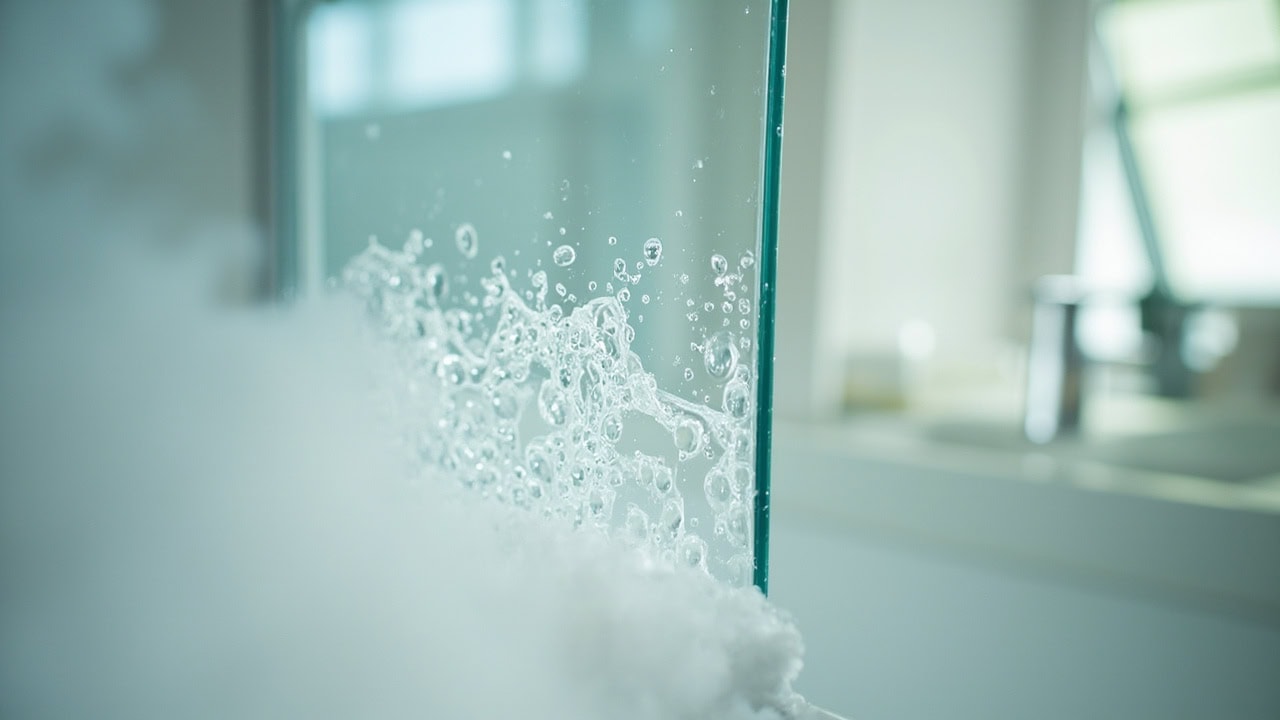
How to Remove Hard Water Deposits from Glass Shower Doors

Hard water deposits on glass shower doors are removed by applying full-strength white distilled vinegar (5% acetic acid, pH 2.5) directly to the affected glass, allowing a 5–10 minute dwell time for the acid to dissolve calcium and magnesium carbonate bonds, then scrubbing with a non-abrasive nylon brush and rinsing thoroughly. The mineral deposits—primarily calcium carbonate (CaCO₃) and magnesium carbonate (MgCO₃)—precipitate from hard water during evaporation and bond electrochemically to the silica surface of glass. Vinegar’s mild acidity dissolves these carbonates by converting them into water-soluble acetate salts that rinse away cleanly.
According to the United States Geological Survey (USGS), hard water is classified by calcium carbonate concentration: soft (0–60 mg/L), moderately hard (61–120 mg/L), hard (121–180 mg/L), and very hard (greater than 180 mg/L as CaCO₃). Homes supplied with hard or very hard water—which includes large portions of the east-central and western United States—experience significantly faster mineral accumulation on shower glass. One grain per gallon (gpg) equals 17.1 mg/L of calcium carbonate, meaning water testing above 7 gpg (approximately 120 mg/L) will produce visible deposits on glass surfaces within days of untreated exposure.
Why Hard Water Deposits Bond to Glass
Hard water contains dissolved calcium and magnesium ions (Ca²⁺ and Mg²⁺) that exist in solution as bicarbonates. When water droplets land on a hot shower door and evaporate, the bicarbonates decompose into insoluble carbonates—calcium carbonate and magnesium carbonate—that precipitate as solid white crusts on the glass surface. This precipitation accelerates at elevated temperatures, which is why shower doors accumulate deposits far faster than cold-water glass surfaces such as windows.
Glass is composed primarily of silicon dioxide (SiO₂), and its surface carries a slight negative electrical charge due to deprotonated silanol groups (Si-O⁻). The positively charged calcium and magnesium cations are attracted to this negative surface through electrostatic bonding. Over time, these mineral deposits crystallize into a rigid lattice structure that adheres strongly to the silica framework. Once crystallized, plain water—no matter how hot—cannot dissolve these carbonates because they are insoluble in neutral-pH water. Only an acidic solution can break the carbonate bonds and return the minerals to a dissolved, rinseable state.
The deposit layer also traps soap scum, body oils, and other organic residues between the mineral crystals and the glass, creating a combined film that appears increasingly cloudy and opaque. This layered buildup is why older deposits feel rough to the touch and resist removal with standard glass cleaners. For related guidance on eliminating soap-based residue, see our guide on how to remove soap scum from bathroom surfaces.
What NOT to Use on Glass Shower Doors
Using the wrong cleaning tool or chemical on glass shower doors can cause permanent damage that no amount of subsequent cleaning will fix. Understanding what to avoid is critical before beginning any hard water deposit removal.
Abrasive Scrubbers
Steel wool, scouring pads with embedded abrasives, and stiff-bristled brushes create microscopic scratches across the glass surface. These scratches scatter light and produce a permanent haze that mimics the very cloudiness you are trying to remove. Once scratched, glass cannot be restored without professional polishing. Use only soft nylon brushes, microfiber cloths, or non-scratch sponges rated for glass.
Bleach-Based and Strong Acid Cleaners
Sodium hypochlorite bleach does not dissolve mineral deposits and can damage chrome and metal hardware finishes surrounding the shower door. Stronger acids—hydrochloric acid (muriatic acid) and phosphoric acid—dissolve carbonates aggressively but can etch glass at high concentrations or prolonged contact times. Commercial bathroom cleaners containing these acids are formulated for tile and porcelain, not for glass. Always check the label for glass compatibility before use.
Ammonia-Based Glass Cleaners
Products like Windex and similar ammonia-based glass cleaners are formulated to remove oils and smudges, not mineral deposits. Ammonia (pH ~11) is a base and has no capacity to dissolve calcium or magnesium carbonates, which require acidic conditions to break down. Spraying an ammonia cleaner on hard water spots will leave the mineral deposits intact while merely cleaning the surrounding glass. For a complete glass cleaning routine that maintains clarity between deep-clean sessions, see our article on how to clean glass shower doors.
Razor Blades Without Lubrication
A single-edge razor blade can remove severe mineral crust, but only when the glass surface is fully lubricated with vinegar solution or soapy water. Dragging a dry razor across glass will gouge the surface. Always hold the blade at a 45° angle and push in a single direction—never scrape back and forth. Keep the surface wet throughout the process, relubricating every few strokes.
How to Remove Hard Water Deposits: Step-by-Step
The following method uses white distilled vinegar as the sole active cleaning agent. White vinegar contains approximately 5% acetic acid by volume and has a pH of roughly 2.5, making it strong enough to dissolve calcium and magnesium carbonates without risking glass etching. The chemical reaction converts insoluble carbonates into soluble calcium acetate and carbon dioxide gas, which releases as small bubbles during the dwell period—a visible sign that the dissolution is active.
Gather the following materials before starting: white distilled vinegar, a clean spray bottle, distilled water (for dilution if needed), a soft nylon brush or soft-bristled toothbrush, a microfiber cloth, a squeegee, and a single-edge razor scraper with fresh blades for severe cases.
- Prepare the vinegar solution. For light to moderate hard water deposits, pour full-strength white distilled vinegar directly into a clean spray bottle. For older or thinner buildup, a 1:1 mixture of vinegar and distilled water provides adequate acidity while extending the solution volume. Warm the mixture slightly—to around room temperature (68–72°F / 20–22°C)—by placing the spray bottle in a bowl of warm water for five minutes. Warmer vinegar reacts faster because the dissolution kinetics of calcium carbonate in weak acid increase with temperature. Do not heat vinegar on a stove or in a microwave, as concentrated acetic acid vapors are irritating to the respiratory system.
- Apply vinegar to all affected areas. Generously spray the vinegar solution onto every glass surface showing visible white, cloudy, or chalky deposits. Pay particular attention to the lower third of the door where water pools and runs down, along the edges where the glass meets the frame, and in corners where mineral accumulation is heaviest. Spray until the solution begins to sheet and drip—insufficient coverage allows deposits to remain partially untreated.
- Allow a 5–10 minute dwell time. The acetic acid needs time to penetrate the mineral lattice and dissolve the carbonate bonds. For light deposits (a faint white film), 5 minutes is sufficient. For moderate to heavy buildup (visible crusty layers), extend the dwell time to 10–15 minutes. You may notice tiny bubbles forming on the deposit surface—this is carbon dioxide gas releasing from the acid-carbonate reaction, confirming the dissolution is underway. Do not allow the vinegar to dry completely on the glass. If the solution begins to evaporate before the dwell time elapses, re-spray to keep the surface wet. For the science behind dwell time and how contact duration affects cleaning efficacy, see the CleaningTuts glossary.
- Scrub with a non-abrasive brush. After the dwell period, use a soft nylon brush or a soft-bristled toothbrush to agitate the loosened deposits. Work in small circular motions across each treated section, applying light to moderate pressure. Focus extra effort on areas with the heaviest cloudiness. The deposits should break apart and suspend in the vinegar solution as a milky residue. Avoid pressing hard enough to flex the brush bristles against the glass—let the chemical dissolution do the work, not mechanical force.
- Rinse thoroughly with clean water. Use a detachable shower head on a gentle spray setting, or pour cups of clean water over the glass to flush away all vinegar residue and suspended mineral particles. Incomplete rinsing leaves a thin film of calcium acetate that dries to a faint haze. Work from the top of the door downward to ensure complete coverage. If your shower head is not detachable, a large sponge soaked in clean water and wrung over the glass works effectively.
- Dry with a clean microfiber cloth. Immediately after rinsing, wipe the entire glass surface dry with a clean microfiber cloth. Microfiber traps residual moisture and any remaining mineral particles rather than pushing them across the glass. Buff in circular motions for a streak-free finish. This drying step is critical—allowing the glass to air-dry invites new water spots to form as residual droplets evaporate, partially undoing the cleaning effort.
- For severe deposits: use the razor scraper technique. When mineral crust is thick enough to feel rough to the touch and resists the vinegar soak, a single-edge razor scraper can physically remove the remaining deposit. Soak the area with full-strength vinegar and keep it wet throughout. Hold the razor at a 45° angle to the glass surface with the blade flat against the glass—never use the blade’s corner or edge at a steep angle, as this will gouge the glass. Push the blade in one direction only in smooth, even strokes. Relubricate with vinegar after every two to three strokes. Replace the blade when it becomes dull, as a nicked or dull blade is far more likely to scratch glass. This technique should be a last resort for severe buildup, not a routine cleaning method.
How to Prevent Future Hard Water Buildup
Removing existing deposits solves the immediate problem, but without prevention, new mineral crust will begin forming after the very next shower. The strategies below address prevention at three levels: surface protection, behavioral habits, and water treatment at the source.
Surface Protection
Applying a hydrophobic glass coating—commonly sold as rain-repellent products for automotive windshields—creates an invisible barrier that causes water to bead and roll off rather than spread and evaporate on the glass. These products use siloxane or fluoropolymer compounds that bond to the silica surface, lowering the contact angle of water droplets to above 90°. Reapply every 4–6 weeks for continuous protection. Products in this category include coatings based on polysiloxane chemistry, which chemically adhere to the glass surface through silanol condensation reactions.
Behavioral Habits
- Squeegee after every shower. Running a squeegee across the glass immediately after showering removes water before it evaporates and leaves deposits. This single habit is the most effective prevention method and takes under 30 seconds.
- Run the exhaust fan during and for 15 minutes after showering. Reducing bathroom humidity limits condensation on glass surfaces and slows the evaporation-deposition cycle. Proper ventilation also helps protect other bathroom surfaces from moisture damage and mildew growth.
- Weekly vinegar maintenance spray. A quick spray of half-strength vinegar (1:1 with water) followed by a squeegee once per week dissolves any nascent mineral deposits before they crystallize into a stubborn crust. Weekly treatment requires far less effort than monthly deep cleaning of accumulated buildup.
Water Treatment at the Source
For homes with water hardness exceeding 7 grains per gallon (approximately 120 mg/L as CaCO₃), a whole-house water softener provides the most permanent solution. Water softeners use ion-exchange resin beads charged with sodium ions to swap calcium and magnesium ions for sodium, reducing hardness to near zero. The USGS reports that water exceeding 180 mg/L (very hard) is common in the upper Midwest, Great Plains, and southwestern states. A shower-head filter is a lower-cost alternative that reduces mineral content at the point of use, though its capacity is limited and cartridges typically require replacement every 3–6 months depending on water hardness. For more on how water chemistry affects cleaning across the home, see our cleaning chemistry guide.
When Cloudiness Will Not Come Off
If the glass remains cloudy after a thorough vinegar treatment followed by razor scraping, the cloudiness is likely caused by permanent etching rather than removable mineral deposits. Etching occurs when mineral deposits sit on glass for extended periods (months to years) and the carbonate crystals interact with the silica matrix at a microscopic level, physically altering the glass surface. Abrasive cleaning compounds, steel wool, or acidic cleaners left on glass for excessive durations can also cause etching. Etched glass cannot be restored with any cleaning method and requires either professional glass polishing (an abrasive process that removes a thin layer of glass) or full door replacement. This distinction is why regular cleaning and prevention are essential—the cost of replacing a set of framed or frameless shower doors runs significantly higher than a bottle of vinegar and a squeegee.
For comprehensive guidance on maintaining all bathroom surfaces beyond just the glass, visit our bathroom cleaning guide. If your hard water problems extend to tile and grout in the shower enclosure, our floor cleaning guide covers grout-specific cleaning techniques that apply equally to vertical shower tile. Additional terminology such as limescale, etching, and pH is defined in the CleaningTuts glossary.
Frequently Asked Questions
Q: Does vinegar damage glass shower doors?
A: White distilled vinegar at standard concentration (5% acetic acid, pH 2.5) is safe for glass shower doors and will not cause etching or damage when used as directed with proper rinsing. Glass is resistant to mild acids at this pH level. Avoid leaving vinegar on glass for more than 15–20 minutes without reapplying or rinsing, as prolonged contact with any acid can eventually affect surface coatings or hardware finishes.
Q: How often should I clean hard water deposits off glass shower doors?
A: Weekly vinegar cleaning prevents hard water deposits from accumulating and causing permanent etching. In areas with very hard water (above 10 grains per gallon or approximately 170 mg/L as CaCO₃), twice-weekly cleaning may be necessary to maintain clear glass. The USGS classifies water above 180 mg/L as very hard, and homes in these areas will see visible deposit formation within days without regular maintenance.
Q: Can I use lemon juice instead of vinegar to remove hard water deposits?
A: Yes, lemon juice contains citric acid (approximately 5–6% concentration) which dissolves hard water minerals through a similar acid-carbonate reaction. Lemon juice has a pH of approximately 2.0, making it slightly more acidic than vinegar (pH 2.5). However, citric acid chelates calcium ions differently than acetic acid and may require longer dwell times or multiple applications for severe deposits. Lemon juice is a viable alternative but is typically more expensive per ounce than white vinegar for regular cleaning use.
Q: Why do my glass shower doors still look cloudy after cleaning?
A: Persistent cloudiness after proper vinegar cleaning and thorough rinsing indicates glass etching—permanent microscopic damage to the glass surface caused by prolonged mineral deposit exposure or abrasive cleaning. Etched glass has physical surface irregularities that scatter light, creating a cloudy appearance that cannot be reversed by any cleaning solution. Professional glass polishing may reduce mild etching by removing a thin layer of glass, but severe etching requires door replacement.
References
- United States Geological Survey (USGS). “Water Hardness.” Water Science School. U.S. Department of the Interior.
- United States Geological Survey (USGS). “Hardness of Water.” USGS Water Education. U.S. Department of the Interior.
- National Center for Biotechnology Information (NCBI). PubChem Compound Summary for Acetic Acid (CID 176). PubChem. National Library of Medicine.
- EPA. “Drinking Water Regulations and Contaminants.” EPA.gov. U.S. Environmental Protection Agency.


