
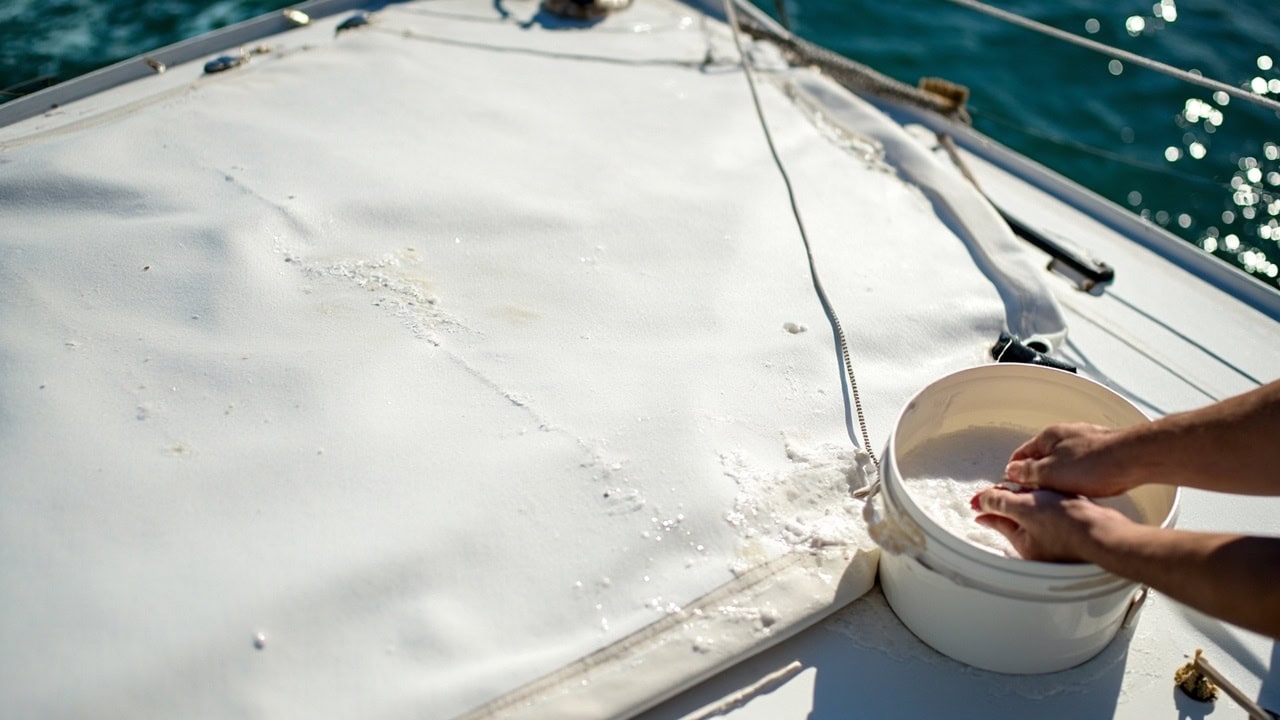
How to Clean Marine Canvas: Complete Guide

Marine canvas must be cleaned with a pH-neutral, non-detergent soap solution applied with a soft-bristled brush at a dilution ratio of 1:16 and a freshwater rinse — acid-based cleaners, bleach, and abrasive tools permanently damage the durable water repellent (DWR) coating that protects against UV, saltwater, and mildew. The cleaning process takes 45–90 minutes depending on canvas size and soil level, and should be performed twice yearly in saltwater environments or annually for freshwater use.
Marine canvas — commonly made from solution-dyed acrylic fibers like Sunbrella or cotton-polyester blends — is engineered to withstand harsh marine conditions, but its protective DWR coating degrades when exposed to the wrong cleaning chemicals. Understanding the correct cleaning method preserves both the fabric’s waterproofing and its structural integrity, extending service life by 3–5 years compared to improperly maintained canvas. For more on specialty fabric care, visit our specialty cleaning guide.
What You Need Before You Start
Gathering the right tools and cleaning agents before you begin prevents中途 substitutions that can damage your canvas. Marine canvas requires specific cleaning chemistry — the wrong soap or brush can strip the DWR coating in as few as two wash cycles.
Tools
- Soft-bristled brush (nylon or horsehair — never wire or stiff bristles)
- Freshwater hose with spray nozzle
- Large bucket (5-gallon minimum)
- Microfiber towels or chamois for spot drying
Cleaning Agents
- pH-neutral castile soap or marine canvas-specific cleaner (pH 7.0–8.0)
- White vinegar (5% acetic acid — for mildew spots only, spot test first)
- Sodium bicarbonate (baking soda) for stubborn salt deposits
Dilution Ratio
Mix your cleaning solution at a dilution ratio of 1:16 — that is one part pH-neutral soap to sixteen parts freshwater. For a standard 5-gallon bucket, this translates to approximately 1 cup of castile soap per 4 gallons of fresh water. This concentration is strong enough to lift salt, bird droppings, and environmental grime without stripping the DWR treatment from the fabric fibers.
Never use dishwashing detergent, bleach, oxygen bleach, or petroleum-based solvents on marine canvas. These chemicals strip the DWR coating and cause irreversible fiber degradation — reducing water repellency within 2–3 wash cycles and weakening tensile strength by up to 40% over time.
Step-by-Step Marine Canvas Cleaning Process
Follow these six steps in sequence. The entire process takes 45–90 minutes depending on canvas size and how heavily soiled it is. Work in sections and avoid letting soap dry on the fabric between steps — this is why rinsing each section before moving on is critical. This method applies to all common marine canvas types including bimini tops, dodgers, sail covers, and enclosure panels.
- Rinse loose debris — Spray the canvas thoroughly with freshwater to remove loose salt crystals, sand, bird droppings, and surface dirt. Start from the highest point of the canvas and work downward to prevent streaking. A thorough pre-rinse removes up to 70% of surface contaminants and prevents them from being ground into the fabric during scrubbing. Use a standard garden hose with a spray nozzle — never a pressure washer, which forces water through the weave and can damage seam stitching.
- Apply soap solution — Mix your pH-neutral soap at the 1:16 dilution ratio in a clean bucket. Dip your soft-bristled brush into the solution and apply it to the canvas using gentle circular motions. Work in manageable sections no larger than 3×3 feet to prevent the soap from drying before you can rinse it. Apply enough solution to saturate the surface without pooling — the canvas should be evenly damp but not dripping.
- Agitate gently — Allow the soap solution a dwell time of 3–5 minutes to break down salt deposits and organic contaminants. Then gently agitate the surface with your soft brush using light pressure. Do not scrub aggressively — excessive mechanical action damages the DWR coating and can force water through the fiber weave. For solution-dyed acrylic canvases (like Sunbrella), the color is locked into the fiber during manufacturing, so gentle agitation is sufficient to restore appearance without fading.
- Rinse thoroughly — Rinse each section completely with freshwater before moving to the next area. Residual soap left on canvas acts as a surfactant — it attracts dirt, creates a sticky film, and accelerates re-soiling. Rinse until the water runs clear and no bubbles remain. Pay particular attention to seams, folds, and crevices where soap tends to accumulate.
- Address mildew spots — For localized mildew growth, apply undiluted white vinegar (5% acetic acid, pH 2.5) directly to affected spots using a soft cloth. Allow 10–15 minutes of contact time for the acetic acid to penetrate and kill the mildew spores, then rinse thoroughly with freshwater. Only use vinegar as a spot treatment — full-canvas vinegar application dilutes and degrades the DWR coating. For extensive mildew that covers more than 15–20% of the canvas surface, use a dedicated marine canvas mildew remover formulated to be DWR-safe. For more on this topic, see our guide on how to remove mold from outdoor fabric.
- Dry completely — Allow the canvas to air dry fully, preferably in direct sunlight. Marine canvas dries faster than standard canvas due to its engineered open-weave construction — typically 4–8 hours in warm, breezy conditions versus 12–24 hours for conventional canvas. UV exposure during drying also helps suppress residual microbial growth. Ensure 24–48 hours of dry weather is forecast before beginning your cleaning project if the canvas will remain installed on the boat.
Marine Canvas-Specific Considerations
What Damages Marine Canvas
Marine canvas is built to endure sun, salt, and spray — but specific cleaning mistakes cause permanent, cumulative damage that shortens its lifespan dramatically. Understanding what to avoid is just as important as knowing the correct method.
- Chlorine bleach and oxygen bleach: Both degrade the DWR coating and weaken cotton-polyester fiber blends. Even diluted bleach breaks the molecular bonds in fluoropolymer-based DWR treatments, causing water repellency to fail within one or two applications. Bleach also causes yellowing on acrylic canvases and can dissolve seam thread.
- Harsh detergents: Dish soaps and laundry detergents contain surfactants designed to strip oils — which is precisely what they do to the DWR treatment. Within 2–3 wash cycles, the canvas loses its water repellency and begins absorbing moisture instead of beading it.
- Wire brushes, stiff bristles, or power washing: High-pressure water and abrasive bristles tear the woven fibers and compromise seam integrity. Pressure washers deliver 1,500–3,000 PSI — marine canvas is rated for garden hose pressure only (40–80 PSI).
- Petroleum solvents (acetone, mineral spirits): These solvents swell and degrade acrylic-based canvases, causing permanent distortion of the fiber structure and loss of dimensional stability.
- Automatic boat washes: Commercial boat wash facilities use aggressive rotating brushes and chemical detergents that destroy DWR coatings and abrade the fabric surface in a single pass.
Protecting Your Marine Canvas
Proper maintenance between cleanings is what ultimately determines how long your marine canvas lasts. A well-maintained bimini top or sail cover can provide 7–10 years of service; a neglected one may fail within 2–3 seasons.
- Re-apply DWR treatment annually — After deep cleaning, apply a marine-grade DWR re-treatment spray. These products use either fluoropolymer or silicone-based chemistry to restore water repellency. Fluoropolymer treatments (the industry standard) provide superior oil and stain resistance alongside water repellency, while silicone-based treatments are more affordable but offer less stain protection. Apply two light coats rather than one heavy coat for even, consistent coverage.
- Store canvas properly off-season — Always store marine canvas in a dry, ventilated space using breathable canvas storage bags. Never store damp canvas — moisture trapped in the folds promotes mildew growth even on DWR-treated fabric, because the coating only repels liquid water, not water vapor.
- Use UV protectant sprays — Marine canvas protectant sprays with UV inhibitors can extend fabric lifespan by 2–3 years. UV radiation breaks down the polymer chains in both acrylic and polyester fibers, causing fading, brittleness, and loss of tensile strength. Apply UV protectant after cleaning and DWR re-treatment for maximum benefit.
Saltwater vs. Freshwater Environments
The cleaning frequency your marine canvas requires depends directly on its exposure environment. Saltwater accelerates canvas degradation through a distinct mechanism — as seawater evaporates from the fabric surface, it leaves behind salt crystals (primarily sodium chloride) that embed in the fiber weave. These crystalline deposits act as microscopic abrasives, gradually wearing down both the fibers and the DWR coating with every flex and fold of the canvas.
In saltwater environments, marine canvas requires deep cleaning every 3–4 months and a freshwater rinse after every outing. Salt crystallization begins within 24–48 hours of exposure as the water evaporates, so timely rinsing is the single most effective preventive measure you can take. Freshwater environments allow much longer intervals — 6–12 months between deep cleanings is sufficient for boats used exclusively on lakes and rivers, since freshwater leaves minimal residue. For guidance on cleaning other marine surfaces that face similar salt exposure, see our article on how to clean vinyl boat seats.
Drying and Finishing Marine Canvas
The drying and finishing phase is where you lock in the results of your cleaning work. Skipping any of these steps — especially the DWR re-treatment — will undo much of the benefit of cleaning and leave the canvas vulnerable to rapid re-soiling and water penetration.
- Air dry in sunlight — Marine canvas weave is engineered for faster drying than standard canvas. Direct sun exposure helps suppress microbial growth and evaporates residual moisture trapped in the fiber weave. Prop the canvas at a slight angle to encourage water runoff rather than pooling in low spots. In humid climates or overcast conditions, use a portable fan to circulate air across the surface.
- Check for water spotting — If water spots appear on the dried canvas, they indicate mineral deposits left behind during rinsing. Mix a solution of 1:16 fresh water and isopropyl alcohol (70% concentration) and wipe the spotted areas gently with a microfiber cloth. The alcohol dissolves mineral deposits without affecting the DWR coating.
- Apply DWR re-treatment — Once the canvas is completely dry and clean, apply a marine-grade DWR spray in a well-ventilated area. Hold the spray can 6–8 inches from the fabric surface and apply in smooth, overlapping passes. Apply two light coats, allowing 15–20 minutes of drying time between coats, rather than one heavy coat that can run and create uneven coverage. The pH-neutral cleaning you performed earlier ensures the DWR treatment bonds properly to the fiber surface.
- Store properly — If storing canvas for the season, confirm it is 100% dry by touching the lowest folds and creases — these are the last areas to dry and the first to develop mildew if moisture remains. Use breathable canvas storage bags and never seal marine canvas in plastic, which traps moisture vapor and creates a greenhouse environment for mold and mildew spores. Store in a cool, dry location away from direct sunlight and heat sources.
Common Mistakes When Cleaning Marine Canvas
Even experienced boat owners make these five cleaning errors. Each one causes measurable, cumulative damage that reduces canvas performance and lifespan. Understanding the chemistry behind why these mistakes are harmful helps you avoid them consistently. For more on how pH levels affect cleaning chemistry across different surfaces, see our kitchen cleaning guide.
| Mistake | Why It Damages Canvas | Correct Approach |
|---|---|---|
| Using dish soap | Detergents contain surfactants that strip the DWR coating after 2–3 uses, leaving canvas absorbent | Use pH-neutral castile soap at 1:16 dilution |
| Power washing | High pressure (1,500–3,000 PSI) tears fibers and separates seams; canvas is rated for 40–80 PSI only | Hand wash with soft brush at garden hose pressure |
| Bleach on mildew | Chlorine bleach breaks fluoropolymer DWR bonds, removes color, and degrades fiber tensile strength | Use white vinegar spot treatment (5% acetic acid, 10–15 min contact) |
| Storing damp canvas | Mildew grows even with DWR treatment when canvas is stored damp — DWR repels liquid water, not vapor | Always dry completely; 24–48 hours minimum before storage |
| Skipping DWR re-treatment | Original factory DWR coating wears off in 6–12 months of regular use; untreated canvas absorbs water | Re-apply DWR annually after deep cleaning |
Frequently Asked Questions
Q: Can I use dish soap to clean marine canvas?
A: No — dishwashing detergents are formulated to cut grease and strip oils, which progressively removes the DWR waterproof coating from marine canvas. Within 2–3 washes, the canvas loses its water repellency entirely. Use a pH-neutral castile soap at a 1:16 dilution ratio instead.
Q: How often should marine canvas be cleaned?
A: Marine canvas should be cleaned every 3–6 months in saltwater environments due to salt crystallization that abrades fibers, or annually for freshwater use. Rinse with freshwater after every saltwater exposure to extend the time between deep cleanings.
Q: Can I pressure wash marine canvas?
A: No — pressure washing tears the woven fibers of marine canvas and can separate seams, compromising both structural integrity and the waterproof coating. Pressure washers deliver 1,500–3,000 PSI while marine canvas is rated for garden hose pressure only (40–80 PSI). Always use hand washing with a soft-bristled brush and garden hose pressure.
Q: How do I remove mildew from marine canvas without bleach?
A: Apply white vinegar (5% acetic acid) directly to mildew spots with a soft cloth, allow 10–15 minutes of contact time, then rinse thoroughly with freshwater. For stubborn mildew on marine canvas, a specialized marine canvas mildew remover is safer than bleach and will not degrade the DWR coating.
References
- Glen Raven, Inc. (2023). Sunbrella Fabric Care and Cleaning Guide. Sunbrella.
- Boat Owners Association of The United States. (2023). Cleaning and Maintaining Marine Canvas. BoatUS.
- Marine Canvas Products. (2022). Marine Canvas Care and Maintenance Guidelines. Marine Canvas Products.
- ASTM International. (2019). ASTM D4850 — Standard Terminology Relating to Fabrics and Fabric Test Methods. ASTM.
- U.S. Environmental Protection Agency. (2024). Safer Choice Standard for Cleaning Products. EPA.


