
How to Clean Boat Teak: Complete Guide

Boat teak must be cleaned with a pH-neutral teak soap applied at a 1:10 dilution ratio using a soft-bristle brush, rinsed thoroughly with fresh water, and dried completely within 15–20 minutes. Harsh chemicals, wire brushes, and pressure washers cause irreversible pitting and oil degradation that accelerates wood deterioration. Teak (Tectona grandis) contains natural oils comprising approximately 1–2% of its weight, giving the wood a density of 660 kg/m³ at 15% moisture content and inherent resistance to rot, pests, and saltwater damage — but these protective oils degrade quickly under abrasive or alkaline cleaning conditions.
What You Need Before You Start
Gathering the right supplies before you begin prevents mid-clean improvisation that leads to damaged teak. The single most important tool is a soft-bristle brush — nylon or horsehair — because stiff bristles scour the wood’s surface and open the grain to moisture intrusion. Never substitute a wire brush, steel wool, or scouring pad, as these cause microscopic pitting that traps salt crystals and accelerates localized decay.
Tools Required
- Soft-bristle brush (nylon or horsehair — never wire)
- pH-neutral teak soap or mild dish soap
- Fresh water supply (hose or bucket)
- Microfiber towels or chamois
- Small bowl or bucket for soap solution
- Protective gloves
Cleaning Agents and Dilution Ratios
Choosing the right cleaning agent at the correct dilution ratio is critical for preserving teak’s protective oil layer. pH-neutral teak soap contains surfactants engineered to suspend salt minerals and organic contaminants without stripping the wood’s natural oils. A white vinegar solution at 1:4 dilution is effective for occasional salt deposit removal, but should not replace regular teak soap cleaning because acetic acid at pH 2.5 can gradually degrade surface lignin with repeated use.
| Agent | Dilution | Purpose |
|---|---|---|
| pH-neutral teak soap | 1:10 (soap:water) | General cleaning, oil preservation |
| White vinegar solution | 1:4 (vinegar:water) | Salt deposit removal (occasional use) |
| Fresh water | Full strength | Rinse after cleaning |
Step-by-Step Cleaning Process
Follow this seven-step sequence to clean boat teak thoroughly while preserving its structural integrity. Each step builds on the previous one, so skipping ahead or combining steps leads to incomplete cleaning or surface damage. Work in sections of 2–3 feet to maintain control over dwell time and prevent soap from drying on the surface.
- Rinse the teak surface with fresh water to remove loose salt, dirt, and debris. Start from the highest point of the deck and work downward to prevent recontamination of already-rinsed areas. Salt crystals are hygroscopic — they absorb atmospheric moisture and hold it against the wood, creating localized zones of elevated moisture content that promote fungal growth beneath the surface.
- Mix the cleaning solution using pH-neutral teak soap at a 1:10 dilution ratio in a bucket. Measure the soap precisely — too concentrated and the surfactants will emulsify the teak’s natural oils; too diluted and the solution lacks the cleaning power to lift embedded grime. Avoid creating excessive foam, which makes it difficult to see the wood surface and gauge your cleaning progress.
- Apply soap solution to a section of teak (2–3 foot section). Let the solution dwell for 2–3 minutes to penetrate grime without drying. The surfactant molecules need this contact time to break the bond between salt deposits, organic matter, and the wood’s surface. In temperatures above 85°F (29°C), reduce dwell time to 90 seconds to prevent premature drying.
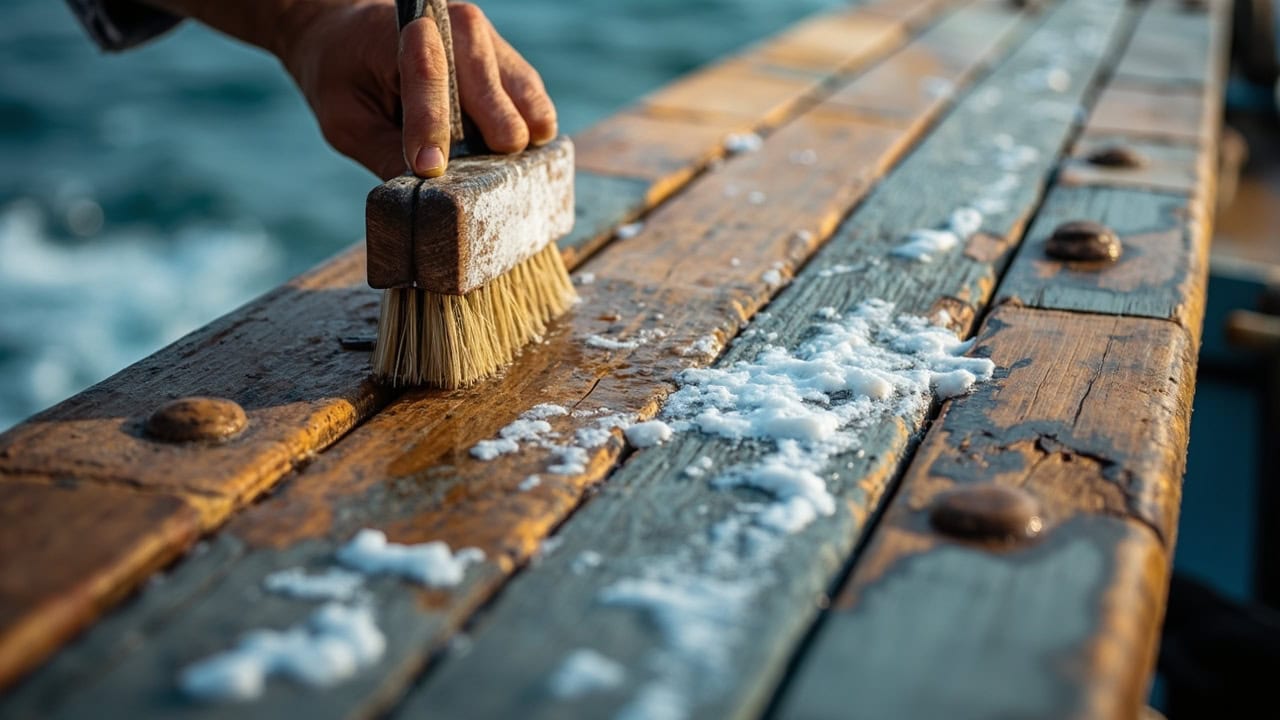
- Scrub with soft-bristle brush using long strokes that follow the wood grain direction. Apply moderate pressure — let the bristles and the soap solution do the work, not your arm strength. Scrubbing against the grain forces contaminant particles into the open pore structure of the wood, where they become nearly impossible to remove without sanding.
- Rinse immediately with fresh water before the soap dries. Incomplete rinsing leaves a surfactant residue film that attracts new dirt and accelerates re-soiling. Flush each section until the rinse water runs completely clear — any cloudiness indicates residual soap or lifted contaminants still present on the surface.
- Dry completely using microfiber towels or chamois. Use an overlapping stroke pattern to avoid leaving streaks. Air drying in direct sunlight causes uneven drying marks because water evaporates at different rates across the grain pattern, leaving mineral deposits visible as white residue lines in the grain valleys.
- Inspect and repeat on stubborn spots — heavily soiled areas may need a second application. Focus on areas with dark staining or visible salt crust, but do not increase scrubbing pressure on the second pass. If a spot resists two cleaning cycles, the discoloration is likely UV oxidation rather than surface contamination, and attempting further cleaning will remove wood fiber unnecessarily.
Boat Teak Specific Considerations
What to Avoid
Certain cleaning tools and chemicals cause permanent damage to teak that no amount of refinishing can fully reverse. Understanding what not to use is as important as knowing the correct technique, because the wrong product can destroy years of natural patina development in a single application.
- Wire brushes or steel wool — cause microscopic pitting that traps moisture and accelerates corrosion. The metal fragments left behind also create rust streaks that stain the surrounding teak an unsightly brown-black.
- Pressure washers — force water into wood cells at pressures exceeding the wood’s natural resistance, causing swelling, raised grain, and eventual cracking along the growth rings. Even low-pressure settings (below 500 PSI) can drive water beneath the surface layer. Bleach or oxygen bleach — degrades lignin in teak, turning the wood grey and brittle. Sodium hypochlorite (household bleach) breaks down the complex polymers that give teak its structural strength, reducing the wood’s ability to flex under load. Sodium percarbonate (oxygen bleach) is less aggressive but still strips natural oils with repeated use.
- Sandpaper (unless refinishing) — removes the natural patina and protective surface layer that develops over years of weathering. Sanding should be reserved for refinishing projects where the goal is to restore the original honey color, not for routine cleaning.
- Oil-based teak finishes on unclean wood — seal in contamination if the wood is not perfectly clean and dry before application. Trapped salt crystals and organic matter beneath an oil film create a localized environment for rot that remains invisible until structural damage has occurred.
Why Teak Requires Special Care
Boat teak contains natural oils that provide water resistance and prevent rot, but these oils exist in a delicate balance. Teak has been used in boat building for over 2,000 years precisely because of this self-protecting oil system. The United States Navy used teak for ship decks through World War II, relying on the wood’s ability to withstand constant saltwater exposure without chemical treatment.
Unlike indoor hardwood, marine teak faces a triple threat: constant salt spray deposits hygroscopic crystals that hold moisture against the surface, intense UV radiation breaks down lignin and causes the characteristic silver-grey weathering, and periodic submersion during heavy seas saturates the wood beyond its natural moisture equilibrium. Cleaning must remove these contaminants without stripping the protective oils — a balance that only pH-neutral cleaning agents and gentle mechanical action can achieve.
Over-maintenance with harsh chemicals is one of the leading causes of premature teak deck replacement. Many boat owners assume that more frequent cleaning with stronger products will keep teak looking new, but the opposite is true — aggressive cleaning shortens teak lifespan by removing the slow-growing heartwood’s oil reserves faster than the wood can replenish them.
Drying and Finishing Boat Teak
After cleaning, boat teak should be dried within 15–20 minutes to prevent water-spotting caused by dissolved minerals left behind as the water evaporates. Use an overlapping stroke pattern with microfiber towels to avoid leaving streaks that become visible when the wood dries completely. The goal is to remove standing water from the grain valleys while leaving the surface slightly damp — this prevents the rapid moisture gradient that causes surface checking (small cracks) in the top wood fibers.
For long-term protection, boat owners choose between three finishing approaches, each with distinct trade-offs in appearance, maintenance requirements, and wood longevity:
- Light maintenance: Apply a thin coat of teak oil (typically linseed-based or tung-based) one to two times per season, only after thorough cleaning and complete drying. Teak oil enhances the wood’s warm honey color but requires reapplication as it wears off — typically every 6–8 weeks in high-sun environments.
- Natural patina option: Many experienced boaters allow teak to weather naturally to a silver-grey color. This patina is purely cosmetic and does not damage the wood or reduce its service life. The silver-grey color results from UV oxidation of surface lignin, which actually forms a protective barrier against further UV penetration.
- Sealer option: Marine-grade teak sealers last 3–6 months and reduce cleaning frequency by creating a semi-permeable barrier that repels water and contaminants while allowing the wood to breathe. Unlike oils, sealers do not feed the wood — they protect the surface from external contaminants only.
Whichever finishing method you choose, never apply oil or sealer over wood that has not been fully cleaned first. For guidance on selecting pH-neutral cleaning agents appropriate for marine and household surfaces, refer to our kitchen cleaning resource that covers surfactant chemistry in detail.
Common Mistakes When Cleaning Boat Teak
Recognizing the most frequent teak cleaning errors helps you avoid costly damage. Each mistake listed below produces visible damage within a single cleaning session — the effects are not gradual. If you have made any of these errors, the remediation steps in our specialty cleaning guide can help you assess whether professional refinishing is needed.
| Mistake | Result | Prevention |
|---|---|---|
| Using wire brush | Permanent pitting, rust streaks | Use only soft-bristle brushes |
| Pressure washing | Wood cell damage, splintering | Hand wash only with fresh water |
| Bleach-based cleaners | Degrades natural oils, turns grey | Use pH-neutral teak soap |
| Incomplete rinsing | Soap residue attracts dirt | Rinse until water runs clear |
| Drying in direct sun | Uneven water spots | Dry in shade or with towels |
| Over-oiling | Sticky surface, dirt accumulation | Oil only when wood appears dry/pale |
Seasonal Maintenance Schedule
Establishing a consistent maintenance routine extends teak deck life significantly. The schedule below balances cleaning frequency with the need to minimize mechanical wear on the wood surface. Teak that receives proper seasonal care can last 30–40 years on a well-maintained vessel, while neglected or over-cleaned teak may require replacement within 10–15 years.
| Frequency | Task |
|---|---|
| After each sail/cruise | Fresh water rinse to remove salt |
| Every 2–4 weeks (active season) | Full cleaning with teak soap |
| Monthly | Inspect for mold, mildew, or wear |
| Season start | Deep clean + consider teak oil application |
| Season end | Clean, apply protective oil, cover if stored |
The post-sail fresh water rinse is the single most impactful maintenance habit. Salt deposits begin crystallizing within hours of exposure, and the sharp crystal edges abrade the wood surface during foot traffic. A quick rinse with fresh water dissolves these crystals before they can cause mechanical damage — it takes less than five minutes and adds years to your teak’s service life. For related marine cleaning topics, see our guides on cleaning marine hardware and removing waterline stains from boat fiberglass.
Frequently Asked Questions
Q: Can I use dish soap to clean boat teak?
A: Mild dish soap (pH-neutral, free of fragrances) can be used as a temporary substitute at a 1:10 dilution, but dedicated teak soap is preferred. Teak soap contains surfactants designed to suspend salt minerals without stripping natural wood oils, while standard dish soap formulations may contain degreasers that emulsify teak’s protective oil layer with repeated use.
Q: How often should I clean my boat teak?
A: Boat teak should be cleaned every 2–4 weeks during active boating season. In saltwater environments, rinse with fresh water after each use and perform a full cleaning at least monthly to prevent salt crystallization and UV damage buildup.
Q: Should I oil my boat teak after cleaning?
A: Oiling is optional and depends on desired appearance. Teak oil enhances the wood’s warm honey color but is not required for durability — teak’s natural oils provide inherent protection. If used, apply only after the wood is completely clean and dry, typically one to two times per season.
Q: Why did my teak turn grey after cleaning?
A: Grey discoloration after cleaning indicates either residual oxidation from UV exposure (natural weathering) or soap residue buildup. For brightening, use a specialized teak brightener product — avoid bleach, which causes the same greying and damages the wood structure.
References
- Wikipedia Contributors. (2025). Teak. Wikimedia Foundation.
- Forest Products Laboratory. (2021). Wood Handbook: Wood as an Engineering Material. USDA Forest Service.
- American Boat and Yacht Council. (2024). Standards for Boat Construction and Repair. ABYC.


