
Cleaning Product Chemistry: How Cleaners Work (pH, Surfactants, Solvents)

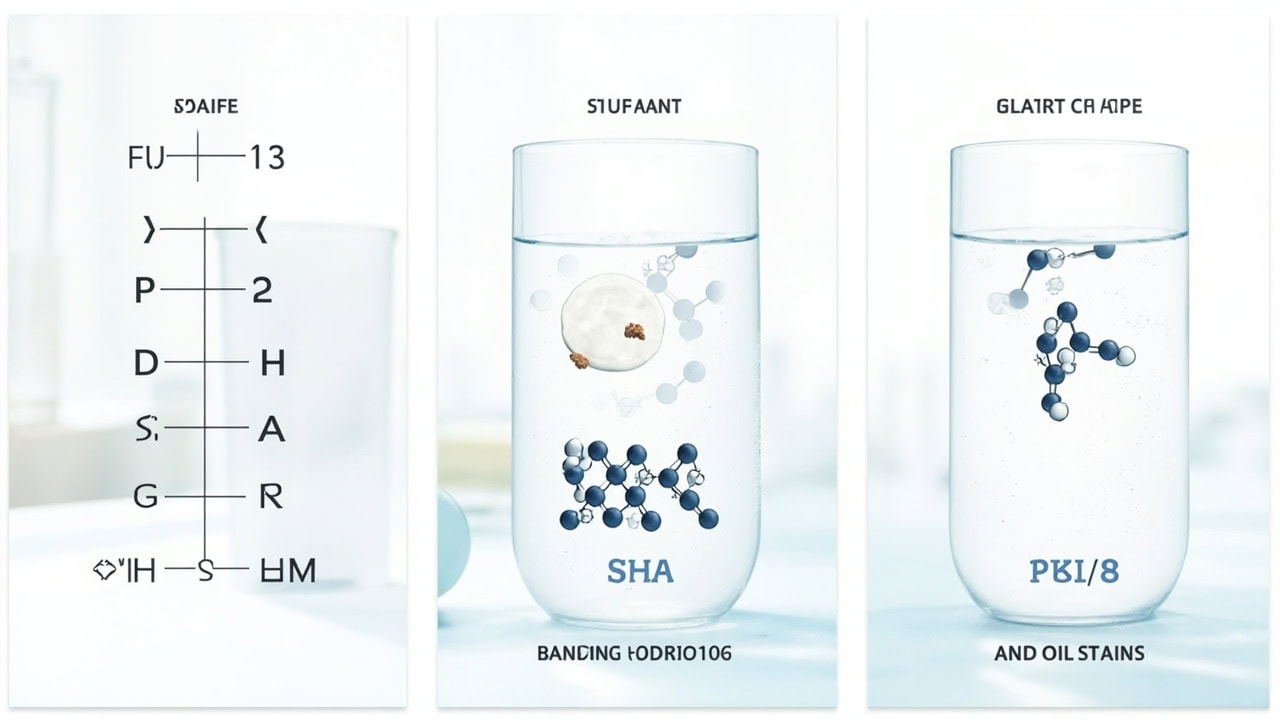
Cleaning chemistry operates through three primary mechanisms: pH modification alters soil solubility, surfactants reduce surface tension to lift contaminants, and solvents dissolve specific soil types. A cleaner at pH 10–14 uses alkaline chemistry to saponify fats and oils, while acidic cleaners at pH 2–6 dissolve mineral deposits like limescale through acid-base reactions. Understanding these mechanisms allows you to match any cleaning product to its intended surface and contaminant — an acid cleaner on mineral deposits, an alkaline cleaner on greasy soils, and surfactant-based cleaners on particulate and organic soils.
What Is Cleaning Chemistry?
Cleaning chemistry is the science of how cleaning agents interact with surfaces and soils at the molecular level. Every cleaning product works through one or more mechanisms: altering pH to dissolve or saponify soils, reducing surface tension to suspend soils in solution, or dissolving soils directly with solvents. The effectiveness of any cleaner depends on matching its chemical mechanism to the type of soil present and the surface being cleaned.
This hub covers the complete Cleaning Chemistry pillar and connects to all related spoke articles covering specific cleaning agents, surface-specific chemistry, and DIY formulation. Each mechanism — pH modification, surfactant emulsification, solvent dissolution, enzymatic digestion, and oxidative bleaching — targets distinct soil categories. When you understand which mechanism addresses which soil, you can select or formulate the correct cleaner for any situation.
Why Understanding Cleaner Chemistry Matters
Most cleaning product failures stem from a mismatch between the cleaner’s chemical mechanism and the soil type. Using an acidic cleaner on alkaline-soluble soils wastes effort and may damage surfaces. Understanding the chemistry prevents costly mistakes:
- Surface damage: Acidic cleaners etch marble and limestone; alkaline cleaners degrade aluminum and wax finishes
- Ineffective cleaning: Using a low-surfactant cleaner on oily soils leaves residue and requires re-cleaning
- Wasted money: Purchasing specialty cleaners when a simple pH adjustment would suffice Safety risks: Mixing incompatible chemicals (bleach + ammonia) produces toxic chloramine gases
This guide gives you the framework to diagnose any cleaning situation and select or formulate the correct product. Every recommendation below is grounded in specific chemical reactions, real pH measurements, and documented surface compatibility data.
Directory of Cleaning Chemistry Spoke Articles
This hub connects to the complete Cleaning Chemistry pillar. All spoke articles link back to this hub and to each other through contextual in-content links.
Pillar 7: Cleaning Chemistry — Complete Article Cluster
| Article # | Title | Type | Focus |
|---|---|---|---|
| 178 (Hub) | Cleaning Product Chemistry: How Cleaners Work | Hub | pH, surfactants, solvents |
| 179 | How pH Affects Cleaning Effectiveness | Spoke | pH scale, soil solubility |
| 180 | Surfactant Chemistry: How Detergents Work | Spoke | Anionic, cationic, nonionic, amphoteric |
| 181 | Solvent Chemistry for Household Cleaning | Spoke | Water, alcohols, petroleum distillates |
| 182 | How Enzymatic Cleaners Work | Spoke | Enzyme types, organic stain breakdown |
| 183 | Bleach and Oxidizer Chemistry | Spoke | Sodium hypochlorite, hydrogen peroxide |
| 184 | Acidic Cleaners: When and How to Use Them | Spoke | Limescale, rust, mineral deposits |
| 185 | Alkaline Cleaners: Fat and Protein Removal | Spoke | Saponification, degreasing |
| 186 | pH-Neutral Cleaners: When to Use Them | Spoke | Delicate surfaces, everyday cleaning |
| 187 | DIY Cleaning Product Formulation Guide | Spoke | Safe home cleaning recipes |
| 188 | Mixing Chemicals Safely: What Not to Combine | Spoke | Hazard avoidance, chemical compatibility |
Understanding the pH Scale in Cleaning
The pH scale measures acidity and alkalinity on a logarithmic scale from 0 to 14, where pH 7 is neutral. Every pH unit represents a tenfold change in hydrogen ion concentration — a solution at pH 4 is ten times more acidic than one at pH 5, and one hundred times more acidic than pH 6. Cleaning products span the full pH range, and each region has distinct cleaning capabilities.
Acidic Cleaners (pH 0–6)
Acidic cleaners dissolve alkaline soils through direct chemical reaction. White vinegar (5% acetic acid, pH 2.5) dissolves limescale by converting insoluble calcium carbonate into soluble calcium acetate and carbon dioxide. Toilet bowl cleaners (pH 1–3, typically containing hydrochloric acid) attack heavy mineral deposits including calcium carbonate, rust (iron oxide), and magnesium deposits. Mild acid cleaners at pH 4–6 handle light scale removal, chrome polishing, and freshwater rinse deposits on fixtures.
Neutral Cleaners (pH 6–8)
Neutral cleaners are safe for all surfaces including sealed stone, wood, and coated metals. Pure water sits at pH 7, and most dish soaps and all-purpose cleaners register between pH 6 and pH 7.5. These products rely on surfactant action rather than chemical reaction to remove soils, making them ideal for daily cleaning where soil load is light to moderate. They cannot dissolve mineral deposits or saponify fats, but they effectively suspend particulate soils.
Alkaline Cleaners (pH 8–14)
Alkaline cleaners work through saponification — the chemical reaction between an alkali and a fatty acid that produces soap. Sodium hydroxide (NaOH) at pH 13–14 breaks the ester bonds in triglycerides (cooking fats, body oils), converting them into water-soluble sodium salts and glycerol. Mild alkalis at pH 8–10 (baking soda at pH 8.3, ammonia solutions at pH 11) handle floor cleaning and glass cleaning. Heavy-duty degreasers and oven cleaners at pH 11–13 tackle carbonized grease and baked-on food residues. Industrial caustic solutions above pH 13 are reserved for professional applications due to their corrosivity.
pH and Soil Solubility
Matching pH to soil type is the fundamental rule of cleaning chemistry. Acid-soluble soils — calcium carbonate (limescale), rust (iron oxide), copper oxide, and magnesium hydroxide — dissolve in acidic solutions through acid-base neutralization. Alkali-soluble soils — fatty acids, protein deposits, organic acids, and sulfur compounds — break down in alkaline solutions through hydrolysis and saponification. Water-soluble soils — sugars, salts, small organic molecules, and hydrophilic particulates — dissolve in plain water, with cleaning enhanced by elevated temperature and surfactant action. For a deep dive into pH mechanics, see our complete guide to how pH affects cleaning effectiveness.
How Surfactants Work: Micelle Formation and Soil Suspension
Surfactants (surface-active agents) are the primary cleaning component in most household detergents. Their dual-nature molecules contain a hydrophilic (water-loving) head and a hydrophobic (water-fearing) tail. When added to water, surfactants arrange themselves into structures called micelles — spherical formations where hydrophobic tails cluster inward, trapping oil and dirt, while hydrophilic heads face outward toward water.
Micelle Formation Process
- At low concentration, individual surfactant molecules migrate to the water surface, orienting their hydrophobic tails upward away from the water
- As concentration increases, hydrophobic tails cluster together to minimize contact with water, forming the core of spherical structures
- Complete micelles form with hydrophilic heads forming a water-compatible outer shell and hydrophobic tails creating an oil-capturing interior
- Soil particles are trapped inside the hydrophobic core and carried away in the water solution
The minimum surfactant concentration needed to form micelles is called the Critical Micelle Concentration (CMC). Below the CMC, individual molecules cannot effectively trap soils. Above the CMC, micelles form and cleaning efficiency increases dramatically. For sodium dodecyl sulfate (SDS), a common anionic surfactant in laundry detergents, the CMC is approximately 8.3 × 10⁻³ mol/L at 25°C. Most consumer cleaning products contain 0.1–2% active surfactant — well above the CMC — ensuring effective micelle formation throughout the cleaning process.
Four Surfactant Types and Their Properties
| Type | Charge | Foaming | Cleaning Profile | Common Uses |
|---|---|---|---|---|
| Anionic | Negative | High | Excellent degreasing, good emulsification | Laundry detergents, dish soap, shampoo |
| cationic | Positive | Low | Fabric softening, antistatic, some disinfecting | Quaternary ammonium compounds (quats) |
| Nonionic | None | Low–Medium | Best for low-temperature washing, hard water tolerance | Dishwasher detergent, low-foam cleaners |
| Amphoteric | Variable | Medium | Gentle, pH-responsive, compatible with other types | Baby shampoos, gentle cleaners, carpet shampoos |
Anionic surfactants — including sodium lauryl sulfate (SLS) and sodium laureth sulfate (SLES) — are the workhorses of household cleaning. Their negative charge creates strong electrostatic repulsion between soil particles, preventing redeposition. Cationic surfactants like benzalkonium chloride (BAC) and cetrimonium bromide (CTAB) carry a positive charge that binds to negatively charged surfaces like hair and fabric, making them effective fabric softeners and antimicrobial agents. Nonionic surfactants such as alkyl polyglucosides and alcohol ethoxylates perform well in hard water and at low temperatures because they have no charge to interfere with dissolved minerals. Amphoteric surfactants like cocamidopropyl betaine shift their charge based on pH, making them compatible with all other surfactant types and ideal for gentle formulations.
Solvent Chemistry: Dissolving Soils Without Water
Solvents dissolve soils that water alone cannot remove — primarily oils, greases, and petroleum-based substances. Water is a polar solvent; non-polar soils require non-polar or intermediate-polarity solvents. Many cleaning products combine water and co-solvents to handle mixed soil types in a single application.
Water — The Universal Diluent
Water dissolves ionic compounds, sugars, amino acids, and water-soluble polymers. It is the primary component in most cleaning formulations (60–95% by volume). Heating water increases its effectiveness by raising the kinetic energy of molecules, accelerating chemical reactions between cleaner and soil. Alkaline saponification proceeds 2–4 times faster at 60°C versus 20°C, and hot water melts semi-solid fats (butter, coconut oil) that remain solid at room temperature.
Alcohols
Isopropyl alcohol (rubbing alcohol, 70–91% concentration) evaporates quickly without leaving residue, making it ideal for glass, electronics, and spot cleaning. Ethanol serves as the solvent base in many disinfecting wipes. Both are polar solvents effective against light oils, fingerprints, and some adhesive residues. Isopropyl alcohol at 70% concentration also functions as a disinfectant by denaturing bacterial proteins.
Petroleum Distillates
Mineral spirits, naphtha, and kerosene are non-polar hydrocarbons that excel at dissolving heavy grease, wax, tar, and petroleum-based soils. Their slow evaporation rate allows extended dwell time on vertical surfaces. These solvents require caution: they are flammable, produce strong odors, and can damage plastics, paints, and some synthetic finishes. Always use petroleum distillates in well-ventilated areas away from ignition sources.
Glycol Ethers
Glycol ethers offer excellent oil and grease solvency with lower toxicity and more pleasant odor than petroleum distillates. They function as coupling agents in formulations, helping water and oil-based ingredients remain mixed. You will find glycol ethers in window cleaners, heavy-duty degreasers, and some all-purpose cleaning concentrates. For detailed solvent selection guidance, see our complete solvent chemistry guide.
Solvent Safety
- Always ensure adequate ventilation when using solvent-based products
- Check surface compatibility — solvents can damage plastics, finishes, and adhesives
- Never mix solvent-based products with bleach — this can create toxic chloroform and other chlorinated compounds
- Store away from heat sources and open flames
Matching Cleaners to Surfaces and Soils
The art of cleaning chemistry is matching the chemical mechanism to the surface and soil combination. Use the tables below as your decision framework for any cleaning task.
Surface-Type Chemistry Considerations
| Surface | Safe pH Range | Safe Solvents | Avoid |
|---|---|---|---|
| Stainless steel | 7–10 | Alcohols, glycol ethers | Chloride salts, abrasive scouring |
| Glass | 4–10 | Alcohols, ammonia | Hydrofluoric acid, strong alkalis |
| Ceramic tile | 2–12 | Most solvents | Hydrofluoric acid |
| Natural stone (marble, granite) | 7 (neutral only) | Alcohols | Acids, strong alkalis, petroleum solvents |
| Wood (sealed) | 6–8 | Alcohols, oil-in-water emulsions | Water overexposure, strong solvents |
| Laminate | 6–8 | Alcohols, mild detergents | Abrasives, excessive water |
| Concrete | 2–13 | Acids for mineral deposits | Acid on colored concrete |
| Aluminum | 6–8 | Mild alkalis, detergents | Strong acids, caustic soda |
Natural stone surfaces demand special attention. Marble and limestone are composed of calcium carbonate, which reacts with acids through the same mechanism that dissolves limescale — producing calcium salt, carbon dioxide, and water. Even mild acids like vinegar cause irreversible etching on polished marble. Aluminum corrodes in strong alkalis through hydrogen evolution, producing visible pitting. When cleaning surfaces you are unsure about, default to pH-neutral cleaners and consult our pH-neutral cleaner guide.
Soil-Type Chemistry Considerations
| Soil Type | Primary Mechanism | Secondary Mechanism | Examples |
|---|---|---|---|
| Fatty foods / grease | Alkaline saponification | Surfactant emulsification | Cooking oil, butter, meat fats |
| Protein stains | Enzymatic digestion | Alkaline hydrolysis | Blood, egg, grass, milk |
| Mineral deposits | Acid dissolution | Chelation | Limescale, rust, hard water marks |
| Particulate soils | Surfactant suspension | Mechanical agitation | Dust, sand, clay, soot |
| Organic stains | Oxidative bleaching | Enzymatic digestion | Coffee, wine, ink, berry stains |
| Ink / dyes | Solvent dissolution | Reductive bleaching | Ballpoint pen, markers, food coloring |
Protein stains require particular attention because heat sets them permanently. Blood, egg, and dairy stains should always be treated with cold water and enzymatic or alkaline cleaners — never hot water. Enzymatic cleaners contain specific protease, lipase, or amylase enzymes that break down protein, fat, and carbohydrate chains at the molecular level. For detailed enzyme chemistry, see our enzymatic cleaner guide.
Getting Started: Building Your Cleaning Chemistry Toolkit
A well-stocked cleaning kit covers the full pH range and mechanism spectrum with just a handful of products. Start with these foundational items and expand based on your specific household needs.
Essential pH-Range Products
| pH Range | Product | Primary Use | Key Chemical |
|---|---|---|---|
| Acidic (pH 2–4) | White vinegar | Light limescale, glass, chrome | Acetic acid (5%) |
| Acidic (pH 1–3) | Toilet bowl cleaner | Heavy limescale removal | Hydrochloric acid |
| Neutral (pH 7) | pH-neutral all-purpose | Daily cleaning, delicate surfaces | N/A (neutral) |
| Mild alkaline (pH 8–9) | Dish soap | Grease cutting, general cleaning | Anionic surfactants |
| Moderate alkaline (pH 10–11) | Ammonia solution | Glass cleaning, heavy grease | Ammonium hydroxide |
| Strong alkaline (pH 12–13) | Oven cleaner | Carbonized grease, baked-on residues | Sodium hydroxide |
Surfactant Basics
- Dish soap (anionic): handles most household cleaning — grease, food residue, general surfaces
- Laundry detergent: higher surfactant concentration with builders, built for heavy soil loads on fabric
- Carpet shampoo: amphoteric or nonionic surfactants formulated for fiber safety and low residue
- Castile soap: mild, plant-based surfactants (sodium or potassium salts of fatty acids) for sensitive applications
When to Use Solvents
- Mineral spirits: heavy grease on mechanical parts, automotive cleaning, workshop degreasing
- Isopropyl alcohol: electronics, glass, evaporative cleaning, sanitizing hard surfaces
- Acetone: nail polish removal, some adhesive residues — always test the surface first
Common Cleaning Chemistry Mistakes to Avoid
Understanding the chemistry prevents these frequent and sometimes dangerous errors:
- Mixing bleach with ammonia or acids. Sodium hypochlorite (household bleach, 3–8% NaOCl at pH 11–12.5) mixed with ammonia produces toxic chloramine gases including nitrogen trichloride. Mixed with acids (including vinegar), bleach releases chlorine gas. Both reactions cause severe respiratory damage.
- Using acidic cleaners on marble or limestone. The reaction is irreversible: calcium carbonate + acid → calcium salt + CO₂ + water. White vinegar (pH 2.5) etches polished marble within seconds of contact.
- Applying strong alkalis on aluminum. Sodium hydroxide reacts with aluminum to produce hydrogen gas and soluble aluminate, causing visible pitting corrosion.
- Using solvent-based products on painted or plastic surfaces. Petroleum distillates and acetone dissolve paint, clear coats, and many thermoplastic polymers, causing clouding and permanent damage.
- Over-diluting concentrates below effective concentration. Diluting below the Critical Micelle Concentration eliminates micelle formation, leaving only individual surfactant molecules with minimal cleaning power. Insufficient dwell time for chemical reactions. Acid and alkaline cleaners require 5–10 minutes of contact time to complete their chemical reactions with soils. Wiping too soon wastes product. Rinsing too quickly. Chemical reactions need time to proceed to completion. Allow cleaners to work before rinsing — this is especially critical for enzymatic cleaners, which may need 15–30 minutes.
For comprehensive safety guidance on chemical combinations to avoid, see our detailed guide on mixing chemicals safely.
Cross-Cluster Connections
Cleaning chemistry principles apply across every cleaning discipline. When selecting cleaners for specific rooms and surfaces, these cross-cluster links provide surface-specific guidance grounded in the chemistry covered here:
- Kitchen Cleaning Hub — pH matching for food-safe surfaces, grease chemistry on stovetops and range hoods
- Bathroom Cleaning Hub — acid-alkaline matching for tile, grout, fixtures, and soap scum removal
- Floor Cleaning Hub — surface-specific pH recommendations for hardwood, tile, laminate, and vinyl
- Laundry Care Hub — surfactant and enzyme chemistry for fabric cleaning
- Stain Removal Hub — soil identification and mechanism matching for specific stain types
Frequently Asked Questions
Q: What is the safest pH for everyday household cleaning?
A: A pH-neutral cleaner (pH 6–8) is safest for daily use on most surfaces including sealed wood, laminate, finished floors, countertops, and appliances. pH-neutral cleaners minimize the risk of surface damage while still effectively removing light soils through surfactant action. Reserve acidic cleaners (pH below 4) for specific applications like limescale removal, and alkaline cleaners (pH above 10) for heavy-duty degreasing tasks.
Q: How do surfactants differ from solvents in cleaning action?
A: Surfactants work by reducing water’s surface tension and forming micelles that physically encapsulate and suspend soils in solution — the soil remains present but is carried away in the rinse water. Solvents dissolve soils chemically, breaking the molecular bonds between the soil and surface and converting the soil into a liquid that wipes away. Many cleaners combine both mechanisms: surfactants emulsify oils while solvents dissolve water-insoluble compounds.
Q: Why does hot water clean better than cold water in most cases?
A: Hot water increases the kinetic energy of molecules, accelerating chemical reactions between the cleaner and soil. Alkaline saponification proceeds 2–4 times faster at 60°C versus 20°C. Heat also reduces water’s viscosity, allowing faster penetration into porous soils, and melts semi-solid fats that cold water cannot dissolve. However, some surfaces like waxed floors or certain plastics require cold or room-temperature water to prevent damage.
Q: Can I mix baking soda and vinegar for cleaning?
A: While this combination fizzes dramatically, it is chemically neutralized. The acidic vinegar (pH approximately 2.5) reacts with the alkaline baking soda (pH approximately 8.3) to produce water, carbon dioxide, and sodium acetate — substantially reducing both reactants’ cleaning power compared to using either alone. Use white vinegar alone for acidic cleaning tasks like limescale and mineral deposit removal, or baking soda alone for alkaline cleaning tasks like grease cutting and odor neutralization.
References
- Covington, A. K., Bates, R. G., Durst, R. A. (1985). Definitions of pH scales, standard reference values, measurement of pH, and related terminology. Pure and Applied Chemistry, 57(3), 531–542.
- Rosen, M. J., Kunjappu, J. T. (2012). Surfactants and Interfacial Phenomena (4th ed.). John Wiley & Sons.
- Dominguez, A., et al. (1997). Determination of Critical Micelle Concentration of Some Surfactants by Three Techniques. Journal of Chemical Education, 74(10), 1227–1231.
- Kosswig, K. (2005). Surfactants. In Ullmann’s Encyclopedia of Industrial Chemistry. Wiley-VCH.
- OxyChem. Sodium Hypochlorite Handbook. Occidental Chemical Corporation.
- Rutala, W. A., Weber, D. J. (2017). Guideline for Disinfection and Sterilization in Healthcare Facilities. Centers for Disease Control and Prevention.
- Smith, M. B., March, J. (2007). Advanced Organic Chemistry: Reactions, Mechanisms, and Structure (6th ed.). Wiley-Interscience.


