
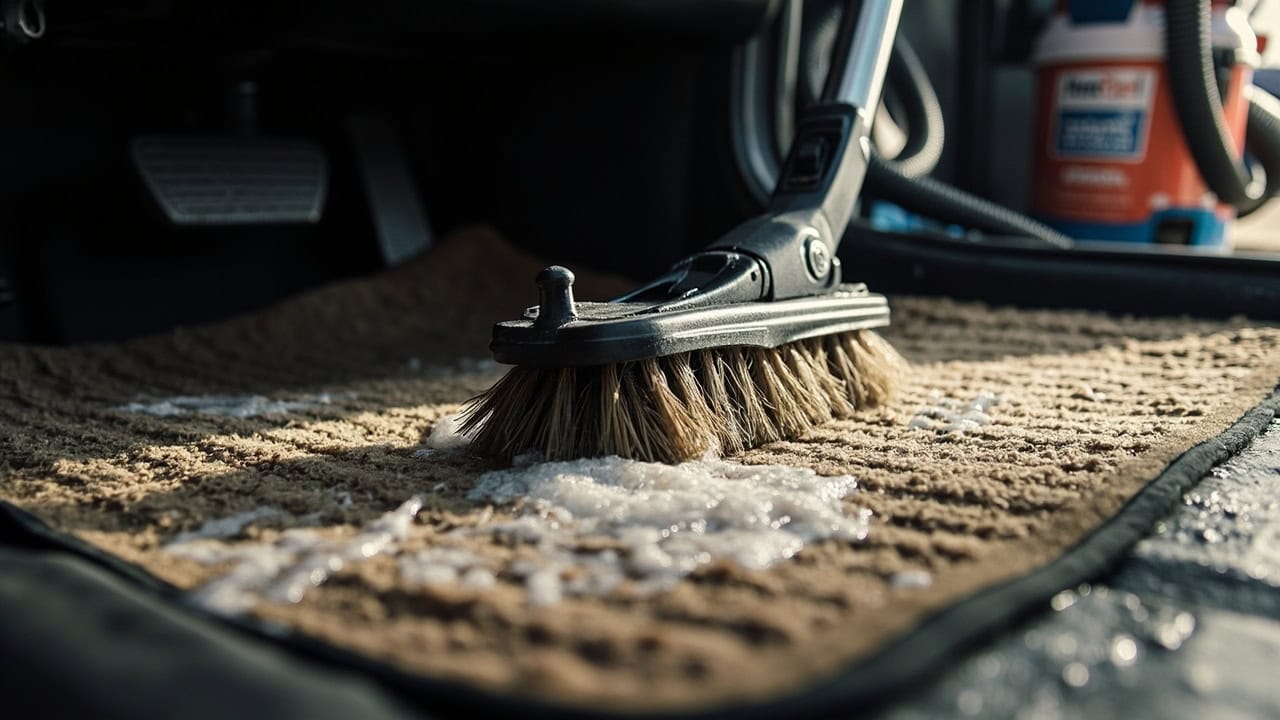
How to Clean Car Carpet and Floor Mats

Carpet and floor mats in vehicles must be cleaned using a pH-neutral cleaner at a 1:10 dilution ratio, agitated with a stiff-bristle nylon brush to break soil loose from synthetic fiber bases, then extracted with a wet/dry vacuum to achieve up to 95% soil removal. This extraction method works for both permanently installed automotive carpet and removable rubber floor mats, though each surface demands different dwell times, agitation pressure, and drying procedures to avoid trapping moisture in the sound-deadening layer beneath the carpet.
What You Need Before You Start
Gathering the right supplies before starting prevents mid-process delays that allow cleaning solutions to dry into the carpet fibers. Each tool serves a specific purpose in the extraction cleaning workflow — substituting household alternatives often introduces incompatibilities with automotive materials.
- pH-neutral carpet cleaner or dedicated automotive carpet cleaning solution — household carpet shampoos contain optical brighteners that bond irreversibly with automotive synthetic dyes
- Stiff-bristle scrub brush (nylon or Tampico natural bristles) — stiffness rating of medium to firm for agitating compacted soil without fiber damage
- Wet/dry shop vacuum or portable extraction unit — minimum 4.0 peak HP for adequate suction during soil and solution removal
- Microfiber towels for surface wiping and edge blotting — 300+ GSM density for maximum absorbency
- Enzyme-based spot cleaner for protein and organic stains (coffee, food, bodily fluids)
- Chemical-resistant protective gloves — nitrile construction resists surfactant and solvent penetration
- Plastic drop cloth for protecting adjacent vehicle surfaces during mat cleaning
Step-by-Step Cleaning Process for Car Carpet
The following seven-step process addresses permanently installed automotive carpet — the material bonded to the vehicle floor pan over a sound-deadening mat. Each step builds on the previous one, so skipping or rearranging steps reduces overall cleaning effectiveness. For the complete specialty cleaning guide covering all vehicle interior surfaces, refer to the hub article.
- Remove floor mats completely. Take out all front, rear, and cargo area floor mats. Shake each mat vigorously outdoors to dislodge loose gravel, sand, and organic debris. Place mats on a plastic drop cloth away from the vehicle. This prevents dislodged soil from redepositing onto wet carpet during the cleaning process.
- Vacuum the carpet thoroughly. Using a shop vacuum with a crevice attachment, work along every seat rail channel, under the brake and accelerator pedals, around center console edges, and into the corner seams where the carpet meets the door sill plates. Dry vacuuming removes up to 80% of loose particulate soil — skip this step and the wet cleaning phase suspends that dry soil into a mud that is significantly harder to extract.
- Pre-treat visible stains. Apply an enzyme-based spot cleaner directly onto oil-based, food, or organic stains. Allow a dwell time of 5 minutes without letting the treated area dry. Enzyme cleaners break down protein chains in organic stains at the molecular level — they cannot perform this function once the carrier solution evaporates. For coffee and beverage stains specifically, see our guide on how to remove coffee stains from car upholstery.
- Apply cleaning solution at 1:10 dilution. Mix the pH-neutral automotive carpet cleaner with warm water — never hot water, which can permanently set protein-based stains by denaturing and bonding them to synthetic fibers. Use a spray bottle to mist the solution lightly onto 2×2 foot sections of carpet. The goal is even coverage without saturation; oversaturating the carpet forces liquid into the jute or foam sound-deadening pad bonded beneath, creating a mold risk that requires professional remediation.
- Agitate with a stiff-bristle brush. Working within each 2×2 foot section, use circular strokes with firm downward pressure to work the surfactant solution to the base of the carpet fibers. Automotive carpet is typically manufactured from nylon 6 or nylon 6,6 with a cut-pile construction rated at 24–32 ounces per square yard — this dense pile traps soil at the fiber base where only mechanical agitation can reach it. Spend approximately 30–45 seconds per section.
- Extract immediately with a wet vacuum. Pass the extraction nozzle over each cleaned section 3–4 times in slow, overlapping strokes. The carpet should feel barely damp — not wet — when extraction is complete. A properly functioning wet/dry vacuum at 4.0+ peak HP removes the suspended soil and cleaning solution together; a dilution ratio that leaves residue in the fibers acts as a soil magnet, causing rapid re-soiling within days. Check the shop vacuum filter between sections, as a clogged filter reduces suction capacity by up to 70%.
- Allow 2–4 hours of air drying. Keep all vehicle doors open or run a portable fan directed at the treated carpet surfaces. Do not replace any floor mats until the carpet is completely dry to the touch in every section, including the areas beneath seat tracks and along door sill seams. Trapped moisture beneath reinstalled mats is the primary cause of persistent musty odors in vehicle interiors.
Step-by-Step Cleaning Process for Rubber Floor Mats
Rubber and all-weather floor mats require a different approach than carpeted surfaces. The non-porous thermoplastic elastomer (TPE) or rubberized vinyl material does not absorb soil — dirt and grime lodge in the raised tread channels and sidewall ridges designed to trap debris. For a visual walkthrough of this process, see how to clean car floor mats with pictures.
- Rinse mats with a garden hose. Hold each mat at an angle against a wall or fence and rinse both surfaces with a steady stream of water to remove loose dirt, sand, and road salt crystals. High-pressure nozzles are not necessary — a standard garden hose flow rate is sufficient.
- Apply all-purpose cleaner or dedicated rubber cleaner. Use a dilution ratio of 1:20 (cleaner to water) for routine maintenance cleaning. For mats with heavy soiling from mud, road tar, or winter salt accumulation, apply the cleaner at full strength directly into the tread channels.
- Scrub with a stiff-bristle brush. Direct brush strokes along the raised tread patterns and into the deep channels where dirt compacts. Pay particular attention to the perimeter walls of each mat cell — this is where road grime and organic material accumulate most densely.
- Rinse thoroughly. Flush the entire mat surface with clean water until no visible foam or cleaner residue remains. Leftover surfactant creates a slippery film on rubber that poses a safety hazard when the mat is reinstalled in the driver footwell.
- Dry completely before reinstallation. Stand mats upright against a wall or fence in a well-ventilated area. Moisture trapped beneath a rubber mat pressed against automotive carpet creates conditions ideal for mold growth and persistent odor — a principle that also applies to bathroom humidity control, where ventilation and surface drying prevent similar microbial growth.
Car Carpet-Specific Considerations
Automotive carpet differs fundamentally from residential carpet in its construction, bonding method, and chemical sensitivity. Understanding these differences prevents costly damage during cleaning.
- Avoid bleach and hydrogen peroxide on colored car carpet. These oxidizing agents cause permanent bleaching of nylon dye lots and degrade the fiber’s tensile strength. Even diluted hydrogen peroxide above 3% concentration strips color from automotive-grade nylon within minutes of contact.
- Never use household carpet cleaners on automotive carpet. Residential carpet shampoos frequently contain optical brighteners — fluorescent whitening agents that bond with synthetic fibers and cannot be removed once applied. These agents create permanent discoloration under ultraviolet light exposure through vehicle windows. Steam cleaning is not recommended for automotive carpet. Excessive heat above 160°F (71°C) can melt the adhesive bonds between the carpet layer and the underlying sound-deadening mat, causing delamination. The sound-deadening layer — typically a bonded jute or recycled cotton fiber pad — is also highly moisture-sensitive. Once saturated, it rarely dries completely in place, leading to persistent mold and mildew problems that require full carpet replacement to resolve.
- Leather-adjacent carpet sections require extra care. Overspray from cleaning solutions landing on leather trim can cause dye transfer from the leather’s pigmented coating, especially on the carpet sections that border leather seat bolsters and door panel trim. Mask these areas with plastic sheeting before applying any spray cleaner.
Drying and Finishing Car Carpet
Proper drying is not optional — it determines whether the cleaning results last weeks or months. Residual moisture left in the carpet base or sound-deadening layer reverses the cleaning effort by creating conditions for microbial growth and soil wicking.
- Use a portable fan directed at the floor for faster drying in humid climates or during cold weather when opening vehicle doors is impractical. A high-velocity fan positioned at the door opening reduces drying time by approximately 50% compared to passive air drying.
- Do not use heat guns or hair dryers to accelerate drying. Direct concentrated heat sets any remaining soil and stains permanently into the synthetic fibers and can warp adjacent plastic trim pieces and seat rail components.
- Apply carpet protector after the carpet is fully dry. A fluoropolymer-based fabric guard spray creates an invisible barrier on fiber surfaces that reduces future soil penetration by up to 60%. Apply in a light, even coat and allow 30 minutes of curing time before reinstalling floor mats.
- Check for residual moisture under seat tracks, in corner seams where the carpet meets the door sill, and at the transition points between carpeted and non-carpeted areas. These low-points collect runoff during extraction and are the last areas to dry completely.
Common Mistakes When Cleaning Car Carpet
| Mistake | Why It Causes Problems | Correct Approach |
|---|---|---|
| Using household carpet cleaner | Contains optical brighteners incompatible with automotive dye | Use pH-neutral automotive-specific cleaner |
| Over-wetting carpet | Trapped moisture causes mold in sound deadening mat | Apply lightly, extract immediately |
| Replacing mats too soon | Damp carpet leads to musty odor and re-soiling | Wait 2–4 hours minimum |
| Ignoring shop vac filter | Clogged filter reduces suction by 70% | Clean or replace filter between sections |
| Skipping pre-treatment | Soil redeposits during extraction | Always pre-treat stains before wet cleaning |
Maintaining Clean Car Carpet and Floor Mats
Consistent maintenance between deep cleanings prevents soil from compacting into the fiber base where it becomes significantly harder to remove. A simple weekly routine extends the interval between full extractions from 3 months to 6 months or longer.
- Vacuum weekly to prevent loose debris from working into the carpet fiber base. Dry soil acts as an abrasive on synthetic fibers underfoot — regular vacuuming preserves both appearance and fiber integrity.
- Spot clean spills immediately by blotting — never rubbing — with a microfiber towel and enzyme cleaner. Rubbing spreads the contaminant and drives it deeper into the pile where extraction becomes far more difficult.
- Remove mats and clean underneath monthly. Soil accumulates where floor mats overlap the vehicle carpet, creating compacted grit lines at the mat edges that abrade both the mat and the carpet beneath.
- Apply fabric protector quarterly to maintain soil release on high-traffic areas. The driver footwell and rear passenger areas behind the front seats receive the most foot traffic and benefit most from regular protector reapplication.
- Keep a small portable extractor in the garage. Regular maintenance cleaning every 3 months with a compact extraction unit prevents deep-set soiling that requires professional-grade equipment to address. Early intervention is always faster and more effective than remediation.
Frequently Asked Questions
Q: What is the best cleaner for car carpet?
A: A pH-neutral cleaner specifically formulated for automotive carpet at a 1:10 dilution ratio delivers optimal soil suspension without damaging synthetic nylon fibers or degrading the latex backing. Avoid acid-based cleaners like vinegar (pH 2.5) or highly alkaline solutions like ammonia (pH 11.6), both of which cause fiber swelling and progressive color fading in automotive-grade nylon 6 and nylon 6,6 carpets.
Q: Can you use a carpet cleaner machine on car carpet?
A: Yes, a portable extraction cleaner designed for automotive use works effectively on car carpet when operated at half the normal solution flow rate. Standard household carpet shampooers deliver too much solution too quickly for automotive carpet, which has no separate pad layer — excess liquid goes directly into the sound-deadening mat bonded to the floor pan and creates a mold risk.
Q: How often should you clean car floor mats?
A: Remove and rinse rubber floor mats weekly to prevent soil compaction in the tread channels, and perform a deep clean with scrub brush and extraction monthly. Carpet-style floor mats should be vacuumed weekly and deep cleaned with a full extraction method every 3 months to prevent permanent soiling that cannot be reversed without professional equipment.
Q: Does baking soda clean car carpet?
A: Baking soda (sodium bicarbonate) is effective for odor neutralization due to its amphoteric properties, but it has minimal cleaning efficacy for embedded soil. It absorbs moisture and oils superficially without the surfactant action needed to suspend and extract dirt particles from the dense pile structure of automotive carpet fibers.
References
- Wikipedia contributors. (2025). Carpet cleaning. Wikimedia Foundation.
- Institute of Inspection, Cleaning and Restoration Certification. (2023). IICRC S100: Standard for Professional Cleaning of Textile Floor Coverings. IICRC.
- U.S. Environmental Protection Agency. (2024). Safer Choice Standard for Cleaning Products. EPA.


