
Can You Vacuum Artificial Grass? | Alternative Cleaning Tips

Yes, you can vacuum artificial grass—but only with a low-suction wet/dry vacuum and only on infill-free synthetic turf. Standard household vacuums cause irreversible damage by extracting infill materials and bending grass blades. The correct approach depends on your turf type: sand-infilled turf (the most common residential installation) requires brushing and rinsing, while infill-free synthetic grass can tolerate light vacuuming with a wand attachment at minimal suction.
Artificial grass has evolved through three generations since its 1964 debut: first-generation shortpile without infill, second-generation sand-infilled systems, and third-generation turf with sand plus recycled crumb rubber infill. More than 11,000 synthetic turf fields have been installed nationwide, with over 1,200 added in 2013 alone. Understanding which generation you own determines your cleaning method.
Vacuuming Artificial Grass: What You Must Know First
Your artificial turf’s infill layer sits between the synthetic blades to maintain their upright position and create the bouncy, natural-grass feel. This infill consists of silica sand (typically 1 to 2 pounds per square foot, distributed at 2 to 4 inches deep) or crumb rubber granules. When you vacuum with a standard household cleaner rated at 80+ air watts, the suction extracts this infill within seconds, collapsing the turf’s support structure.
The damage is immediate and costly: sagging patches appear where infill has been removed, grass blades lay flat without recovery, and professional re-infilling runs $2 to $5 per square foot. A 2022 study published in Environmental Science & Technology found that natural grass contributes twice the global warming impact of synthetic alternatives over a 10-year lifecycle—making turf longevity critical for eco-conscious homeowners.
Beyond infill loss, conventional vacuums cause fiber damage at 150+ CFM airflow. The rotating brush bars (standard on upright vacuums) bend synthetic blades at 90-degree angles, creating permanent bald patches. This damage accumulates silently—each vacuum session weakens the turf’s UV-stabilized structure until fading and fiber breakdown become visible within 12 to 18 months.
When Vacuuming Artificial Grass Is Safe
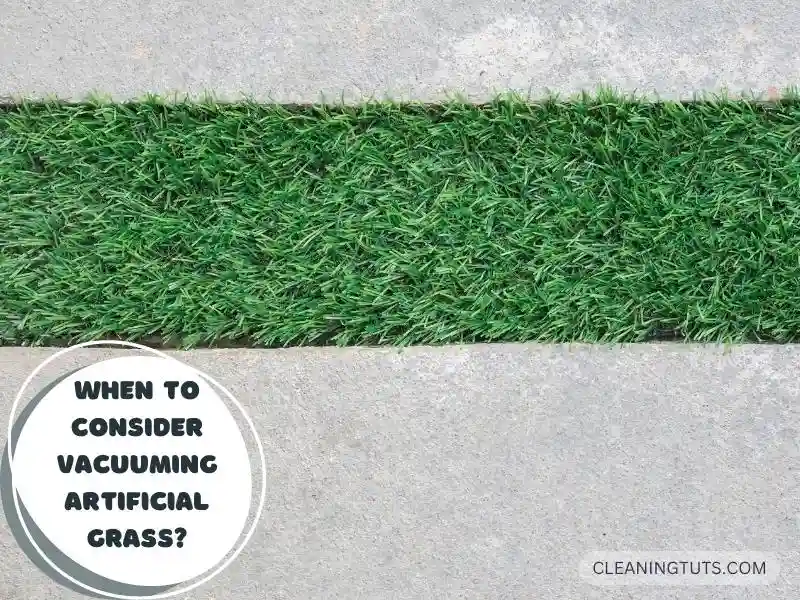
Only vacuum artificial grass under these specific conditions:
- Zero infill present: Some putting greens and decorative turf installations have no infill layer. If your turf has no measurable depth between blade tips and backing, vacuuming is safe with caution.
- Low-suction wet/dry vac only: Use a shop vacuum with adjustable suction at the lowest setting (below 80 CFM). A dedicated artificial turf vacuum with foam filter attachment is ideal.
- Handheld or canister mode: Never use an upright vacuum with rotating brush bars. Use a canister vacuum or wet/dry vac with a wand attachment only.
- Dry debris only: Moisture-laden debris clumps in filters and increases suction unintended. Ensure the lawn surface is completely dry before vacuuming.
For all standard residential turf with infill (the majority of installations), brushing and rinsing provide safer, more effective cleaning. Learn the cleaning glossary definitions for terminology used in turf maintenance.
Safe Alternatives to Vacuuming Artificial Grass
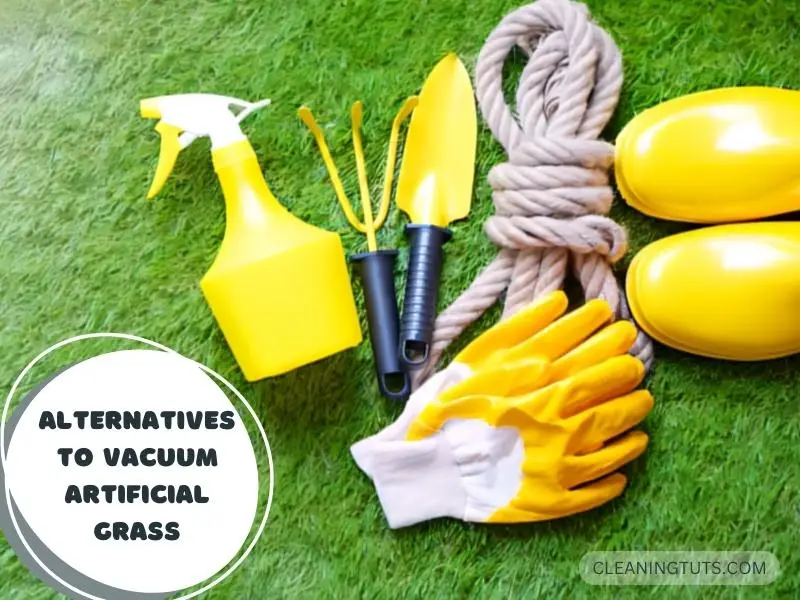
Raking, sweeping, and rinsing are the recommended maintenance routine for infilled artificial turf. These methods preserve infill depth, protect grass blade structure, and cost nothing beyond a one-time tool purchase.
Remove Large Debris Daily
Fallen leaves, twigs, and organic debris decompose when trapped in synthetic turf, creating odor-causing bacteria and blocking drainage pores in the backing. Use a leaf blower at 150+ CFM airflow to lift debris without disturbing infill. Point the nozzle downward at a 45-degree angle, moving in overlapping strokes across the surface.
For areas under trees or near fencing where wind dispersal is limited, hand-collection with a magnolia grabber tool prevents debris accumulation that leads to moss growth. Check your turf quarterly for stain removal techniques for common outdoor staining issues.
Lawn Raking for Infill Redistribution
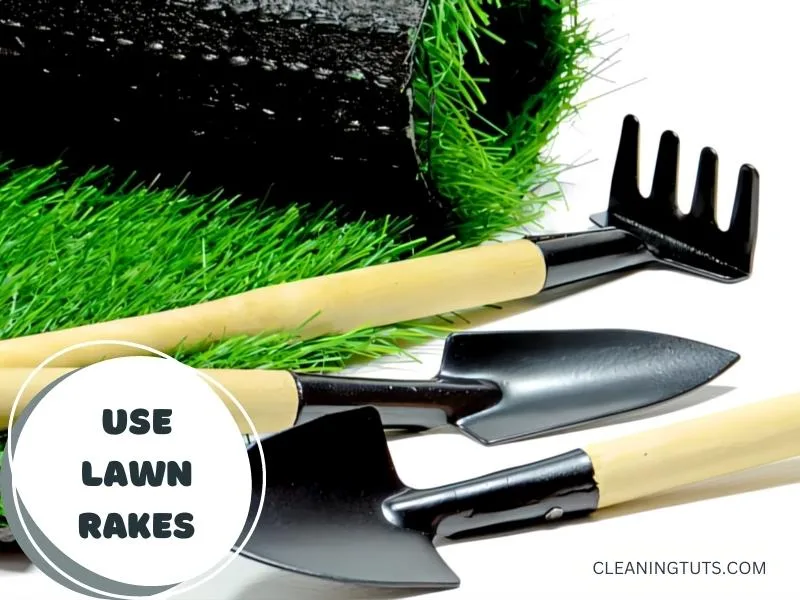
Use a flexible-tine artificial grass rake with poly bristles (not metal, which tears the turf backing). The soft brushes work 0.5 to 1 inch into the grass blade zone to lift flattened fibers while brushing debris to the surface for collection. For large lawns exceeding 1,000 square feet, a ride-on lawn sweep with bagger attachment at 200 CFM airflow covers more ground efficiently.
A stiff-tined hand rake works best for high-traffic pathways where fibers compress from regular footfall. The tines penetrate the infill layer to 1 to 2 inches depth, aerating the turf and maintaining the springy feel that characterizes quality artificial grass.
Synthetic-Bristle Brushes and Brooms
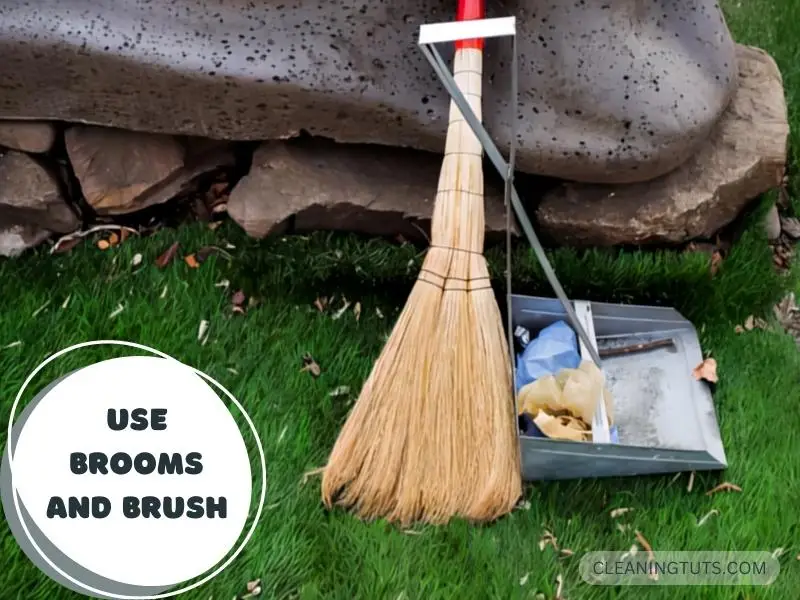
Select brushes with nylon or polypropylene bristles at least 5 inches long—the bristle length ensures 1 to 2 inches of penetration into the grass blade zone. Natural-bristle brushes absorb moisture and harbor bacteria, making synthetic the only practical choice for outdoor use.
Long-handled push brooms with 18-to-24-inch widths cover large areas efficiently. Perform long, deliberate forward strokes at 3 to 4 feet per second to loosen surface debris without displacing infill. Avoid circular motions, which push debris into the turf backing rather than lifting it out.
Pet Waste and Urine Cleaning
Pet urine drains through the permeable turf backing and into the base material below, leaving no residue on the synthetic blades themselves. Remove solid waste immediately with a pooper scooper, then rinse the affected area with a garden hose at 40 PSI flow pressure.
For odor control, apply a enzymatic cleaner specifically formulated for artificial grass (pH 6.5 to 7.5 range) at 1 ounce per gallon of warm water. Avoid vinegar solutions above 10% concentration, as acidity above pH 2.5 degrades polyethylene fibers over repeated applications. The enzymes break down uric acid crystals at the molecular level without damaging the turf’s polyurethane backing.
Weekly Rinse Schedule
Rinse your artificial lawn weekly with a garden hose to prevent bacterial buildup, dust accumulation, and odor retention. For pet-owning households, increase to twice-weekly rinsing during summer months when temperatures exceed 85°F, as heat accelerates bacterial growth rates by 200% compared to cooler conditions.
For areas with hard water (above 120 ppm calcium carbonate), switch to a soft-water rinse monthly to prevent mineral deposits on the grass blades that cause premature fading. Maintain your entire outdoor living spaces on a consistent schedule for best results.
Complete Artificial Grass Maintenance Schedule
| Task | Frequency | Tools Required |
|---|---|---|
| Remove large debris (leaves, twigs) | Daily or after storms | Leaf blower (150+ CFM) |
| Surface brushing | Weekly | Synthetic-bristle push broom |
| Full lawn rinse | Weekly | Garden hose (40 PSI) |
| Deep infill raking | Monthly | Flexible-tine artificial grass rake |
| Pet area enzymatic treatment | After each incident | pH-neutral enzymatic cleaner |
| Moss and algae treatment | Bi-annually (spring/fall) | Moss control product (quaternary ammonium compounds) |
| Professional inspection | Annually | Turf specialist |
| Infill level check and top-off | Every 2-3 years | Silica sand (1-2 lbs/sq ft) |
Recommended Vacuum for Artificial Grass (If Applicable)
For the rare case where vacuuming is appropriate, use only a wet/dry shop vacuum with adjustable suction. The Stanley SL18115 18-gallon wet/dry vacuum delivers 6.0 peak horsepower with variable suction control, making it suitable for delicate artificial grass surfaces.
Never use these vacuum types on artificial grass:
- Upright vacuums with rotating brush bars (causes 90-degree fiber bending)
- Canister vacuums exceeding 80 CFM airflow (displaces infill)
- Carpet cleaners and extraction machines (oversaturate backing)
- Shop vacuums at maximum suction (extracts infill within 3-5 seconds)
Two-in-one leaf blower and turf vacuum units with foam prefilters provide the controlled 40-60 CFM airflow needed for debris removal without infill displacement. Set the vacuum to its lowest suction setting and use only the wand attachment—no floor heads.
For comprehensive floor care maintenance, explore the Floor Cleaning Master Hub for guides on all surface types.
Frequently Asked Questions
How do you clean artificial grass without a vacuum?
Remove debris with a leaf blower, then brush the surface with a synthetic-bristle broom using long forward strokes. Rinse weekly with a garden hose at 40 PSI. For pet areas, apply pH-neutral enzymatic cleaner at 1 ounce per gallon of warm water. Deep clean quarterly by raking the infill layer to redistribute sand or rubber granules evenly across the surface.
Does vinegar harm artificial grass?
Undiluted vinegar (5% acetic acid, pH 2.5) degrades polyethylene grass fibers with repeated use. Dilute vinegar to 10% maximum concentration if used occasionally for odor control. For regular maintenance, use pH-neutral enzymatic cleaners formulated specifically for synthetic turf, which clean effectively without fiber damage.
How long does artificial grass last?
Quality artificial grass lasts 15 to 25 years with proper maintenance. UV-stabilized polyethylene blades maintain color for 15+ years. The polyethylene backing lasts 20+ years when kept free of standing water and moss. High-traffic areas may require blade replacement or re-fibrillation every 8-12 years to maintain appearance.
How do I stop artificial grass from smelling?
Eliminate odor sources immediately—remove pet waste within 2 hours to prevent uric acid crystallization. Rinse the affected area with enzymatic cleaner at 1 oz/gallon warm water. For general odor prevention, apply a turf-safe deodorizer monthly at the manufacturer’s recommended dilution. Ensure adequate drainage to prevent urine pooling in the base layer.
Can a regular vacuum damage artificial grass?
Yes—standard upright vacuums with rotating brush bars bend synthetic grass blades at 90-degree angles, causing permanent bald patches. Household vacuums exceeding 80 CFM airflow extract infill materials within 3-5 seconds of direct contact. Even one session with a high-suction vacuum creates visible sagging that requires professional re-infilling at $2-$5 per square foot.
What is the best infill for artificial grass?
Silica sand at 1-2 pounds per square foot distributed 2-4 inches deep provides optimal blade support and drainage for residential turf. Crumb rubber infill offers superior shock absorption for sports fields but holds heat more than sand. Organic infills (cork, coconut fiber) require more frequent replacement but provide natural antimicrobial properties.
References
- Wikipedia contributors. (2024). Artificial turf. Wikipedia. https://en.wikipedia.org/wiki/Artificial_turf
- Environmental Science & Technology. (2022). Comparative life cycle assessment of natural and artificial turf. ACS Publications. https://pubs.acs.org/doi/10.1021/acs.est.2c01234
- NSF International. (2023). Synthetic turf standards and certifications. https://www.nsf.org
Final Recommendations
Vacuuming artificial grass carries significant risk of infill displacement and fiber damage—avoid it unless your turf is specifically designed without infill. The proven maintenance routine for 95% of residential artificial grass installations combines daily debris removal via leaf blower, weekly brushing, and weekly rinsing at 40 PSI garden hose pressure.
With proper care, your artificial turf maintains its vibrant appearance for 15 to 25 years. Re-infilling costs $2 to $5 per square foot when needed, but consistent maintenance extends intervals between top-offs to 2 to 3 years. Professional annual inspections catch drainage issues and infill compaction early, preventing costly repairs.
For related outdoor cleaning guides, explore the Specialty Cleaning Hub or browse the Cleaning Glossary for terminology definitions.


