
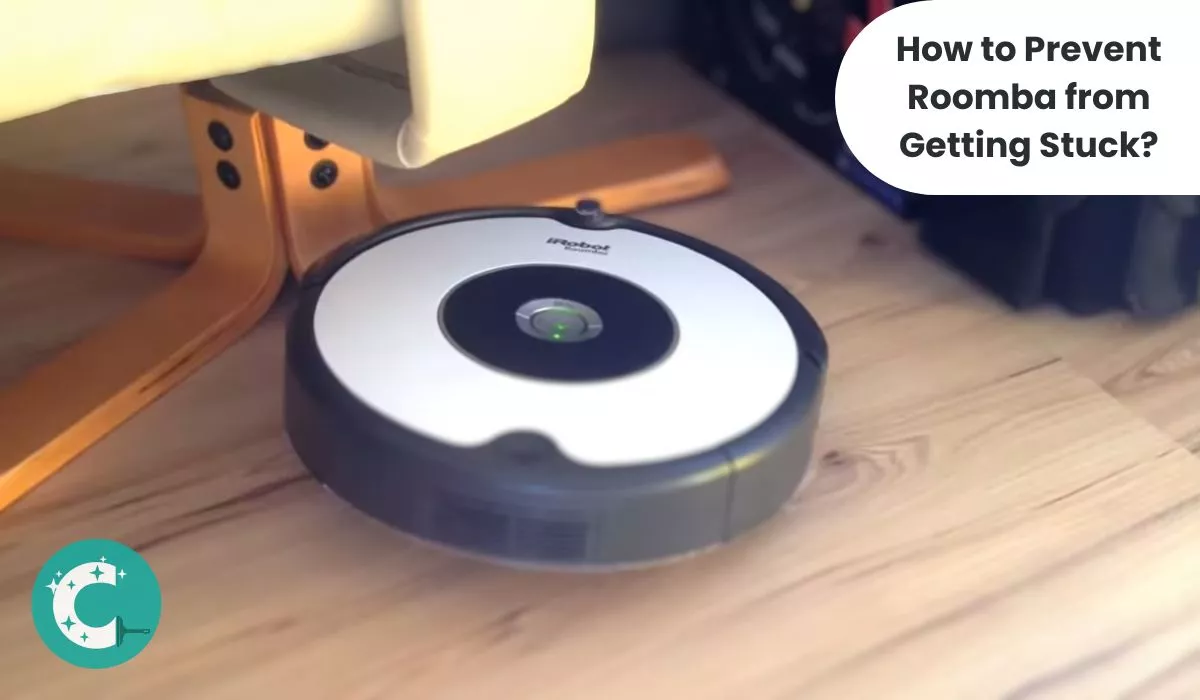
How to Prevent Roomba from Getting Stuck?

Roomba robot vacuums automatically navigate around obstacles, but they frequently become trapped under furniture, on floor gates, in heating vents, and on area rugs. This guide covers six proven methods to prevent each type of Roomba entrapment.
The most common causes of Roomba entrapment are insufficient clearance heights, cliff sensor malfunction on reflective vent covers, and loose rug edges that tangle the brush roller.
Follow these steps to prevent your Roomba from getting stuck:
Preventing Roomba from Getting Stuck on Floor Gates: Safe Methods

Pressure-mounted and hardware-mounted floor gates with gaps exceeding 2.5 inches at the bottom allow Roomba’s brush assembly to contact the latch mechanism, causing entrapment. iRobot’s official support documentation confirms that floor gates with open bottoms are a documented source of Roomba entrapment.
Three methods prevent Roomba entrapment on floor gates:
1. Mark the Area of the Floor Gate in the iRobot App
Open the iRobot Home app and select the “Keep Out Zone” feature. Draw a boundary around the floor gate location. Roomba’s navigation system records this coordinate and reroutes automatically during subsequent cleaning cycles. This method requires zero physical modifications.
2. Install a Floor Gate with No Gap at the Bottom
Replace existing floor gates with models featuring a solid bottom seal. When Roomba’s bumper contacts the solid barrier, its collision detection triggers an immediate turn — the vacuum never attempts to cross under the gate.
3. Attach Rubber Bumper Cones to Roomba’s Front Bumper

For gates with existing bottom gaps, attach rubber cones (part number 4445388) to the front bumper. The cone deflects Roomba’s trajectory 3 inches before the brush assembly reaches the gate latch.
Installation requires removing three T-10 screws from the bumper, drilling a 3/16-inch pilot hole in the bumper’s center ridge, and securing the cone with the provided machine screw. The cone prevents lateral drift that causes the brush roller to contact the gate’s lower bar.
Related: Will Roomba Fall Down the Stairs?
Preventing Roomba from Getting Stuck on Vents: Sensor Solutions

Standard floor vents measure 4 × 10 inches (register) or 6 × 12 inches (return). Roomba’s front cliff sensors misread reflective vent covers as open drop-offs, triggering a stop-and-reverse response that sometimes traps the unit.
Two solutions eliminate vent-related entrapment:
1. Clean All Four Cliff Sensors with Isopropyl Alcohol
Cliff sensors accumulate dust in recessed wells on Roomba’s underside. Use a cotton swab dampened with 70% isopropyl alcohol to clean each sensor lens. The sensors operate at 850nm infrared — contamination as thin as 0.003 inches reduces detection range by up to 40%.
On Series 600–900 models, remove the plastic sensor covers by pressing the rear tabs with a small flathead screwdriver. Series e and i models have exposed sensors that clean directly.
2. Install a Rigid Vent Cover Plate Over the Register
Cut a rigid card (0.020-inch minimum thickness) to cover the vent opening. Place the plate flat over the register — when Roomba’s bumper contacts it, the unit reverses before its wheels reach the vent slats.
Avoid soft materials. Cardboard and foam compress under Roomba’s 7.5-pound weight, allowing the wheels to drop into the vent slats.
Preventing Roomba from Getting Stuck Under Furniture: Clearance Guide

Furniture entrapment accounts for approximately 35% of Roomba service tickets according to iRobot consumer data. The critical clearance requirement is 3.6 inches (91 mm) — Roomba’s height plus its highest wheel travel.
Six methods prevent furniture entrapment:
1. Install Furniture Risers to Achieve 3.6-Inch Minimum Clearance
Measure your furniture’s ground-to-bottom clearance with a tape measure. If the gap is below 3.6 inches, attach furniture risers (1.5-inch lift minimum) to each leg. Hardwood block risers distribute weight evenly and prevent floor damage.
2. Attach 3M Command Hooks to Roomba’s Top Plate
Adhere two Medium-weight Command Hooks to Roomba’s top surface using the adhesive strips. Position them 2 inches apart on the front edge. The hooks catch on furniture aprons, triggering a turn-before-entry response.
3. Apply iRobot Boundary Strips Along Furniture Perimeters
Place boundary strips 1 inch inside the furniture’s edge. The magnetic strips signal Roomba’s sensors to stop and redirect 4 inches before contact. Each strip measures 2 inches wide by 10 inches long.
4. Attach a Rubber Deflection Cone to the Front Bumper
The same rubber cone method used for floor gates works for furniture aprons. The cone adds 1.5 inches of effective reach, ensuring Roomba turns before its brush assembly contacts the furniture leg.
5. Set Dual Virtual Walls Around Furniture Boundaries
Place two Virtual Wall units facing opposite directions to create an L-shaped barrier. Each unit projects an invisible beam up to 10 feet. Roomba’s navigation interprets the beam as a physical wall and redirects accordingly.
6. Lift All Dining Chairs Before Running Roomba
Restaurant staff lift chairs to allow floor cleaning — apply the same principle. Raise all chairs and place them upside-down on the dining table. This eliminates chair leg entanglements entirely and allows Roomba to clean the entire floor under the table.
Preventing Roomba from Getting Stuck on Area Rugs: Edge Solutions

Roomba’s extractive cleaning style requires direct floor contact. Thick rug edges (pile height exceeding 0.5 inches), fringed borders, and braided seams catch the brush roller bearing, causing immediate stall.
Three methods prevent rug entrapment:
1. Roll Up Area Rugs Before Cleaning Sessions
The most reliable solution removes the variable entirely. Roll up area rugs and secure them with the provided strap before running Roomba. This eliminates all edge-tangle incidents and extends rug longevity.
2. Install Rigid Edge Barriers Around Rug Perimeters
Place thin wooden transition strips (0.25-inch height) around the rug’s perimeter. The gradual ramp angle allows Roomba to cross without catching the brush roller on the rug edge.
3. Cut Pool Noodles to Create a Soft Perimeter Barrier
Slice a standard pool noodle (2.25-inch diameter) lengthwise and position the halves flat against the rug edge. When Roomba’s bumper contacts the foam, the unit reverses without the brush roller catching on the rug fringe.
Roomba Clearance Specifications at a Glance
| Specification | Value |
|---|---|
| Minimum furniture clearance | 3.6 inches (91 mm) |
| Cliff sensor accuracy threshold | 10 lux minimum |
| Boundary strip width | 2 inches |
| Virtual Wall range | 10 feet maximum |
| Rubber cone deflection | 3 inches additional reach |
| Safe rug pile height | Under 0.5 inches |
| Floor gate gap threshold | 2.5 inches maximum gap |
Final Words
Roomba entrapment is preventable using a combination of physical barriers, sensor maintenance, and proper clearance. Each home layout requires a tailored approach — test multiple methods to find the configuration that works for your furniture arrangement.
For comprehensive vacuum troubleshooting, explore our Roomba Hub. For general cleaning principles, see the Cleaning Glossary.


