
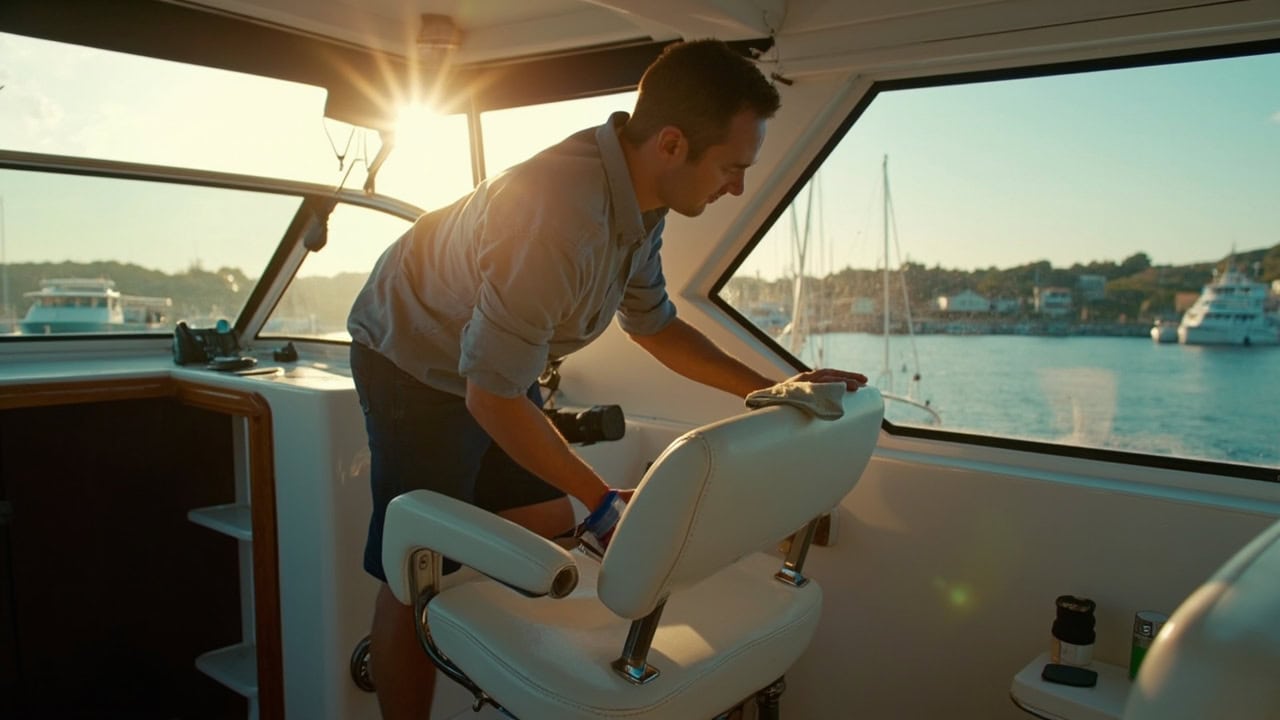
How to Clean Boat Interior: Complete Guide

Cleaning a boat interior requires a pH-neutral marine cleaner diluted at 1:20, soft-bristle nylon brushes, microfiber towels, and a stepwise method that clears debris, rinses salt, spot-treats grime, and ends with thorough drying and UV-protectant application. Salt crystals, trapped humidity, and UV exposure make marine interiors degrade faster than automotive or household surfaces — every step in the process exists to counter one of those three forces.
Marine vinyl, gel coat finishes, and enclosed cabin spaces face a combination of challenges absent from land-based cleaning: saltwater residue amplifies abrasion on every surface, UV radiation breaks down plasticizers in vinyl upholstery, and humidity trapped in seams and storage compartments fuels mold and mildew growth within 24–48 hours. A systematic approach — rinse first, then clean, then protect — prevents each of these damage pathways rather than treating symptoms after they appear.
What You Need Before You Start
Gather every tool and product before starting. Running to retrieve a missing microfiber towel mid-clean means leaving cleaning solution on vinyl longer than its recommended 5-minute maximum dwell time — which risks drying the surface and leaving surfactant residue that attracts dirt faster.
- Soft-bristle brushes — nylon or boat-specific non-abrasive brushes that clean vinyl grain and seams without fracturing protective coatings
- pH-neutral boat cleaner or mild dish soap diluted 1:20 with fresh water — pH between 6.5 and 7.5 protects marine vinyl plasticizers and gel coat finishes
- White vinegar solution (1:1 ratio with water) for dissolving salt mineral deposits on metal hardware, railings, and gel coat waterline stains
- Microfiber towels — minimum 4 towels: two dedicated to cleaning, two reserved exclusively for drying to prevent re-introducing grime
- Wet/dry vacuum with soft brush attachment for removing loose sand, salt crystals, crumbs, and debris from compartments without scratching surfaces
- Marine-grade vinyl protector with UV inhibitors — restores water repellency and blocks ultraviolet degradation after cleaning
- Personal protective equipment — nitrile gloves and eye protection to shield skin and eyes from cleaner overspray and salt residue
For the chemistry behind why pH matters in cleaning products, see our Cleaning Chemistry Hub. Understanding surfactant behavior and pH at the molecular level helps you select the right product for each marine surface.
Step-by-Step Boat Interior Cleaning Process
Follow these eight steps in order. The sequence is engineered so each step prepares the surface for the next — skipping the freshwater rinse, for example, means salt crystals become abrasive grit when you scrub in step four.
- Remove all loose items and debris. Empty cabinets, compartments, and storage bins completely. Vacuum loose sand, salt crystals, and crumbs using the soft brush attachment on your wet/dry vacuum. Removing dry debris first prevents it from turning into abrasive paste when you introduce water and cleaner in later steps. Pay attention to crevices around seat bases and under console edges where salt accumulates.
- Pre-rinse with fresh water. Rinse all interior surfaces — vinyl seats, fiberglass panels, dashboard, flooring — with fresh water to dissolve and flush surface salt before any cleaning agent touches the surface. Salt residue (primarily sodium chloride) acts as an abrasive when scrubbed dry, scratching gel coat and abrading vinyl stitching. A thorough pre-rinse eliminates this risk entirely.
- Apply cleaner to vinyl and upholstery. Spray pH-neutral marine cleaner onto vinyl surfaces and upholstery. Allow 30–60 seconds of dwell time so the surfactants penetrate body oils, sunscreen residue, and grime embedded in the vinyl grain. Do not let cleaner sit longer than 5 minutes — extended contact dries the surface and leaves surfactant residue that accelerates re-soiling.
- Scrub with soft-bristle brush in circular motions. Work the cleaner into vinyl grain and upholstery seams where mold spores, mildew, and body oils accumulate. Use gentle, consistent pressure — aggressive scrubbing fractures the protective topcoat on marine vinyl, exposing the substrate to UV damage and staining. Circular motions lift grime from textured surfaces more effectively than back-and-forth strokes.
- Clean gel coat and hard surfaces. Wipe the dashboard, instrument console, and fiberglass panels with a damp microfiber towel. For stubborn waterline marks or yellowing on gel coat, apply a dedicated marine polish after the initial cleaning pass — polish compounds contain mild abrasives that remove oxidation without damaging the gel coat layer beneath.
- Rinse thoroughly with fresh water. Remove all cleaning residue from upholstery seams, vinyl stitching, and hard surface edges. Residual surfactant acts as a dirt magnet — it lowers surface tension and traps airborne particles, making the surface soil faster than if it had never been cleaned. Rinse until the water runs clear with no foam or slickness.
- Dry completely with clean microfiber towels. Blot — do not rub — upholstery and vinyl surfaces until moisture-free. Rubbing pushes water deeper into seam channels and stitching holes. Wipe hard surfaces with a separate dry microfiber towel. Deploy a portable fan or open all hatches to circulate air and reduce total drying time below 2 hours.
- Apply marine vinyl protector with UV inhibitors. Spray the protectant onto clean, fully dry vinyl surfaces. Buff with a clean microfiber towel to distribute an even film that restores water repellency and blocks UV radiation from breaking down vinyl plasticizers. This single step can double the service life of marine upholstery exposed to full sun.
Boat Interior-Specific Considerations
Marine interiors face four unique threats that household and automotive cleaning guides rarely address. Each requires a specific countermeasure built into your cleaning routine.
Saltwater exposure. Always rinse with fresh water before applying any soap or cleaner. Salt crystals amplify abrasion exponentially — a single grain of dried salt under a brush bristle scratches gel coat the way sandpaper would. Salt also leaves mineral deposits that degrade rubber seals and rot stitching in upholstered panels. Freshwater rinsing dissolves and flushes salt before it can cause damage.
Enclosed cabin humidity. After cleaning, operate a dehumidifier or deploy moisture absorbers (calcium chloride-based products work well) inside enclosed cabin spaces. Humidity above 60% RH inside a sealed cabin creates ideal conditions for mold colonization within 24–48 hours. Proper drying and ongoing moisture control prevent regrowth.
UV damage on vinyl. Marine-grade vinyl contains UV stabilizers, but these deplete over time under sustained sun exposure — faster than automotive vinyl because boats lack garage shelter between uses. Applying a UV-inhibitor protectant after every thorough cleaning replenishes the sacrificial UV-blocking layer and prevents cracking, fading, and hardening.
Odor absorption. Boat interiors absorb and retain fuel fumes, bilge odors, and musty organic smells in their foam cushions and fiberglass lining. Standard air fresheners mask these odors temporarily. An enzymatic cleaner applied after the main cleaning pass breaks down odor molecules at the source — enzymes catalyze the organic compounds that produce the smell rather than covering them with fragrance.
Drying and Finishing Boat Interior
The drying phase is not optional — it is the step that determines whether your cleaning lasts or whether mold returns within days. Trapped moisture in seams, under cushions, and inside storage compartments is the single most common cause of rapid re-soiling and mildew regrowth on boats.
- Open all hatches, ports, and vents during and after cleaning to maximize cross-ventilation. Airflow across wet surfaces cuts drying time by 50% or more compared to closed-cabin drying.
- Deploy a portable dehumidifier in the cabin overnight if the interior was heavily soiled or large areas remain damp after towel drying. Target humidity below 50% RH to prevent mold spore activation.
- Check and clean scuppers (drainage holes in the deck and transom) to ensure rinse water exits the boat rather than pooling in low spots. Blocked scuppers trap water against gel coat and hardware, promoting staining and corrosion.
- Store cleaning cloths in a sealed bag after use to prevent re-introducing salt, debris, or residual cleaner onto surfaces during the next cleaning session.
- Inspect canvas, Bimini tops, and cushion covers for independent cleaning needs — these fabric and canvas components collect salt and mold separately from the vinyl and gel coat surfaces you just cleaned.
Common Mistakes When Cleaning Boat Interior
Avoiding these five errors prevents the most frequent causes of premature vinyl failure, gel coat damage, and persistent mold on boat interiors.
| Mistake | Why It Damages | Correct Approach |
|---|---|---|
| Using household cleaners | pH extremes (below 5 or above 9) degrade marine vinyl plasticizers and etch gel coat finish | Use pH-neutral marine-specific cleaners (pH 6.5–7.5) |
| Scrubbing salt dry | Salt crystals act as abrasive grit that scratches gel coat and abrades stitching threads | Always rinse salt with fresh water before any scrubbing |
| Skipping drying step | Trapped moisture in seams and foam promotes mold colonization within 48 hours | Fully dry all surfaces and run dehumidifier post-clean |
| Applying wax before cleaning | Wax seals in grime, salt, and contaminants — making future cleaning harder and less effective | Clean all surfaces first, then apply protectants to bare, clean surfaces |
| Ignoring bilge area | Accumulated moisture and fuel residue in the bilge cause persistent cabin-wide odors | Clean bilge with dedicated bilge cleaner and deodorizer during every full interior clean |
Maintenance Schedule for Boat Interior
Consistency prevents the cumulative damage that turns a manageable cleaning task into a costly upholstery replacement. This four-tier schedule balances effort against the rate at which salt, UV, and humidity degrade marine surfaces.
After every use: Quick freshwater rinse of seats and flooring to dissolve salt before it dries and crystallizes. Open all hatches and ports to air out the cabin for at least 2 hours. This 10-minute routine prevents 80% of the salt and moisture damage that accumulates between deep cleans.
Weekly during active season: Spot-clean high-traffic areas — captain’s chair, helm console, boarding areas — with a damp microfiber towel. Wipe the dashboard and instrument panel. Check storage compartments for moisture accumulation and ventilate if dampness is present.
Monthly during active season: Full interior clean following the eight-step process above. Apply marine vinyl protector with UV inhibitors to all upholstery surfaces. Inspect and clear all scuppers and drainage channels. This monthly deep clean removes embedded grime that weekly spot-cleaning cannot reach.
Seasonal (spring commissioning and winterization): Deep clean every surface including bilge, storage lockers, and under-cushion compartments. Treat all upholstery with a dedicated vinyl conditioner in addition to the UV protectant. Inspect every seal, seam, and stitching line for cracking or separation — repair before storing to prevent moisture intrusion during the off-season.
For the complete boat care system, see our guide to cleaning boat hull exteriors and our article on removing mold from boat cabins. The Specialty Cleaning Hub covers all niche cleaning scenarios beyond marine applications, and the Kitchen Cleaning Hub shares relevant cleaning chemistry principles — pH-neutral cleaners and surfactant science apply across all surface types.
Frequently Asked Questions
Q: What is the best cleaner for boat interior vinyl seats?
A: A pH-neutral marine vinyl cleaner is the safest choice — it dissolves grime without degrading the plasticizers in marine-grade vinyl that keep seats soft and UV-resistant. Dilute at 1:20 with fresh water and apply with a soft microfiber cloth, never a stiff brush. Products formulated specifically for marine vinyl maintain the correct pH balance (6.5–7.5) and contain surfactants designed to lift salt residue and body oils without stripping the UV-protective topcoat.
Q: How do you prevent mold and mildew in a boat cabin?
A: Prevent mold by removing all moisture sources after each use — open hatches and ports to maximize airflow, run a dehumidifier in enclosed cabin spaces to keep humidity below 50% RH, and apply an enzymatic cleaner to any visible mold spots before spores colonize deeper into upholstery fibers. Moisture absorbers containing calcium chloride provide passive humidity control between uses. The critical window is 24–48 hours after any wet event — if surfaces dry within that timeframe, mold spores cannot establish.
Q: Can I use household vinegar to remove salt stains from boat surfaces?
A: Yes — a 1:1 white vinegar and freshwater solution dissolves salt mineral deposits on metal hardware and gel coat surfaces without damaging marine finishes. White vinegar contains approximately 5% acetic acid (pH 2.5), which is strong enough to break down sodium chloride and calcium deposits but mild enough for brief contact on gel coat. Rinse immediately after application with fresh water and dry thoroughly to prevent acid etching from prolonged exposure.
Q: How often should you clean the inside of a boat?
A: Clean boat interior thoroughly at least once monthly during active use season, perform a deep clean at spring commissioning and before winterization, and always rinse and air out after saltwater use to prevent salt degradation and moisture-related mold growth. Boats used in saltwater environments may require biweekly attention to high-contact surfaces like the captain’s chair and boarding platforms.
References
- United States Environmental Protection Agency. (2024). Safer Choice Standard for Cleaning Products. EPA.gov.
- Boat Owners Association of The United States. (2023). Boat Cleaning and Maintenance Guide. BoatUS.com.
- American Boat and Yacht Council. (2023). Standards for Marine Vehicle Maintenance and Safety. ABYC.org.
- National Marine Manufacturers Association. (2024). Marine Industry Statistics and Maintenance Standards. NMMA.org.


