
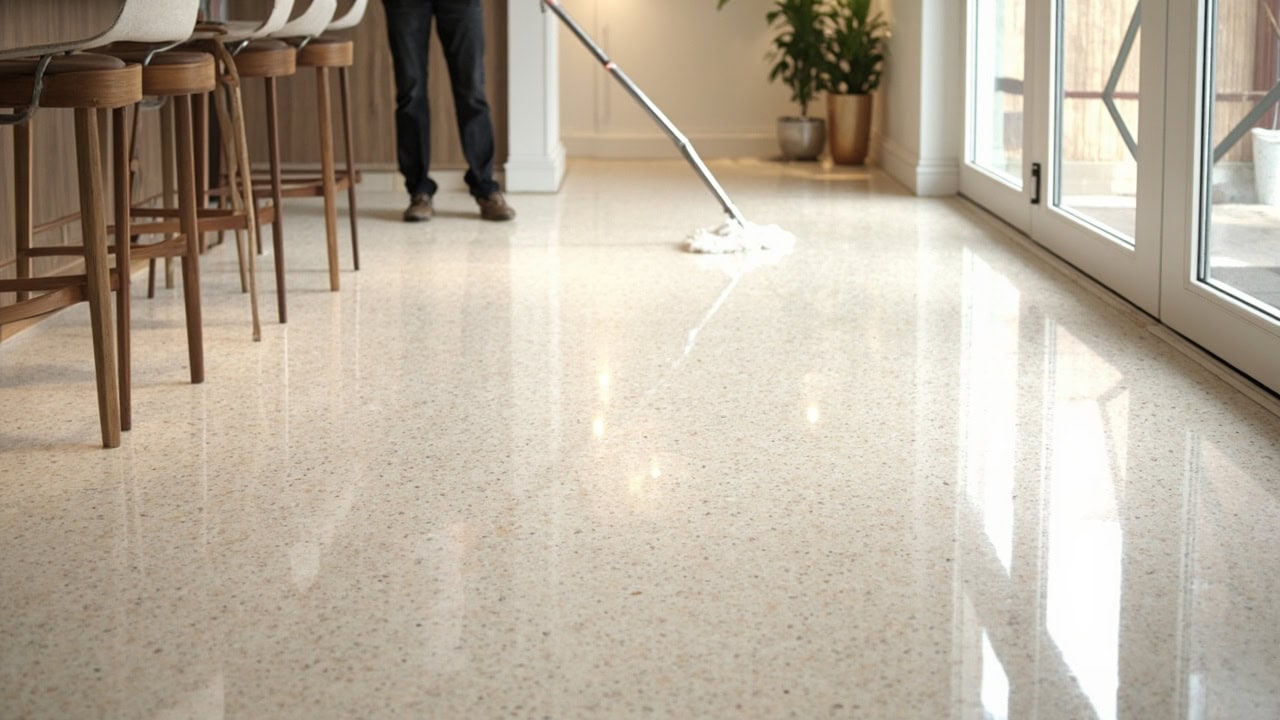
How to Clean Terrazzo Floors: Complete Guide

Terrazzo floors must be cleaned with a pH-neutral cleaner at a dilution ratio of 1:20 and a barely-damp microfiber mop to preserve the polished marble or glass aggregate surface — acid-based or abrasive cleaners cause permanent etching that cannot be reversed. The cleaning process involves dry debris removal, wet mopping with proper dwell time, and buffing to restore the floor’s natural sheen. Never use vinegar, bleach, or ammonia on terrazzo as they attack the calcium-based binder and cause pitting in the matrix.
Terrazzo is a composite material pioneered in Venice in the 15th century, consisting of chips of marble, quartz, granite, glass, or other suitable aggregate material bound together with either a cementitious binder or a polymeric resin binder (epoxy, polyester, or vinyl ester). Modern terrazzo installed in residential and commercial settings after 1970 predominantly uses polymer binders, which require different care than traditional cementitious terrazzo. Understanding your terrazzo’s binder type is the first step in establishing a safe and effective floor cleaning routine.
What You Need Before You Start
Gathering the correct tools and cleaning agents before beginning ensures the process is efficient and safe for your terrazzo surface. Using the wrong materials — even briefly — can cause irreversible damage to the polished aggregate matrix.
Tools Required
- Microfiber mop with separate rinse bucket (never wring out in the cleaning solution — this reintroduces dirty water to the floor)
- pH-neutral cleaner specifically formulated for stone or terrazzo
- Soft-bristled scrub brush for grout lines, corners, and edges
- Clean microfiber towels or chamois for drying
- Terrazzo-compatible stone polish (optional, for periodic buffing)
Cleaning Agents and Dilution
- pH-neutral cleaner at 1:20 dilution ratio — 1 part cleaner to 20 parts warm water. This ratio ensures effective cleaning without alkaline or acidic assault on the binder.
- Water temperature: lukewarm — not hot, not cold. Extreme temperatures can affect the adhesive bonding between the aggregate and binder in the matrix. Ideal range is 65–75°F (18–24°C).
- Optional pre-treatment: Small amount of hydrogen peroxide (3%) applied directly to oil stains, scuff marks, or embedded dirt before the main cleaning solution. Allow 30–60 seconds of dwell time only.
What to Avoid on Terrazzo
Terrazzo’s polished surface is vulnerable to chemical and physical damage. The following products and tools will cause permanent harm to the calcium-based binder and aggregate matrix:
- Vinegar and all acid-based cleaners (pH < 7) — acetic acid at pH 2.5 dissolves the calcium binder, causing permanent etching, dull spots, and pitting that cannot be polished out without professional re-surfacing
- Bleach (sodium hypochlorite) — degrades the polymer binder in modern epoxy terrazzo and oxidizes metallic aggregates, causing discoloration and surface brittleness
- Ammonia — alkaline attack on marble chips causes etching, loss of polish, and a frosted appearance on the aggregate surface
- Abrasive scrubbers, steel wool, or scouring powders — physically scratch the polished surface, creating micro-abrasions that dull reflectivity and trap dirt
- Oil-based cleaners or wax products — create filming and slippery residue that builds up over repeated applications, masking the terrazzo’s natural lustre
For definitions of technical cleaning terms, consult the Cleaning Glossary.
Step-by-Step Terrazzo Floor Cleaning Process
Follow this seven-step process exactly as described. Each step is sequential — skipping steps, particularly the rinse step, is one of the most common causes of terrazzo damage and dullness in residential settings.
- Remove dry debris: Sweep or vacuum the entire floor using a soft-bristle attachment to collect loose dirt, dust, and particulate matter. Never push debris across the surface — lift the vacuum head or mop head when changing direction to prevent dragging abrasive particles across the polished surface. For daily maintenance, a dry microfiber mop alone is sufficient for light debris removal.
- Pre-treat stubborn spots: Apply a small amount of pH-neutral cleaner undiluted directly to oil stains, scuff marks, or embedded dirt in high-traffic areas. Allow 30–60 seconds of dwell time without letting it dry completely. For protein-based stains (food, blood), use 3% hydrogen peroxide instead, applying it only to the stained area and blotting dry after 60 seconds.
- Prepare cleaning solution: Mix pH-neutral cleaner with lukewarm water (65–75°F / 18–24°C) at a 1:20 dilution ratio — 1 part cleaner to 20 parts water — in a bucket. Never add vinegar, ammonia, or bleach to this solution under any circumstances. Using a separate bucket for the rinse water is critical to avoid cross-contamination.
- Mop the surface: Dip the microfiber mop into the solution, wring until barely damp (the mop should leave no puddles — a good test is pressing the mop firmly on the floor; if water pools, it is too wet), and mop in a figure-eight or S-pattern to avoid pushing grime into the same paths repeatedly. Change the mop direction at each pass.
- Clean edges and grout lines: Use a soft-bristled scrub brush with the cleaning solution to agitate debris from the edges, corners, expansion joints, and any grout lines adjacent to the terrazzo. Do not use a wire brush or hard-bristled tool, as these will scratch the polished surface. Work in sections and rinse the brush frequently.
- Rinse the floor: Empty the dirty solution, refill with clean lukewarm water, and rinse the mop thoroughly. Go over the entire floor with the clean rinse water to remove any residual cleaning solution. This step is non-negotiable — residual cleaning solution left on the surface creates filming and streaks as it dries, dulling the finish over time.
- Dry and buff: Immediately dry the floor with a clean microfiber towel or chamois using overlapping strokes from one end of the room to the other. Change the towel when it becomes saturated. For additional shine, buff the completely dry surface with a clean, dry microfiber mop using fast circular motions. Perform optional buffing monthly or as needed to maintain the floor’s natural polish.
Terrazzo-Specific Considerations: What to Avoid
The table below summarizes the most common damaging agents, their chemical mechanism of harm, and the visible damage they cause. Understanding why these products damage terrazzo helps you make informed choices about any cleaning product before applying it to your floor.
| Product Type | Why It Damages Terrazzo | Damage Appearance |
|---|---|---|
| Vinegar (acetic acid, pH 2.5) | Dissolves calcium binder in the matrix through acid-base reaction with calcium carbonate | Dull spots, white hazing, pitting, irreversible loss of polish |
| Bleach (sodium hypochlorite) | Degrades polymer binder, oxidizes metallic aggregates (bronze, copper, iron chips) | Discoloration, brittle surface, hairline cracks in binder |
| Ammonia | Alkaline attack on marble chips causes leaching of calcium compounds | Etching, frosted appearance on marble chips, loss of reflectivity |
| Abrasive powders (soft scrub, comet) | Physical scratching of polished surface at microscopic level | Scuff marks, loss of reflectivity, dulled finish in traffic patterns |
| Oil-based waxes (Pledge, furniture spray) | Creates film buildup that traps dirt and creates uneven sheen | Streaking, slippery residue, yellowing over time |
pH Considerations
Terrazzo typically has a surface pH of 7–8 (slightly alkaline to neutral). The safe cleaning range is pH 6.5–8.5. Any cleaner with a pH below 6.5 (acidic) will begin dissolving the calcium-based binder upon contact, with damage accumulating with each use. Any cleaner with a pH above 9 (strongly alkaline) will cause saponification of any residual oils and may cause the marble aggregate to appear cloudy or “etched.” Always test a new cleaning product on an inconspicuous area — such as inside a closet threshold — before applying it to the main floor surface.
The pH of common household cleaners for reference: vinegar (pH 2.5), lemon juice (pH 2.0), bleach (pH 11.5–12), ammonia (pH 11.0), dish soap (pH 7.5–8.5). Only dish soap and true pH-neutral stone cleaners fall within the safe range for terrazzo.
Drying and Finishing Terrazzo Floors
Proper drying is critical for terrazzo because the aggregate matrix — particularly in floors with exposed marble or limestone chips — can absorb water, leading to three significant problems that compound over time if not addressed.
Risks of Inadequate Drying
- Efflorescence: White mineral salt deposits (calcium carbonate) rising to the surface as water evaporates through the matrix. This appears as a fuzzy white coating that cannot be wiped away and requires acid-free efflorescence removers to dissolve.
- Biological growth: Damp, dark environments between aggregate and binder foster mold and mildew, particularly in kitchens and bathrooms where organic matter is present. This creates health hazards and produces musty odors.
- Water spot staining: As water evaporates from the surface, it leaves behind dissolved mineral traces (calcium, magnesium) that form cloudy spots requiring re-buffing to remove.
Proper Drying Technique
- Use clean, dry microfiber towels or a chamois — these materials absorb water without leaving lint or fiber residue
- Work in overlapping strokes from one end of the room to the other to ensure complete coverage
- Change the towel or cloth immediately when it becomes saturated — a saturated cloth stops absorbing and begins redistributing water
- For large areas (over 200 square feet), use a wet/dry vacuum on the “vacuum only” setting to pull standing water before towel drying — this dramatically reduces drying time and prevents water from being forced into the matrix
Optional Buffing for Extra Shine
After the floor is completely dry, buff with a clean, dry microfiber mop using fast circular motions — the friction generates a mild heat that releases the natural gloss of the polished surface without applying any wax or sealant. This technique, known as burnishing, is standard practice in commercial terrazzo maintenance and restores 10–15% of lost reflectivity on lightly dulled floors. Perform monthly or as needed to maintain shine. For floors that have lost significant luster due to accumulated wear, consult a professional terrazzo restoration service that uses diamond-polishing equipment — this process grinds the surface at progressively finer grit levels (starting at 400-grit) to re-polish the binder and aggregate to their original finish.
Common Mistakes When Cleaning Terrazzo Floors
These six mistakes account for the majority of terrazzo damage reports in residential settings. Avoiding them will extend the life and appearance of your terrazzo floor indefinitely.
- Using vinegar or “natural” acid cleaners: Despite being marketed as safe for homes and eco-friendly, vinegar’s acetic acid (pH 2.5) etches terrazzo permanently on first contact. This is the single most common cause of terrazzo damage. The etching is invisible at first — a slight loss of reflectivity that most homeowners don’t notice until the damage is widespread and irreversible. There is no DIY fix for etching; professional diamond-polishing is the only remedy.
- Using too much water: Soaking terrazzo allows water to penetrate between the aggregate and binder, weakening the bond over time and promoting efflorescence. Always use a barely-damp mop technique — the mop should leave no visible puddles and the floor should dry within 2–3 minutes of finishing the rinse pass.
- Skipping the rinse step: Residual cleaning solution left on the surface creates filming and streaks as it dries, dulling the finish. The residue also acts as a sticky layer that attracts and traps dust and dirt faster than an unfilmed surface, creating a cycle of increasing dullness that homeowners often misinterpret as the floor “wearing out.”
- Using microfiber pads that are too abrasive: Not all microfiber is the same — terrazzo requires soft, non-abrasive microfiber typically labeled “smooth” or “glass cleaning” microfiber (approx. 200–300 GSM, split fibers). “Scrub” or “deep clean” microfiber has a higher pile and slightly abrasive texture designed for scuff removal — it will scratch polished terrazzo if used for routine mopping.
- Applying wax or topical sealers: Terrazzo installed after 1970 typically has a permanent polished finish achieved during the manufacturing process through diamond grinding and honing. Wax and sealers create maintenance-heavy buildup that must be stripped periodically, can discolor to a yellow hue over time, and can actually seal in dirt rather than protecting the surface. If your terrazzo needs sealing, consult the original installation documentation or a terrazzo professional.
- Neglecting regular dry mopping: Dirt and grit act as an abrasive when walked across terrazzo — a single grain of sand tracked in from a doorway can create a visible scratch in a high-traffic path with just a few footfalls. Daily dry mopping with a microfiber mop prevents the accumulation of abrasive particles. This single habit adds more to terrazzo longevity than any cleaning product or technique.
Frequently Asked Questions
Q: Can I use vinegar to clean terrazzo floors?
A: No — vinegar’s acetic acid (pH 2.5) permanently etches the calcium-based binder in terrazzo, causing dull spots and pitting that cannot be polished out. Use only pH-neutral cleaners with a dilution ratio of 1:20. If you have already used vinegar on your terrazzo, the damage is permanent until professional diamond-polishing re-surfacing is performed.
Q: How often should I clean terrazzo floors?
A: Dry mop daily to remove debris, wet mop with pH-neutral cleaner weekly, and perform a thorough rinse monthly. High-traffic areas — entryways, kitchens, bathrooms — may require more frequent wet cleaning (2–3 times per week) to maintain appearance. The daily dry mopping is non-negotiable regardless of foot traffic; it is the most impactful maintenance task for preventing abrasive damage.
Q: Can I use a steam mop on terrazzo?
A: Steam mops are not recommended — the high heat (typically 200–300°F / 93–149°C) can degrade the polymer binder in modern epoxy and polyester terrazzo and may cause thermal shock leading to hairline cracks in the matrix. The pressure of steam mops also forces moisture into the aggregate-binder interface faster than traditional mopping. If you must use a steam mop on a different floor type in your home, never bring it into contact with terrazzo without verifying the binder type with your installation documentation.
Q: How do I restore shine to a dulled terrazzo floor?
A: First, determine whether the dullness is caused by surface scratches or by wax/sealer buildup — if the latter, clean with a pH-neutral wax stripper. Then buff the dry floor with a clean, dry microfiber mop using fast circular motions (burnishing). For severe dulling, surface scratches, or etching, consult a professional terrazzo restoration service for diamond-polishing re-surfacing, which grinds the floor at 400-grit or finer to restore the original factory finish. Budget $3–8 per square foot for professional re-polishing.
Related Articles
If you found this guide useful, you may also be interested in:
- How to Clean Marble Floors — marble and terrazzo share calcium-based surface chemistry and identical pH requirements; the same cleaning principles apply
- How to Clean Granite Countertops — granite and terrazzo share sealing and care considerations; both require pH-neutral cleaners and careful avoidance of acidic substances
- Floor Cleaning Hub — the master guide to all floor types including tile, grout, hardwood, and laminate
- Kitchen Cleaning Hub — comprehensive kitchen care including floor maintenance for all kitchen floor types
References
- Terrazzo.com. (2024). National Terrazzo & Mosaic Association — Terrazzo Technical Resources. National Terrazzo & Mosaic Association.
- Wiley, J. & Taylor & Francis Group. (2018). Stone Conservation: Principles and Practice. Routledge.
- NIST/ISCS. (2023). Standards for Composite Floor Materials and Maintenance. National Institute of Standards and Technology.
- Mayo Clinic Health System. (2023). pH Values of Common Household Cleaning Agents. Mayo Clinic.
- Wikipedia Contributors. (2024). Terrazzo. Wikipedia, The Free Encyclopedia. Retrieved from https://en.wikipedia.org/wiki/Terrazzo.


