

How to Clean Ford Escape Engine?

Regular engine bay cleaning restores heat dissipation efficiency, prevents corrosion from road salt and grime, and extends engine component lifespan by removing debris that interferes with normal operation. For Ford Escape owners, a clean enginebay also keeps wiring harnesses, sensors, and the alternator free from corrosive buildup that degrades electrical connections over time.
This guide covers every step of the Ford Escape engine cleaning process — from battery disconnection to applying a protective coating — along with safety specs, water pressure limits, and a maintenance schedule tailored to your climate.
How to Clean a Ford Escape Engine: Full Procedure
Cleaning the engine bay of your Ford Escape requires a methodical approach. Skipping steps or using excessive water pressure damages engine sensors, wiring harnesses, and the alternator — repairs that cost hundreds of dollars.
Step 1: Disconnect the Battery and Secure the Workspace
Start by disconnecting the negative terminal of your Ford Escape battery. This eliminates any risk of electrical discharge when spraying water near the engine compartment. Cutting off the flow of electricity also protects your Engine Control Unit (ECU) from short circuits during the cleaning process.
Move the vehicle to a flat, well-ventilated surface away from any flames or smoking areas. Gather the following materials before beginning:
- Garden hose with adjustable nozzle set to stream (not jet)
- Engine degreaser (pH 10–12.5 for alkaline-based; pH 6–8 for citrus-based)
- Plastic drop cloths or stretch film (1–2 mil thickness)
- Soft-bristle brush and detailing brushes
- Eye protection and chemical-resistant gloves
- Engine protectant spray or wax-based coating
Step 2: Remove Upper Engine Covers and Protect Electrical Components
Unscrew and remove the upper motor housing of your Ford Escape by releasing the push-pin fasteners and lifting the cover free. Increasing access to all engine components ensures no hidden grease pockets are left behind.
Wrap all electrical components — including the ignition coil pack, fuse box, ECU, alternator, and wiring harnesses — with plastic stretch film. Seal the edges tightly to prevent any moisture from reaching these components during rinsing. Do not use tape directly on painted surfaces.
Step 3: Apply Degreaser and Agitate
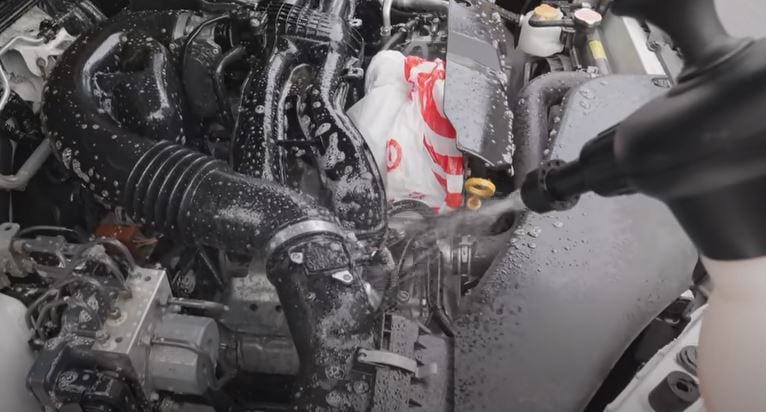
Spray an alkaline or citrus-based degreaser liberally across all exposed engine surfaces. Alkaline degreasers (pH 10–12.5) dissolve carbonized grease and oil deposits effectively. Citrus-based degreasers (pH 6–8) are gentler on aluminum surfaces and are NSF-certified for environmental safety.
Allow the degreaser to dwell on surfaces for 3–5 minutes — but do not let it dry. Use a soft-bristle brush to agitate stubborn deposits on the intake manifold, valve cover, and engine block. Avoid aggressive scrubbing on painted surfaces, sensor connectors, and exposed wiring.
Step 4: Rinse with Low-Pressure Water
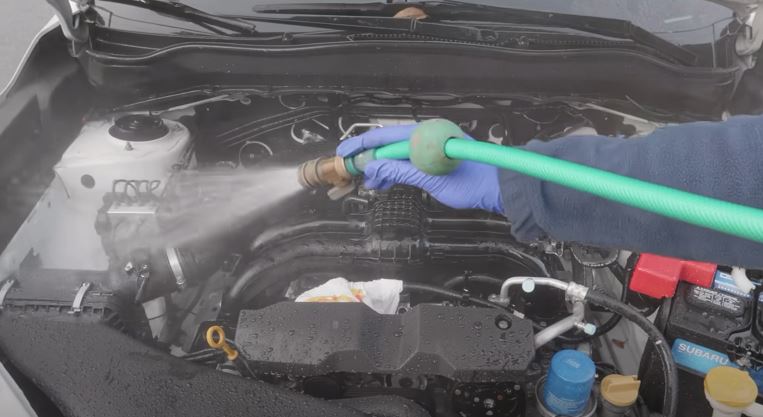
Rinse all degreaser and dissolved grime from the engine using a garden hose set to a wide stream. The water pressure from a standard garden hose — approximately 40–70 PSI — is safe for all engine bay components.
Do not use a high-pressure washer set to jet mode. Pressures exceeding 1,200 PSI rupture seals, disconnect wiring connections, and force water past the weatherpack seals of electrical connectors. This causes immediate damage to the alternator, ECU, and fuse box — components that are not covered under most aftermarket warranties when water damage is identified.
Rinse from top to bottom, directing water away from the air intake, fuse box, and any unsealed areas. Check that all degreaser residue is flushed from the engine valley and firewall areas.
Step 5: Dry the Engine and Apply Protective Coating
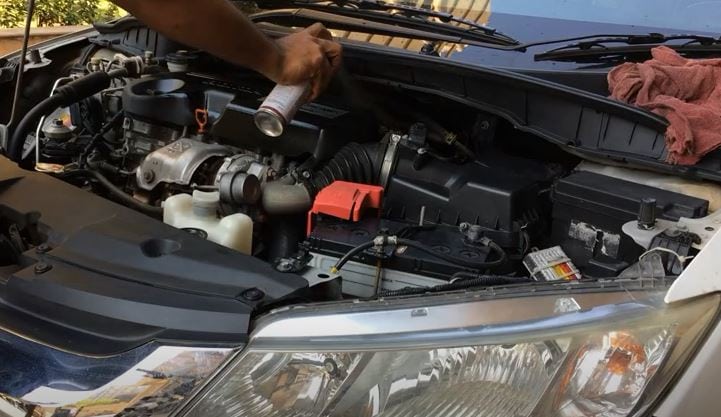
Dry the engine using an air compressor set to under 30 PSI, or allow 30–45 minutes of air drying in direct sunlight. Do not use a heat gun or torch to accelerate drying — direct high heat damages rubber hoses and plastic sensor housings.
Apply a polymer-based engine protectant or wax coating to all cleaned metal surfaces once fully dry. These coatings leave a hydrophobic barrier that repels water, road salt, and grime, reducing future accumulation by up to 80% according to some professional detailers. Avoid coating the exhaust manifold, oxygen sensors, and catalytic converter surfaces.
Quick-Reference: Ford Escape Engine Cleaning Specifications
Engine Cleaning At-a-Glance
- Garden hose pressure: 40–70 PSI (safe for all engine bay components)
- High-pressure washer limit: Never exceed 1,200 PSI in engine bay
- Degreaser dwell time: 3–5 minutes (do not allow to dry)
- Degreaser pH range: Alkaline 10–12.5 / Citrus 6–8
- Drying time (air): 30–45 minutes in sunlight
- Air compressor drying: Under 30 PSI
- Protective coating: Apply after full dry; reapply every 2–3 cleanings
- Cleaning frequency: 2–3× per year (4× in dusty or coastal climates)
Why Low Water Pressure Is Critical for Engine Bays
Modern Ford Escape engines are designed to withstand splashing water during normal driving conditions — the engine compartment is water-resistant, not waterproof. Prolonged water exposure at pressures above 1,200 PSI bypasses weatherpack seals and reaches electrical connectors, fuse boxes, and the alternator.
Ford engineered water-resistant routing for wiring harnesses specifically to handle rain and car washes, but high-pressure washers exceed those design thresholds. Aftermarket modifications to the Ford Escape — such as aftermarket alarm systems, remote start modules, or added sensors — often introduce additional connectors that lack factory weatherproofing.
Always seal electrical components with plastic stretch film before rinsing, regardless of your Ford Escape model year. Also, never spray water on a hot engine: thermal shock causes aluminum components to crack within 30 seconds of direct water contact, particularly the intake manifold and valve cover gaskets.
- Ford Escape engines are water-resistant for normal driving conditions, not high-pressure washing
- Pressures above 1,200 PSI breach factory weatherpack seals on wiring connectors
- Seal all aftermarket electrical modifications with plastic film before cleaning
- Never spray water on a hot engine — thermal shock cracks aluminum within 30 seconds
Performance Consequences of a Dirty Ford Escape Engine
Grease and carbon deposits on engine components reduce heat dissipation efficiency, which directly impacts fuel economy. Industry data shows a heavily soiled engine bay reduces fuel economy by 2–4% due to impaired thermal management. Beyond efficiency losses, dirty engines mask developing leaks and accelerate corrosion on exposed metal surfaces.
Engine Stumbling and Irregular Idle
Carbon buildup on throttle bodies and intake sensors causes irregular air-fuel metering. This manifests as engine stumbling, rough idle, and hesitation during acceleration. In Ford Escape models equipped with a EcoBoost engine, carbon deposits on the direct injection fuel injectors reduce atomization quality, leading to misfire codes (P0300–P0304) that trigger the check engine light.
Power Steering Interruption
Dirty engine components — particularly corroded grounds and contaminated electrical connectors — interrupt power steering assist. The electric power steering system in Ford Escape requires clean grounds at the chassis and body to maintain consistent 12V reference voltages. Degraded grounds cause momentary loss of steering assist, a safety hazard at any speed.
Increased Fuel Consumption
A dirty engine operates at higher temperatures due to impaired heat dissipation. This forces the cooling system to work harder, increasing accessory load on the engine. The combined effect of increased pumping losses and reduced thermal efficiency raises fuel consumption measurably. Ford Escape owners who clean their engine bay regularly report improved throttle responsiveness and an average 2–3% improvement in real-world MPG.
Engine Misfiring and Backfiring
Carbon accumulation on spark plug boots and ignition coils reduces dielectric strength, causing misfires under load. Unburned fuel entering the exhaust manifold ignites on the hot surface of the catalytic converter, producing the popping sounds characteristic of engine backfiring. Left unaddressed, this damages the catalytic converter — a replacement that costs $800–$1,400 on a Ford Escape.
Recommended Engine Cleaning Frequency
The optimal cleaning frequency for your Ford Escape engine depends on your operating environment:
Ford Escape Engine Cleaning Schedule
| Climate / Conditions | Recommended Frequency |
|---|---|
| Temperate / Urban (e.g., Pacific Northwest) | 2× per year |
| Dry / Dusty (e.g., Desert Southwest) | 4× per year (every 3 months) |
| Coastal / Salt Air (e.g., Gulf Coast) | 4× per year (every 3 months) |
| Winter / Road Salt Regions | 2–3× per year; at least once before winter storage |
| Off-Road / Construction Sites | Monthly to quarterly depending on debris accumulation |
Cleaning before winter storage is particularly important for Ford Escape owners in northern states. Road salt and calcium chloride deicers accelerate corrosion on exposed engine mounts, brake lines, and underhood wiring. A single winter season without engine cleaning can leave visible surface rust on bare metal engine components.
References
- Family Handyman. (2024). How to Clean an Engine Bay. Published online.
- Chad Zani, Detail Geek. Expert automotive detailing guidance on engine bay water pressure safety.
- NSF International. (2023). NSF Certification for Cleaning Products. Standards for commercial degreaser safety and environmental compliance.
- U.S. Environmental Protection Agency. Safer Choice Program — criteria for degreaser formulations acceptable for residential use near waterway drainage.
Keeping the engine of your Ford Escape clean is a maintenance task that directly impacts performance, longevity, and safety. The steps in this guide — disconnecting the battery, sealing electrical components, using low-pressure rinsing, and applying a protective coating — take 60–90 minutes and require no professional tools.
For related Ford maintenance guides, see our articles on cleaning engine block water passages and cleaning Ford ActiveX seats. For broader cleaning techniques applicable across vehicle types, explore the Specialty Cleaning Hub.

