
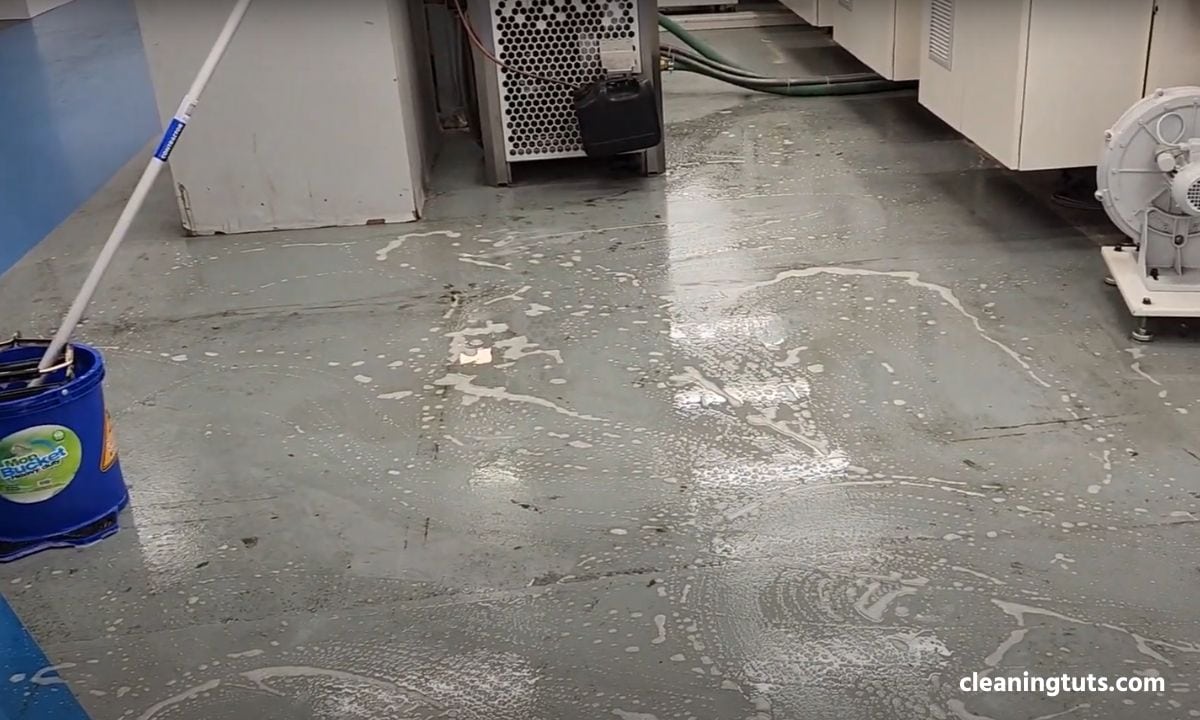
How to Clean Warehouse Floor? – Explanation and Tips

Warehouse floors endure heavy daily traffic from forklifts, pallet jacks, and pedestrian workers across surfaces that accumulate dust, debris, grease, and liquid spills. Cleaning warehouse floors using the right equipment and techniques removes slip hazards, reduces bacterial load, and extends the service life of concrete sealant coatings.
A dirty warehouse creates health risks and operational inefficiency. Dirty floors cause respiratory issues, slips, falls, and equipment damage during product movement. The debris that collects on warehouse floors spreads bacterial infections and viruses. Maintaining a clean floor protects workers, preserves inventory, and projects professionalism to every visitor.
Why Is It Essential to Clean Warehouse Floors?
Warehouse floor cleaning directly affects worker safety, operational efficiency, and regulatory compliance. Skipping routine maintenance creates hazards that compound over time.
Ensuring Safety
Clean floors eliminate trip hazards from cardboard fragments, packaging strapping, and accumulated debris. Dust and fine particulate matter trigger allergic reactions and respiratory distress in workers exposed for extended shifts. OSHA estimates that slips, trips, and falls account for a significant portion of warehouse workplace injuries each year — preventive cleaning reduces this risk directly.
Increasing Productivity
Cleaning and organizing the warehouse simultaneously improves workflow efficiency. Workers locate materials faster in a clutter-free environment, reducing search time and misplacements. Studies on environmental design consistently show that organized workspaces reduce cognitive load, enabling faster task completion and fewer errors.
Aesthetics and Credibility
First impressions shape client and partner perceptions. Dirty flooring signals neglect and undermines credibility in competitive industries. Clean warehouse floors reflect operational discipline and strengthen the company’s professional image during inspections, client tours, and vendor assessments.
Complying with Regulations
State and federal regulations govern sanitation standards for facilities storing consumer goods. Non-compliance results in citations, fines, and potential lawsuits. Maintaining sanitary warehouse floors is a baseline requirement for food, pharmaceutical, and consumer goods storage operations.
What Equipment Is Needed for Cleaning a Large Warehouse Floor?
Assess the warehouse dimensions, floor substrate, and soil composition before selecting equipment. Standard warehouses range from 10,000 to 50,000 square feet; large facilities exceed 50,000 square feet and require ride-on equipment for practical coverage.
Matching equipment to floor type and soil load prevents damage to concrete surfaces and ensures cleaning cycles complete within operational windows. The four core equipment categories for warehouse floor cleaning are manual tools, vacuum systems, mechanical scrubbers, and pressure washers.
List of Required Tools for Cleaning Warehouse Floors
Microfiber Mop
Microfiber mop heads remove 99.9% of bacteria from surfaces using only water, according to multiple controlled studies. The split-fiber construction traps dust and particles in microscopic channels that cotton mops leave behind. One pass with a microfiber mop outperforms three passes with a conventional cotton mop, reducing labor time and chemical consumption.
Microfiber mops are machine-washable and reusable hundreds of times, lowering long-term consumable costs. They leave floors streak-free and dry faster, which reduces slip risks during the cleaning window.
Wet and Dry Vacuum
Wet-and-dry vacuums handle both liquid spills and dry debris in a single unit, eliminating the need for separate equipment. These vacuums reach corners, loading dock seams, and racking bases where debris accumulates. Industrial models rated for continuous duty operate at 200–400 CFM airflow to handle fine dust, metal shavings, and packaging residue.
For warehouses with oil or coolant spills, a wet vacuum rated for hydrocarbon recovery prevents slippery residues from spreading across walkways.
Walk-Behind and Ride-On Floor Scrubbers
Walk-behind scrubbers cover cleaning paths of 20–30 inches per pass and suit facilities under 20,000 square feet. Ride-on scrubbers clean paths of 32–48 inches wide and achieve productivity rates of 20,000–40,000 square feet per hour depending on model and operator experience.
Ride-on scrubbers combine scrubbing, brushing, and drying in one pass, eliminating separate drying steps. Modern ride-on units include on-board detergent metering that dilutes cleaning solution at ratios between 1:64 and 1:128, ensuring consistent chemical delivery without waste.
Pressure Washer
Pressure washers apply water at 1,500–4,000 PSI to blast away caked mud, fuel residue, and industrial film from concrete. Gas-powered models deliver the highest pressure for outdoor loading docks and covered warehouse sections. Electric pressure washers suit indoor use where exhaust fumes are a concern.
Pair pressure washing with a wet vacuum or squeegee system to remove the displaced water promptly — standing water left on concrete re-deposits soil and creates slip hazards.
How to Clean Warehouse Floor: A Step-by-Step Process
Schedule warehouse floor cleaning during low-traffic periods such as early morning before operations begin, overnight shifts, or planned facility shutdowns. Daily spill response runs concurrently with normal operations using portable equipment.
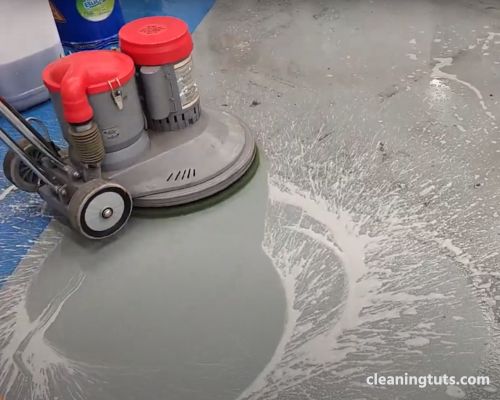
Step 1: Vacuum and Collect Trash
Before applying any liquid cleaner, remove loose debris by hand and with a wet-and-dry vacuum. Place waste bins at every aisle intersection to encourage immediate disposal and prevent debris from scattering across the floor during operations.
Vacuum the entire floor systematically in overlapping passes to capture fine dust that becomes mud when mixed with subsequent cleaning solution. Skipping this step causes liquid cleaners to form a muddy slurry that stains concrete and requires extra drying time.
Step 2: Apply Degreaser and Agitate
Apply an alkaline degreaser at a dilution ratio of 1:64 to 1:128 depending on soil intensity. Allow 5–10 minutes of dwell time for the solution to penetrate grease and oil films before agitation. Use a deck brush or自动 scrubber brush to work the solution across the floor in overlapping circular passes.
For heavy oil deposits, a 1:10 dilution of concentrated degreaser applied directly and scrubbed with a stiff-bristled brush dissolves contamination that standard dilution ratios leave behind.
Step 3: Rinse and Neutralize
Rinse the floor with clean water using a pressure washer or ride-on scrubber set to rinse mode. Test surface pH with litmus paper — cleaned concrete should measure between pH 7.0 and pH 8.5. If pH exceeds 8.5, apply a diluted acid neutralizer (pH 6.0–7.0) and rinse again until the surface reaches neutral range.
Failing to neutralize residues leaves alkaline salt deposits that attract moisture, create slippery surfaces, and degrade sealant coatings prematurely.
Step 4: Mop and Dry
Follow rinsing with a microfiber mop to collect any remaining suspended particles. Open HVAC ventilation and industrial fans to accelerate drying. Concrete floors typically dry within 30–60 minutes depending on ambient humidity, temperature, and air circulation.
Do not apply sealant to a damp floor — moisture trapped beneath the sealant causes delamination, bubbling, and coating failure within weeks of application.
Step 5: Apply Sealant
Apply a concrete sealant or floor wax after the surface reaches full dryness. Epoxy coatings last 3–7 years under forklift traffic and provide chemical resistance to oil, acid, and coolant spills. Urethane coatings offer superior UV stability for warehouses with natural light exposure and typically last 2–5 years.
Apply two thin coats rather than one thick coat — thin coats bond better and cure more evenly, reducing the risk of peeling. Allow the first coat to cure for 4–8 hours before applying the second coat.
Sealant application extends floor longevity significantly. Unsealed concrete in high-traffic warehouses shows surface degradation within 12–18 months. Sealed concrete maintains structural integrity and appearance for years, reducing long-term resurfacing costs.
Warehouse Floor Cleaning Tips for Facility Managers
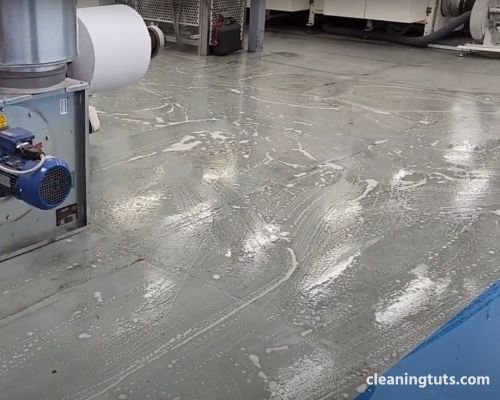
Clean During Low-Traffic Windows
Schedule full floor cleaning cycles before morning shift start, during scheduled maintenance windows, or on weekends when no operations occur. Cleaning during active operations spreads debris to clean zones and creates safety hazards for workers.
Establish Daily Spot-Cleaning Routines
Assign workers to address spills and debris accumulation at the start and end of every shift. Loading dock areas and forklift staging zones require cleaning several times daily because these zones generate the most soil.
Clean Spills Immediately to Prevent Staining
Liquid spills migrate into concrete pores within minutes of contact, creating stains that require pressure washing and degreasing to remove. Use absorbent spill kits for oil and coolant immediately upon discovery, then follow with a wet vacuum and neutral cleaner.
Warehouse Floor Cleaning Frequency: Daily, Weekly, and Monthly Schedules
Establish a tiered cleaning schedule that matches effort to soil level:
| Frequency | Tasks | Equipment Needed |
|---|---|---|
| Daily | Vacuum walkways, spot-clean spills, clear debris from aisles | Wet-and-dry vacuum, microfiber mop |
| Weekly | Full floor scrub with degreaser, rinse, and dry | Ride-on or walk-behind scrubber, pressure washer |
| Monthly | Deep clean with acid neutralizer, inspect sealant, reapply wax if needed | Pressure washer, scrubber, sealant applicator |
| Quarterly | Full sealant inspection, touch-up applications, deep degreasing of oil zones | Industrial scrubber, wet vacuum, sealant supplies |
Facilities handling food, pharmaceuticals, or biohazard materials require daily deep cleaning regardless of traffic level. Extreme weather conditions — snow, rain, or dust storms — warrant additional cleaning cycles to prevent contamination from outdoor pollutants.
Concrete Warehouse Floor pH and Chemical Safety Standards
Concrete surfaces naturally measure pH 10–12 due to the alkaline compounds in cement. New concrete must cure for 28 days before cleaning to prevent surface damage. Harsh acidic cleaners below pH 4.0 etch concrete surfaces, creating rough textures that trap dirt and accelerate wear.
Industrial degreasers operate in the pH 9.0–11.5 range to saponify oils without damaging concrete. Always rinse thoroughly after degreaser application — residual alkalinity attracts moisture that breaks down sealant adhesion over time.
Personal protective equipment (PPE) requirements for warehouse floor cleaning include chemical-resistant gloves rated for alkaline solutions, safety goggles or face shields, and non-slip footwear. Ensure proper ventilation when using pressure washers indoors to prevent moisture accumulation in electrical enclosures.
Can Warehouse Floor Cleaning Techniques Be Applied to Stair Vacuuming?
The systematic approach used for warehouse floors — vacuum first, then scrub, rinse, and dry — applies directly to stair cleaning. Effective stair vacuuming requires a lightweight, maneuverable vacuum with a HEPA filter to capture fine dust without redistributing allergens into the air. Starting at the top step and working downward in overlapping passes ensures no area is missed. Refer to the Vacuum Troubleshooting Master Hub for equipment selection guidance, or see the full stair vacuuming guide for step-by-step instructions.
Conclusion
Cleaning warehouse floors requires matching the right equipment to facility size, establishing daily and weekly cleaning routines, and applying protective sealant to extend concrete lifespan. The process breaks down into five steps: vacuum debris, apply degreaser, rinse and neutralize, dry completely, and apply sealant.
Consistent daily upkeep prevents soil accumulation that makes deep cleaning sessions more time-consuming and costly. Using microfiber mops, industrial scrubbers, and pH-neutral cleaners protects both worker safety and facility infrastructure.
For additional guidance on selecting the right equipment and chemicals for your facility, explore the Floor Cleaning Master Hub or browse the Cleaning Glossary for terminology definitions. For other high-traffic surfaces, the Specialty Cleaning Hub covers commercial and industrial cleaning scenarios beyond standard warehouse maintenance.
References
- Occupational Safety and Health Administration (OSHA). Slips, Trips, and Falls in Warehouses. U.S. Department of Labor. osha.gov/stopfalls
- Environmental Protection Agency (EPA). Safer Cleaning Products and Practices. epa.gov/greenerproducts
- National Safety Council (NSC). Workplace Slip, Trip, and Fall Prevention. nsc.org/workplace/safety-topics/slips-trips-falls
- International Concrete Repair Institute (ICRI). Guide for Concrete Floor and Slab Construction. icri.org


